


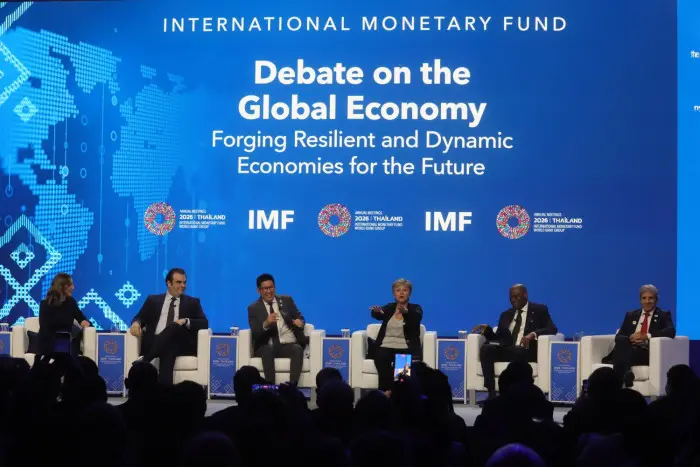
Kristalina Georgieva, managing director of the International Monetary Fund (IMF), warned that countries must rebuild economic buffers, address global imbalances and prepare for the rapid expansion of artificial intelligence (AI).
She was speaking at the "Debate on the Global Economy: Forging Resilient and Dynamic Economies for the Future" on Thursday.
Ms Georgieva warned of widening economic disparities, persistent inflation and growing reliance on AI to drive growth.
The IMF maintained its 2026 global growth forecast at 3.1%, but Ms Georgieva said the figure masked diverging fortunes. The US, China and India, along with economies supplying the AI value chain, including Thailand and South Korea, are benefiting from investment. Conflict-hit countries and fuel importers with limited exposure to the AI boom face greater pressure.
Rising energy and food prices are adding to inflation, while AI investment is creating further demand. Persistent inflation could force central banks to maintain tighter monetary policies, raising borrowing costs for governments already burdened by debt and deficits.
"The global economy was becoming increasingly dependent on continued enthusiasm for AI investment, while other growth drivers remained comparatively weak," she said.
Citing Amara's law, Ms Georgieva noted that technological progress tends to be overestimated in the short term and underestimated in the long term.
Countries must prepare for technological change by ensuring AI adoption is backed by adequate infrastructure, skills, regulation and ethical safeguards, she said.
Speaking at the same forum, Finance Minister Ekniti Nitithanprapas said Thailand must strengthen its economic foundations and accelerate structural reforms to withstand global uncertainty.
He warned that vulnerable households and businesses need greater support to cope with external pressures.
Mr Ekniti likened Thailand to a "small boat facing many storms", highlighting its exposure to global shocks and the need to build resilience.
He identified four major challenges: rising energy prices, geo-economic fragmentation, global interest rate volatility and rapid advances in AI.
"As an oil-importing economy, Thailand remains vulnerable to rising international energy prices, which increase household living costs and business expenses," he said.
Shifting global supply chains offer opportunities as Thailand attracts redirected foreign investment, but some domestic industries struggle to adapt to changing trade patterns, he said.
Global financial volatility also tightens liquidity and raises borrowing costs. However, Thailand's fiscal discipline has helped keep 10-year government bond yields relatively stable at about 2.3%, below levels in the US and Europe.
AI is reshaping trade, productivity and investment. Thailand could benefit from its role in the global AI hardware supply chain, but other businesses risk losing competitiveness.
"What we need to do is to make sure our boat is strong enough to withstand the wind," Mr Ekniti said, stressing fiscal discipline and economic stability as safeguards against external shocks.