


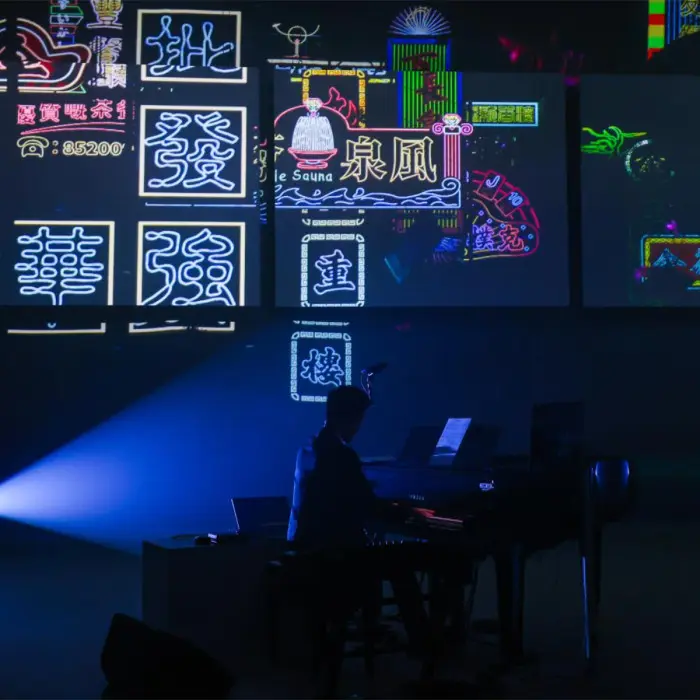
Nostalgia poured thick when Hong Kong's Jumbo Floating Restaurant, an iconic spot that was forced to close due to Covid-19 in 2020 after four decades of operation, appeared on the screen at the Hong Kong Cultural Centre's Studio Theatre in Tsim Sha Tsui. Audiences soon found themselves sailing through a tide of motifs -- neon-lit streets, flats, colonial buildings, churches, vessels and food -- much like the Star Ferry crossing Victoria Harbour, just a stone's throw away. The piano conjured a pleasant daydream, at least until something strange happened.
Opening the Hong Kong Performing Arts Expo (HKPAX) 2026 last week, City Reverie, a multidisciplinary show of piano and art by Joel Kwong, Vvzela Kook, Fung Lam and Silver Cheung, charts the island's course from its maritime roots to its futuristic vision. Nostalgia gradually descended into turbulence and renewal. Performers used technology to transform their piano hand placement into lines of light. They also collected biometric data from wristband-clad audiences to compose the final chapter of their live performance.
But it just fell flat as it was not well integrated into the show. Moreover, it is disturbing how surveillance technology is seeping into our most private human experience in the name of participatory art. For the remainder of the expo, I could not remember any art tech.
City Reverie seemed to signal the way forward. This year's theme, "Passion In Motion", embraces emerging trends in performing arts including co-evolution with technology. In the opening ceremony, Kenneth Fok, chairman of HKPAX, expressed the platform's commitment to finding new opportunities.If this is the case, the pressing question is why? It gives the impression some artists did it out of fear of missing out rather than having a clear purpose. More is needed to justify why and how art tech in Hong Kong matters.
Still, HKPAX 2026 made a mark elsewhere.
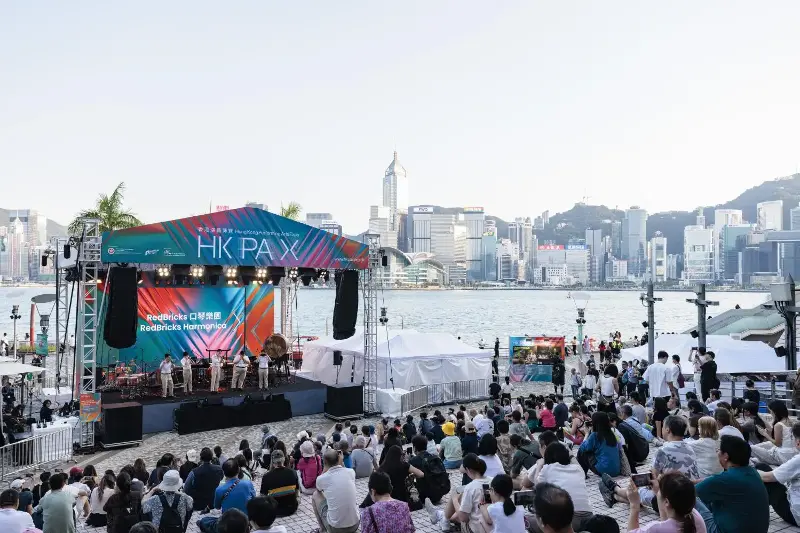
HKPAX offers free programmes to engage the public.
Having a purpose was a recurring topic in the opening talk. Iconic Asian playwright Stan Lai shared his breakthrough when he discovered that artists should have two elements, method and wisdom, to succeed. While methods can be learned, wisdom is gained through living a life. I think it also applies to knowing how to use technology with a purpose. He further challenged the idea that inspiration is an exclusively external intervention. Instead, he keeps a "separate file" for collecting imprints on his mind that he can tap into later for artistic creation.
Place-based art calls for slow, meaningful interaction with surrounding environments. Joining the conversation were Lindy Hume, a creative director from Australia, and Tze Chien Chong, a playwright and director with the Singapore International Festival of Arts (SIFA). Currently based in the seaside town of Tathra, New South Wales, Lindy explained that headlands provide "space to stand and think big thoughts". Landscape orientation is the philosophy of her company, Crimson Rosella Creative Adventures, that engages with creative practices outside metropolitan cities.
On the other hand, Tze is aware of how his city-state is short of space ("smaller than Manhattan"), but open to new arrivals. Currently at the helm of SIFA, he is finding ways to bring people from all walks of life together. As a result, he has restored the festival village, a free, open-access hub for gathering outside, to the event in the same way previous editions did. "I never think that art is meant to convert anyone, but it is space and time for people to gather," he said.
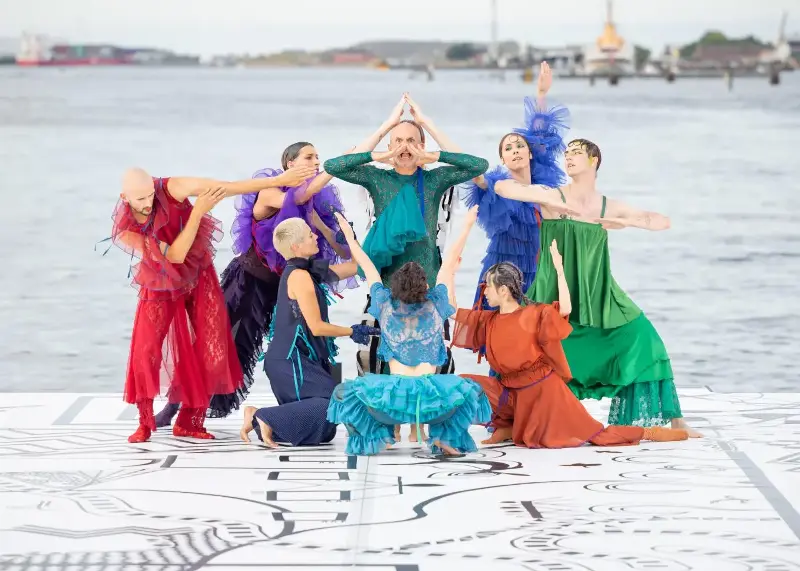
Bloody Moon.
Art is not born in a vacuum, but caught in an intricate web of relationships. Continuing this tenor, a key thread that connects some international artists is how they revisit their canonical works. FreeEroica by Stegreif (Germany) is a playful adaptation of Ludwig van Beethoven's Symphony No.3, which he originally composed for Napoleon Bonaparte, but retracted his dedication when the hero turned tyrant. In this reimagining, the orchestra caused havoc on stage, performing barefoot, throwing away sheet music and making funny noises to uphold revolutionary ideals.
In the same way, 9.2 by Cas Public (Canada) draws inspiration from Beethoven's loss of most of his hearing when he composed Symphony No.9. It brings deaf and hearing dancers together to explore the challenge of communication. When Cai Glover, a deaf choreographer, took off his hearing aid and performed in silence, it forced other hearing dancers, as well as hearing audiences, to experience the struggle, frustration and rage he felt when compelled to follow others using a hearing device that could not clearly distinguish one voice from another.
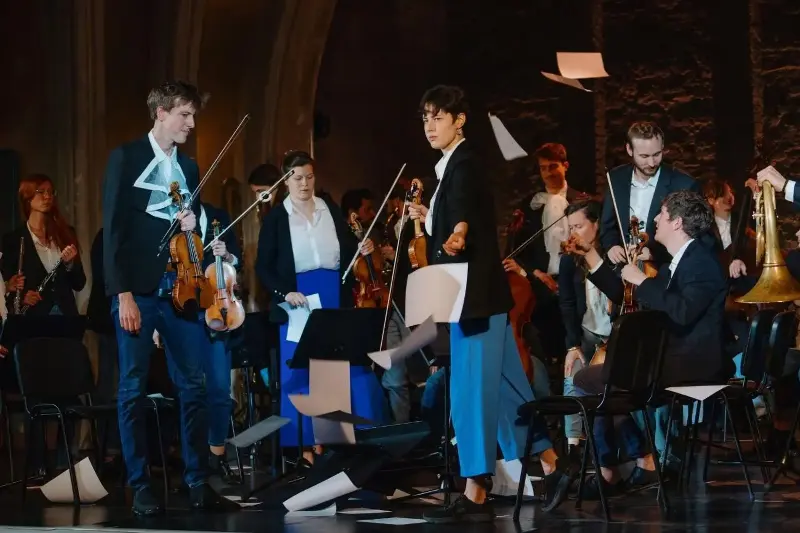
FreeEroica.
Some regard individuality as an ultimate goal of artistic expression. Bloody Moon by the Danish Dance Theatre goes to the other end of the spectrum. Here, a group of dancers moved in sync as if they had a hive mind. Any change in movement -- jerking, writhing and many other acts -- sent a ripple through them all in the same way cognitively intelligent zombies in Yeon Sang-ho's Colony are choreographed. Dancers commanded the stage with power and charisma.
A number of pitches (around 10-15 minutes for each presentation) explored universal themes of life, death and everything in between. Inspired by a performer's experience of living in the socially-stratified Seoul, a city of "high-rise apartment buildings", Breath by Creative Group A Person;s (South Korea) follows his 30m-rope climb to confront his own vulnerability in a life-or-death moment. Like a meditative practice, public theatre allows the performer and audiences to hold their breath to stay fully awake during life's journey.
Meanwhile, In Common by One Fell Swoop Circus (Australia) foregrounds the role of social support in communities. In this piece, acrobats perform on a pliable sculpture of steel rods and cables that float in mid-air. Its structure evokes the world's fragile ecosystem where a butterfly wing's flap could trigger a cascade of events. Yet, it is held in place by "tensegrity", an architectural concept (a portmanteau of tension and integrity) that explains how resilience is made possible by compression.
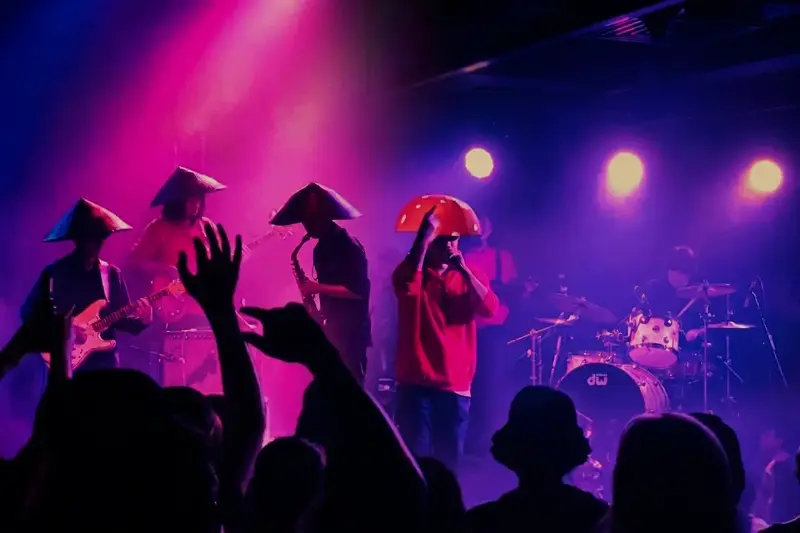
Danger Back To Jazz.
Between Two Lights by Huang Ruo, a Chinese-American composer, explores the liminal condition between death and rebirth. During the pandemic, he attended his mother's funeral in their home village in China. Placed under quarantine in a hotel, he could not go forward or backward, feeling trapped somewhere in between. Still, The Tibetan Book Of The Dead and the Heart Sutra gave him an emotional anchor. From there, the vocal theatre emerged to embrace here and now to forge anew.
HKPAX 2026 also showcased homegrown talent. Despite a small time slot (20 minutes for each show), local artists convinced me why I should experience art in Hong Kong. TS Crew's No Sugar No Milk, for example, followed chaos in cha chaan teng (eateries that adapt foreign dishes using local ingredients). It combined theatre with martial arts, dance, street art and circus to show the city's dining fusion to the world.
Fountain Collective's Danger Back To Jazz was my favourite show. Behind the island's institutional facade lies so much raw and pure energy. Its improvisation evokes an urban experience that bombards "flaneurs" with a perpetual stream of sensory stimuli. It ended on a high note with Fung Lam and Wing Shya's Nocturne: A Dialogue Between Music And Cinematic Art, a love letter to their home that combines piano with film visuals to reveal hidden faces of the neon-lit city beyond its fast rhythm and cosmopolitan face.
As HKPAX is keeping abreast of change, it remains unclear where technology is going and how it is reshaping art. It seems that some -- including me -- are still holding close to their hearts the way things are and were.
The third edition of HKPAX is set to return in October 2028. Visit hkpax.org.hk.
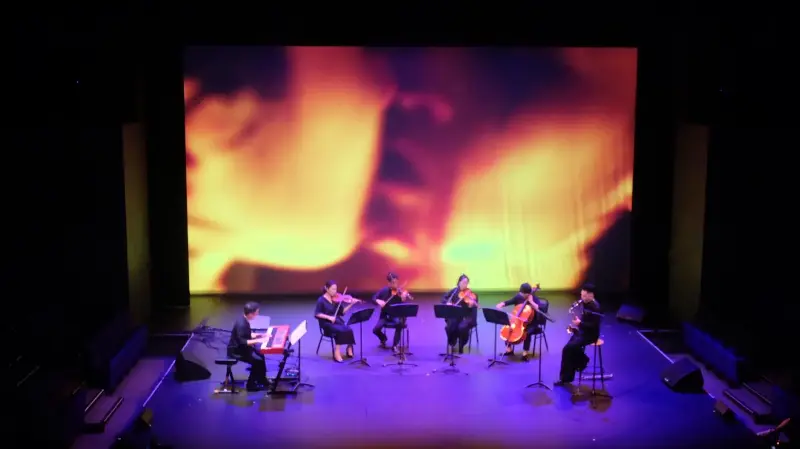
Nocturne. Photo: Thana Boonlert
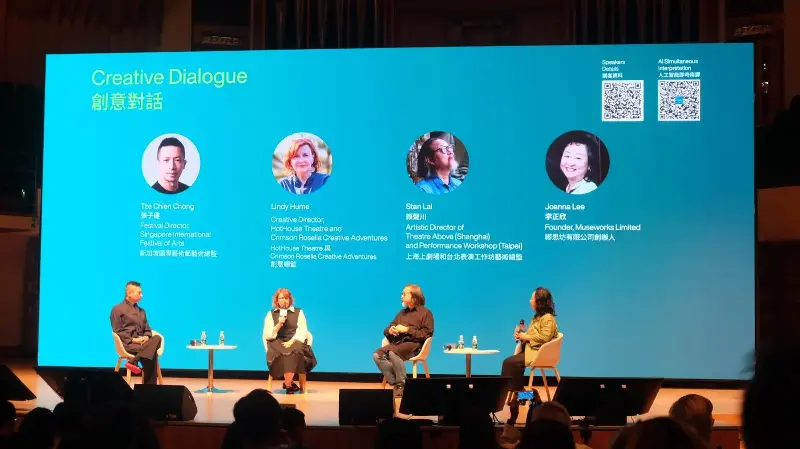
From left, Tze Chien Chong, Lindy Hume, Stan Lai and Joanna Lee. Photo: Thana Boonlert
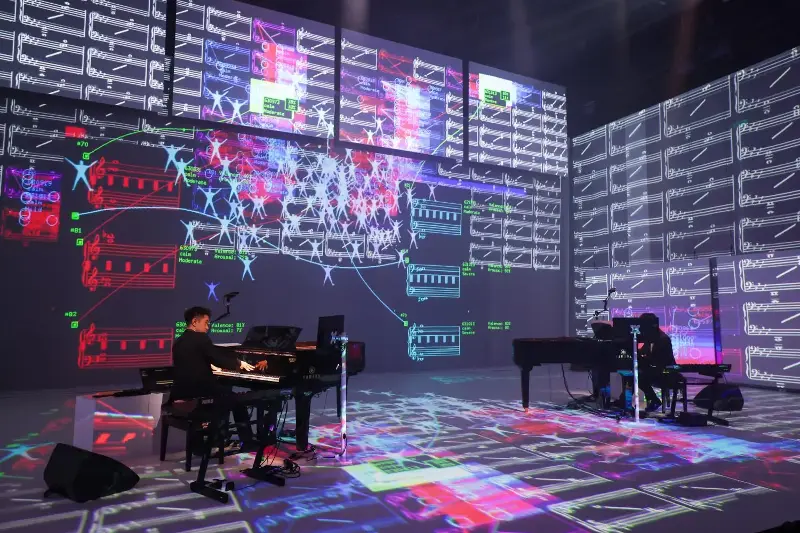
City Reverie uses technology to visualise piano hand movement and biometric data.