


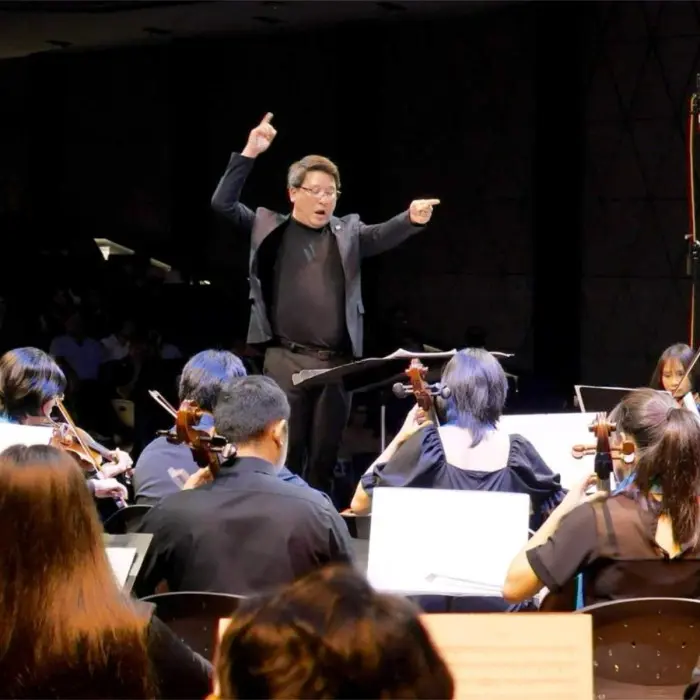
Late last month, Siam Sinfonietta had its final concert of the 2025/26 season at the splendid King's College Great Hall with a double header of two important works in the symphonic repertoire, Sibelius' Violin Concerto and Beethoven's Third Symphony, the Eroica, both challenging works.
Since the orchestra has had tremendous acclaim in the overseas press and has toured many of the world's great halls, it's easy to forget that at its heart the Siam Sinfonietta is a youth orchestra, the only one in the region not beholden to any institution but created by young people themselves, who first pitched the idea of a kids' orchestra that could play "real music" to composer-conductor Somtow Sucharitkul 15 years ago.
When hearing the Siam Sinfonietta play massive works by Mahler, Strauss, and Stravinsky, this reviewer has often remarked that if you closed your eyes, you would not imagine it was a youth orchestra.
This feeling has been shared by many other reviewers including British critic Michael Proudfoot. But founder Somtow reminded us of this in his opening remarks.
He said that this concert is in some senses a farewell; every seven years or so, with the age limit of 25, the Siam Sinfonietta experiences a more or less complete turnover and many of the young musicians playing last Sunday were already working at professional orchestras like the Royal Bangkok Symphony and the Thailand Philharmonic.
Indeed, one of the purposes of the concert was to say farewell to Bhakasak Jaovawanaridhi, who played the Sibelius concerto.
The introduction set a somewhat elegiac tone as Somtow explained that he had received a shoulder injury from conducting Wagner and was waiting to find out if he would need surgery.
He did not know when he would conduct again, but he pointed out that one of the most satisfying moments for a teacher is "that moment when you know your student has exceeded you".
Somtow then welcomed Bhakasak to the stage and introduced Trisdee Na Patalung, who has emerged as Thailand's most internationally recognised conductor, to do the concert.
From the opening of the concerto to its first climax, the Sinfonietta played so atmospherically and with such passion that at times it outplayed the soloist. But by the second movement, Bhakasak had found his metier and delivered a polished, poetic reading of the song-like central movement.
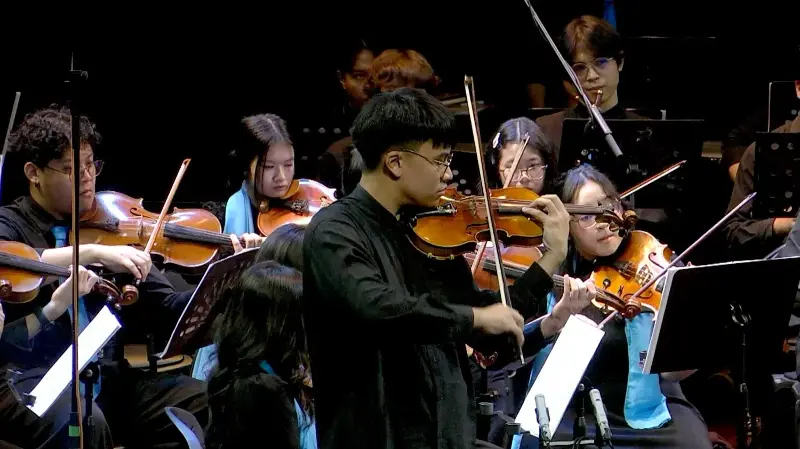
The third movement was fierce and powerful with a good interplay between Bhakasak and Trisdee. Trisdee's interpretation was cerebral and nostalgic, bringing to mind long Scandinavian winters with languorous tempi.
There was nothing languorous about Trisdee's Eroica Symphony, which charged full-tilt out of the gate at quite a clip.
Its timing was closest to that of Roger Norrington (around 46 minutes with repeats observed), who is famous for sticking to Beethoven's own metronome markings even when they are controversial.
Trisdee, who is known for his love of authentic performance practice, must have adhered to those markings as well.
But unlike Norrington, who can be a little bland in his accuracy, Trisdee did the authentic tempi and simultaneously had the excitement and grandeur of one of the Golden Age conductors of yesteryear. He did it by going for the sweep and arc of the phrases rather than dwelling on details.
This was one of the more thrilling Eroicas this reviewer has heard in a live performance.
We will miss Bhakasak and dozens of other members of Siam Sinfonietta as they go on to their full professional careers, but we hear that audition applications for the coming season of Siam Sinfonietta were the highest they have ever been.
Next season, the faces will largely be different. Hopefully, the passion will remain the same.
Stan Gayuski writes on music for international publications, and is a representative of the International Mahler Society.