



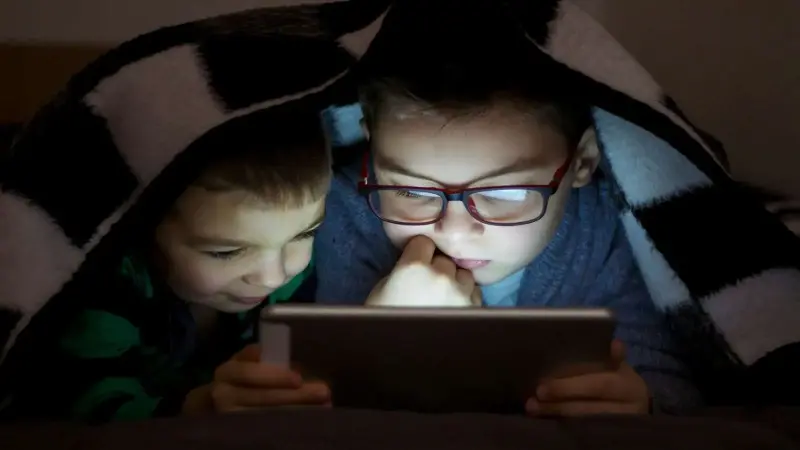
A child sits at their desk, pencil in hand, and cannot get to the answer present in the room, but is usually restless, distracted and unable to hold a thought long enough to write it down. Our first instinct is to look inward: is this a motivation problem, a learning difficulty, a rough morning at home? We then look at the curriculum, at pedagogy, and at classroom environment. What we often overlook is the fuller picture: the two hours of passive screen time the night before, the absence of any outdoor movement in days, and the excess weight a child has been quietly carrying.
We fail to connect these dots because we have trained ourselves to see them as separate problems. In reality, they are deeply interdependent. "Obesity, unregulated screen time, and declining academic performance form what we would call the invisible triangle because we have chosen, institutionally and culturally, to address each corner in isolation", Ms Manisha Malhotra, Director-Principal, Satya School, Gurugram, tells Health Shots. The moment we look at all three together, a different picture emerges: one compounding cycle that affects children and their learning every day.
A number that belongs to us
The World Obesity Atlas 2026 estimates that approximately 41 million Indian children aged five to nineteen are living with high BMI, of whom nearly 14 million are classified as obese. "On current trajectories, that number may exceed 20 million by 2040", says the Principal. These numbers describe children in our classrooms, sitting in the chairs we arranged for them. Rapid urbanisation has reshaped the culture of Indian childhood: the street, the open ground, the unscheduled afternoon.
The ICMR-NIN report identified unhealthy diets as the single largest contributor to India’s total disease burden, not because they are lazy, but because the environment they inhabit no longer demands it. And then there is attention. "A generation of children is arriving at school progressively less equipped to sustain the focused effort that learning requires," says the Principal. This cannot be called parenting failure or generational weakness. Rather, it is the output of an environment we collectively built and have been slow to examine.
How the triangle closes?
The mechanism that links all three corners is worth tracing carefully, because it is more biological than behavioural. Unregulated screen time displaces physical activity. "This is its most direct consequence: not just time lost, but the metabolic and neurological benefits of movement that never arriv,e" says the Principal. Physical inactivity in children creates the energy imbalance that drives weight gain.
Still, it also does something less visible: it deprives the brain of the regular stimulation it needs to regulate attention, manage mood, and consolidate learning. Obesity, when it develops, is not only a physical condition. The triangle closes. What a child who is disengaged looks like is often a child whose environment has quietly closed off the conditions in which engagement is possible.

The screen is not the villain
Digital tools have genuinely transformed what is possible in a classroom. Personalised learning, access to primary sources of education, the pedagogical case for technology is real, and it is not going away. They do. "Indian children now average 2.7 hours of recreational screen time daily before educational screen use is count,ed" says the Principal. A 2025 meta-analysis in Cureus found that under-five children in India are already averaging 2.22 hours of daily screen time, exceeding the Indian Academy of Pediatrics’ recommendation of one hour for that age group.
The honest challenge for schools is that we have become part of the exposure problem. Smart boards, digital homework, and learning apps have layered academic screen hours onto children who are consuming varied content at home, abandoning digital pedagogy. "It is a reason to regulate it and apply it with more rigour: to ask, before every screen-based task, whether it genuinely needs to be on a screen, or whether a hands-on, offline alternative would serve the learning goal more effectively and give a child’s visual system and attention span a necessary interval of r,est" says the Principal.
From understanding to ‘making it happen’
Understanding the triangle is a beginning. What follows from it is a set of deliberate choices in how schools design the day, how families structure evenings, and how communities decide what they value. Within schools, the priority is to move physical activity out of the category of ‘supplementary’ and into the category of ‘foundational’. This means protecting PT periods when academic schedules tighten.
In those 10 to 15 minutes, energy resets, focus returns, and the school breathes as one. It is a simple yet powerful reminder that movement is not a break from learning, but an essential part of it. We are also reviewing our use of digital tools in the classroom, ensuring screen-based tasks are purposeful and bounded and actively replacing passive digital consumption with hands-on, offline learning wherever possible. "Within families, the most effective shifts tend to be structural rather than willpower-dependent", says the Principal. Families must establish screen-free periods, especially in the hour before bed, when blue light most disrupts sleep and the winding-down that growing children need. Meals must be protected as screen-free, social rituals an investment of twenty minutes that pays back in connection, conversation, and appetite regulation.
Children do not follow instructions. They follow examples. A child who sees their parents scroll through dinner does not believe screens can wait. The example we set is more instructive than any rule we post on the fridge. "More than just keeping children engaged during the holidays, the challenge nurtured a culture of wellbeing, accountability, and shared gr,owth" says the Principal. It demonstrated that when habits are built together, they endure longer, leaving behind not just healthier routines, but a stronger, more connected school community.
Within communities, the question is what we collectively normalise. A culture that measures childhood productivity entirely through examination results, that treats additional tuition as the responsible response to underperformance, and that treats outdoor play as a luxury is quietly sustaining the very conditions that produce poor examination results. Unstructured outdoor time is not a reward for finishing homework; it is a neurological necessity for doing it well. A child who runs, climbs, and plays returns to a book with a brain that is genuinely better prepared to read it.
From awareness to accountability
If we continue to treat obesity, screen use, and academic performance as separate concerns, we will continue to solve none of them effectively. Children cannot be expected to learn well in bodies that are under-moved, minds that are over-stimulated, and routines that are under-regulated. "Multiple hands shape every child's day: a teacher's lesson plan, a parent's evening routine, a community's idea of what childhood should look like", says the Principal. We are not facing a generation that is less capable of learning. We are facing a generation placed in conditions that make learning harder than it needs to be. When we change those conditions together, academic performance will not need to be pursued relentlessly. It will follow, naturally and sustainably.