



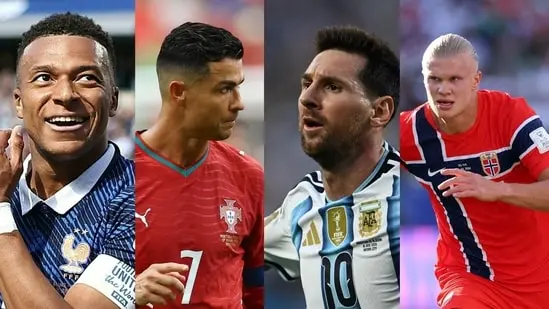
The first round of FIFA World Cup 2026 group-stage matches has already offered a sharp snapshot of football’s shifting power map. Lionel Messi and Cristiano Ronaldo arrived carrying the weight of history, both stepping into a sixth World Cup. Kylian Mbappe entered as the modern tournament monster, already chasing the great scoring records of the competition. Erling Haaland, meanwhile, finally had his first World Cup stage after Norway’s long absence from the tournament.
Their opening matches gave four very different stories. Messi turned Argentina’s opener into a personal masterpiece. Mbappe once again looked built for this competition. Haaland announced himself with the brutal certainty of a pure No. 9. Ronaldo, however, endured a frustrating night where the symbolism of his appearance was bigger than his footballing impact.
The raw numbers tell the first story
Messi produced the most complete headline act of the four. Argentina beat Algeria 3-0, and Messi scored all three goals. It was not just a strong opening performance; it was total ownership of the result. On his 200th appearance for Argentina, he marked another historic night with his first World Cup hat-trick and moved level with Miroslav Klose’s all-time men’s World Cup scoring record.
Mbappe was not far behind in pure impact. France beat Senegal 3-1, with Mbappe scoring twice. His brace was especially important because the match had pressure in it. France were not simply padding numbers. Senegal had reduced the deficit, and Mbappe’s second goal killed the contest. That is the kind of goal that separates statistical performance from match-winning value.
Haaland’s numbers were also emphatic. Norway beat Iraq 4-1, and Haaland scored twice in the first half. For a player making his World Cup debut, it was almost exactly the statement expected from him: direct, clinical, physically overwhelming and decisive. He did not need romance around the performance. He simply did what elite strikers are supposed to do.
Ronaldo’s numbers were the weakest. Portugal drew 1-1 with DR Congo. Ronaldo started, made history by appearing at a sixth World Cup, but finished with no goal and no assist. More damagingly, Portugal managed only one shot on target, and Ronaldo missed presentable close-range chances in the second half. For a player whose current value is increasingly tied to penalty-box efficiency, that made the performance look underwhelming.
Messi showed control, not just finishing
Messi’s hat-trick was the standout because it carried both statistical and emotional authority. At this stage of his career, the question is no longer whether he can still produce isolated moments. It is whether he can still dominate a World Cup match.
Against Algeria, the answer was clear. Argentina’s 3-0 win was not a collective attacking spread where Messi happened to be part of the scoreline. He was the scoreline. Three goals in a World Cup opener, on a historic international appearance, gave Argentina the perfect start and immediately placed Messi at the centre of the tournament’s early narrative.
This was legacy and performance meeting in the same match.
Also Read: Cristiano Ronaldo stunned! DR Congo script FIFA World Cup history, hold Portugal to shock 1-1 draw in campaign opener
Mbappe remains football’s most dangerous World Cup forward
If Messi’s performance carried the weight of history, Mbappe’s carried the threat of inevitability. He has reached a stage where World Cup matches appear to sharpen him rather than burden him.
His two goals against Senegal reinforced the idea that he is the most reliable big-tournament forward of this generation. The second goal was particularly valuable because it arrived after Senegal had made the contest uncomfortable. A 2-1 lead is never secure in a World Cup opener. Mbappe turned uncertainty into closure.
That is why his performance ranks above Haaland’s despite both scoring twice. Mbappe’s goals carried a slightly higher pressure value.
Haaland’s debut was exactly what Norway needed
Haaland’s first World Cup match had a different kind of significance. Unlike Messi, Ronaldo and Mbappe, he had never played on this stage before. That made the Iraq match a test of translation: could his club-level inevitability survive the emotional weight of a World Cup debut?
It did. His two first-half goals restored Norway’s command after Iraq had equalised and helped them to a commanding 4-1 win. This was not a decorative brace. It changed the rhythm of the match and put Norway in early control of their group campaign.
For Haaland, this was not the most poetic performance of the round. But it was perhaps the cleanest striker’s display: arrive, finish, win.
Ronaldo’s historic night came with uncomfortable questions
Ronaldo’s opener was historic but not convincing. At 41, starting a World Cup match is extraordinary. Appearing in a sixth edition places him in rare territory. But elite football is cruel because history does not protect a player from present-tense judgment.
Portugal’s draw against DR Congo exposed the problem. Ronaldo remains a major presence, but Portugal need output, not just aura. With no goal, no assist and missed chances, his performance looked especially poor when placed next to Messi, Mbappe and Haaland.
The issue is not that Ronaldo can no longer matter. The issue is that his margin for influence has narrowed. If he is not finishing chances, he contributes less across the wider flow of the game than the other three.
Final verdict
On opening-match impact, Messi clearly leads the list. A hat-trick in a 3-0 win is impossible to look past. Mbappe follows because his brace came with genuine pressure value and confirmed his status as the game’s most frightening World Cup forward. Haaland sits third, not because he was poor, but because Mbappe’s goals carried slightly more match-state weight. Ronaldo comes fourth: historic appearance, disappointing performance.
The broader story is powerful. Messi proved the old magic is not finished. Mbappe showed he may already own this tournament stage. Haaland announced his arrival. Ronaldo, for now, reminded the world of his greatness more through presence than performance.