



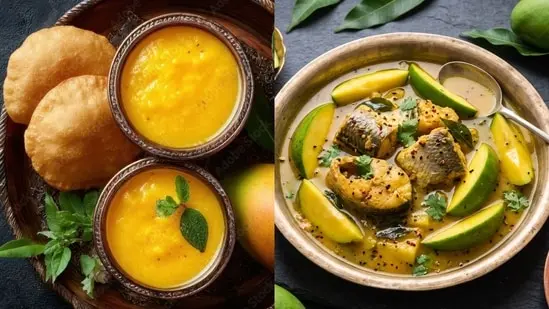
Reinvention may be one of the key culinary trends globally, but some foods, like mangoes, remain timeless; rooted in cultures, regions and emotions. Long before modern food trends, the 14th-century Sufi poet Amir Khusrow captured its charm in his famous riddle: “He visits my town once a year. He fills my mouth with kisses and nectar. I spend all my money on him. Who, girl, your man? No, a mango.”
The ‘King of Fruits’ has anchored Indian summers for centuries. Critic and food historian Pushpesh Pant says, “People forget that the mango is born of Indian soil. Everything else across the globe — from Brazil to Thailand — pales in comparison to the native Indian varieties. The fruit’s true legacy stems from its absolute versatility across every stage of its life cycle. When it is raw, it provides a sourness with a depth of flavour no other ingredient can replicate, elevating everything from chutneys to aachar. As it ripens, it becomes the rich centre of timeless pairings like aamras-poori, aam ki barfi, aam panna and more.”
Every region has a variety it claims as its own, allowing the fruit to cater to both our collective national identity and individual regional pride, because har aam ka apna flavour hota hai (every mango has its own distinct personality).
Savoury favourites
Mango reminds Chef Nishant Choubey of his childhood favourite, ripe mango rasam. “It is traditionally prepared with raw mangoes. But in my home, we celebrated the sweetness of fully ripe ones. It was a beautiful balance of sweet, tangy, spicy, and peppery flavours, with the natural fruitiness mellowing the warmth of roasted spices, curry leaves, and mustard seeds. During mango season, my friends would gather at home, eagerly asking for the recipe. I’d smile and say, ‘Forget the recipe for now, just enjoy the rasam. Even today, I continue to make it exactly as I remember. Every bowl takes me back to those carefree summer afternoons, proving that the most memorable recipes are the ones that bring people together.”
Chef Ameya Parachand - Executive Chef at TAB (The American Buzz) says, “Kairichi Daal is a dish I’ve been eating and making since childhood, a recipe handed down by my mother. It’s a classic Maharashtrian preparation made with raw mangoes, and its unique texture is what draws me to it most. It’s not completely smooth, but has a beautifully rustic, coarsely textured bite. The dish brings together the sharp tanginess of raw mango with a gentle kick of heat from fresh green chillies and whole dried red chillies in the tempering. It’s an irreplaceable, comforting dish that I look forward to making and enjoying every year during the pre-monsoon and summer months.”
Chef Tarun Sibal brings an unexpected sabzi combination to the focus. “My mother used to make a traditional kache aam aur kaddu ki sabzi. Made with unpeeled yellow pumpkin, it’s cooked down with aromatic fennel, bitter methi dana, a punch of hing, fresh green chillies, raw mango, and jaggery (gud). That perfect khatti-meethi (tangy and sweet) contrast is popular across North India for good reason—it instantly elevates everything around it. Whether you pair it with a plain layered paratha or scoop it up with hot, fluffy pooris, it’s the kind of nostalgic home cooking that can completely change your day.”
Bringing a North-Eastern perspective, Chef Kabyashree Borgohain from Project O’Tenga says, “In Assamese cuisine, raw mango isn’t just an addition; it’s the ultimate natural balancing agent. Assamese food relies heavily on delicate, comforting sour curries, and during the summer, raw mango takes centre stage in our classic Masor Tenga (sour fish curry). Fish can often be rich or fatty, and instead of relying on heavy spices or citrus that might overpower the dish, we use raw mango. Its clean, sharp tartness cuts right through the richness of the fish, cutting through the fat to create a light, deeply comforting, and perfectly balanced broth. It’s a staple recipe in countless Assamese households and a flavour profile so many of us have grown up eating at home every summer.”
Sweet delicacies
One dish that has stayed with Chef Siddharth Vasudev (Executive Chef, The Tivoli) is the mango rabdi kheer. “If there’s one mango dessert I’ll always be attached to, it’s Mango Rabdi Kheer. As a child, I waited for the season because my family always made it at home...no fancy ingredients, just good mangoes, thick rabdi, and everyone sitting together after lunch. For me, this is the taste of an Indian summer, comforting, fresh, and full of memories, which is why I still serve it to our guests today,” he says.
We can’t miss out on the classic aamras while talking about mango delicacies that stand the test of time. Chef Amit Gothwal says, “It’s a simple, beautiful preparation: silky ripe mango pulp, naturally sweet, finished with a hint of cardamom. Served with hot puris, it’s absolutely heavenly. I’ve always associated this with summer lunches during school years, when the season’s first mangoes arrived, and the entire family gathered. Despite being humble, it remains a deeply indulgent dish for me that revives those unhurried times.”
And a mango dessert that has also been replicated in modern cuisine is the steamed mango sandana. Parikshit Joshi, Executive Chef of Someplace Else, says, “Growing up in Maharashtra, mango was deeply woven into our traditions. While we relished delicacies like Kairi Lonche and Mango Barfi, the dish that instantly takes me back is Mango Sandana—a traditional Konkan delicacy made with ripe pulp, rice rava, coconut, and cardamom, all gently steamed and finished with melted ghee. Every summer in our native village of Guhagar, the family gathered on the verandah to enjoy hot Sandana. Today, we continue the tradition at home, sometimes serving warm Sandana with a scoop of vanilla ice cream. It’s a blend of nostalgia and new memories, proving that some traditions only get sweeter with time.”