



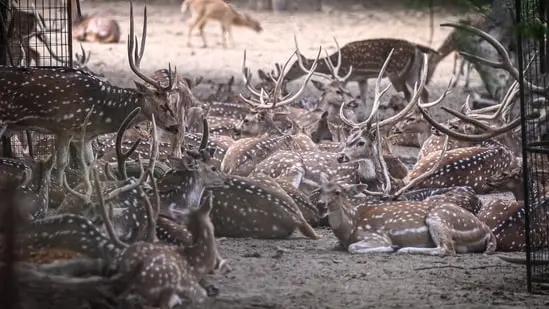
A Supreme Court-appointed Central Empowered Committee (CEC) has recommended retaining only 38 of approximately 400 spotted deer at the AN Jha Deer Park in Hauz Khas, and translocating the rest to wildlife reserves in Rajasthan in a phased manner, due to severe crowding and ecological stress within the urban enclosure. It has also called for restoring the park’s “mini-zoo” status, provided certain habitat enrichment measures are taken.
Also read: India announces visa relief for foreigners, no penalty on overstay amid US-Iran conflict
The Supreme Court will take the final decision on the matter.
In a report dated March 6 submitted to the Supreme Court, the CEC said the deer population at the park far exceeds its ecological carrying capacity, making long-term animal welfare and habitat sustainability impossible without drastic population reduction.
The panel noted that 261 deer have already been moved between 2023 and 2025 to Ramgarh Vishdhari Tiger Reserve and Mukundara Hills Tiger Reserve in Rajasthan, but hundreds still remain at the Delhi enclosure. HT has accessed a copy of the report.
Also read: Why is Kharg Island crucial to Iran's oil network? Inside ‘crown jewel’ struck by US as war escalates
The report relied on guidelines issued by the Central Zoo Authority (CZA) regarding enclosure size requirements for spotted deer.
“It prescribes a minimum outdoor enclosure area of 1,500 sq. metres per pair of spotted deer… Treating approximately 70% of the gross enclosure area as net usable open space, the existing enclosure at A.N. Jha Deer Park, measuring about 10.26 acres (around 41,500 sq. metres), provides an estimated usable area of about 29,000 sq. metres,” the report read.
“...On this basis, the enclosure can sustainably accommodate approximately 19 deer units (pairs) -- resulting in a scientifically assessed carrying capacity of around 38 deer,” it read.
According to the CEC, the enclosure, which is located in the centre of a dense urban area, simply does not have the ecological capacity to house the current population. “The present deer population… is substantially in excess of the scientifically assessed ecological carrying capacity of the enclosure, giving rise to serious concerns relating to animal welfare, habitat sustainability, and long-term population management,” the panel said in the report.
A scientific population estimation carried out by the Wildlife Institute of India (WII) earlier this year pegged the deer population at the park to be around 459 individuals (±31.8) using a direct count method, while a video-based count suggested a minimum population of about 370 deer. The Delhi Development Authority (DDA) has maintained in its submission to the panel that around 400 deer are currently housed at the A.N. Jha mini zoo, after 261 deer were translocated to Rajasthan between 2023 and 2025, as per the report.
The committee has also flagged signs of ecological degradation inside the enclosure, including overgrazing, soil compaction and degradation of ground vegetation, indicating sustained stress on the habitat.
The deer park, established in 1968 with just six deer that were brought from Uttarakhand, eventually saw its population grow rapidly over the decades.
The Central Zoo Authority cancelled its recognition in 2023 and approved the translocation of about 600 deer to wildlife habitats, a move that later came under legal scrutiny before the Supreme Court.
Following a court direction in November 2025, the CEC conducted inspections of the park, as well as the two Rajasthan tiger reserves, where deer had already been released.
The CEC further emphasised that translocating herbivores to predator landscapes, such as tiger reserves, was not inherently problematic, terming it a common conservation practice.
“Conservation science and contemporary wildlife management recognise translocation and prey augmentation as legitimate and widely accepted conservation tools. Natural predation following release constitutes a normal ecological process integral to prey–predator dynamics,” the report said.
The panel also said there were procedural gaps during the previous transfer of 261 deer, including the absence of microchips or identification tags, which made it difficult to track the individual survival rate post-release.
For the deer that remain in Delhi, the committee recommended that the park be restored as a recognised mini-zoo, but only after a series of habitat improvements. These include planting native grasses, restoring water bodies and lakes within the park, repairing damaged fencing, ensuring functional water troughs, and building night shelters.