



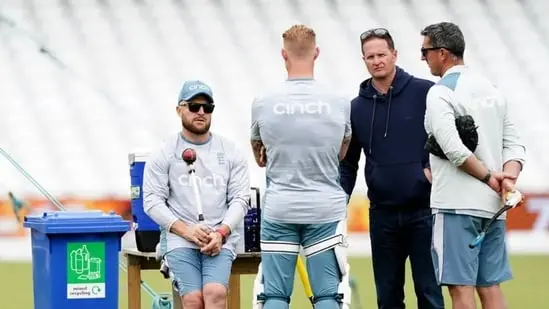
The England and Wales Cricket Board has concluded its review of England’s 1-4 Ashes defeat in Australia, a tour that raised serious questions over preparation, selection, discipline and intent. The fallout had left the positions of managing director Rob Key, head coach Brendon McCullum and captain Ben Stokes under scrutiny. Yet, in a decision that has sparked debate, the ECB opted for continuity, with all three retaining their roles.
Chief executive Richard Gould defended the move, stating: “This is not the time to throw everything out.”
Under the Key-McCullum regime, which began in April 2022, England have played 14 Test series, winning eight and drawing three. At home, they remained unbeaten across eight series, although two, against Australia in the 2023 Ashes and India in 2025, ended in draws.
ALSO READ: England Ashes review: Five biggest talking points as ECB rejects a clear-out after 4-1 humiliation vs Australia
However, the contrast overseas has been stark. In six away series, England managed just two wins, a whitewash in Pakistan in 2022/23 and a victory in New Zealand in 2024/25, while suffering defeats in India (2023/24), Pakistan (2024/25) and Australia (2025/26).
The latest Ashes debacle proved particularly damaging. England lost the urn inside 11 days, with the tour further marred by allegations of excessive drinking during a break in Noosa. Questions over discipline, preparation, and mindset intensified, with both McCullum and Key bearing the brunt of the criticism. Further controversy emerged with revelations around Harry Brook’s conduct in Wellington, adding to the sense of a team losing control as scrutiny deepened.
Yet, despite the mounting criticism, the ECB stood firm.
Why did the board persist with the current leadership?
England’s performance at the T20 World Cup appears to have played a key role. While not title contenders, England produced an unbeaten run through the Super Eights to reach the semifinals, a campaign seen as just enough to restore faith in the setup.
The ECB has opted not to publish its full findings, but outlined key points to the media at Lord’s. Gould reiterated that he had given “a lot of consideration” to “the right mix of leadership” before confirming that McCullum and Key would continue.
“It may not be the popular route, it may not be the easiest route, but I think it’s the right route,” Gould said.
“We are not going to select or deselect management based on a popularity campaign. We’re going to do it based on good judgment, objective views.”
McCullum still has 18 months remaining on his contract. While there were suggestions of limiting his role to white-ball cricket, Gould backed him to continue across formats, citing belief that he can “adapt and evolve”.
Preparation, a major talking point during the Ashes, was also acknowledged as a key failure. McCullum had earlier admitted he “didn't get right” the build-up to the series, and Key echoed that sentiment following the review.
“If you start with the performance and planning culture, we've certainly not got that right,” said Key. “But there's a difference between not caring about planning and preparation and not getting it right. I do feel a little bit when it came to the New Zealand one-day series, that the management were very pragmatic and they just said that's what we've got available, we'll make the best of it. And that's not good enough. We at the ECB need to make sure that we've got options for them to have the best preparation they can.”
England will next face South Africa and Bangladesh later this year, along with a one-off Test in Australia, series that could ultimately define whether the ECB’s decision to persist with the current regime proves justified.