



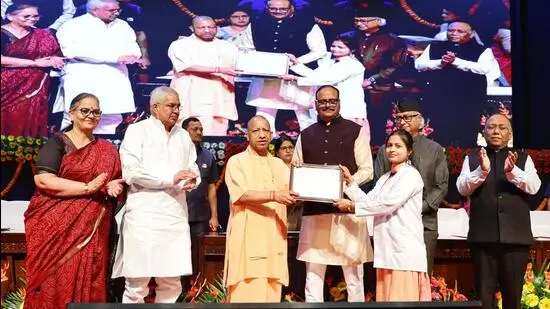
Chief minister Yogi Adityanath on Sunday said there is a heavy demand for Indian nursing professionals across the world.
Nursing candidates who learn a language alongside a nursing course can secure better careers both in the country and abroad, the chief minister said.
He made the remark at a function to distribute appointment letters to 1,228 nursing officers, including 131 men, at Lok Bhavan here.
“Recently, I went to Japan, where there is a heavy demand for Indian nursing professionals. The same is the case in Germany and Korea. If you go to European countries, there is a feeling among people that Indian nursing professionals will do good work,” he said.
“Countries like Japan and Germany have a high demand for trained nursing professionals, where language skills can provide added advantages,” he said.
The chief minister also said that to encourage more women to take up nursing in different parts of the country, modules should be created that impart knowledge in regional languages, such as Marathi, Telugu, Malayalam, Tamil and Bengali.
“Institutions like the King George Medical University, the Sanjay Gandhi Postgraduate Institute of Medical Sciences, and the Ram Manohar Lohia Institute of Medical Sciences have established simulation labs within their premises. Through these facilities, they are working to ensure that students become proficient not merely in theoretical knowledge, but in practical skills as well,” Adityanath said.
The chief minister also said that before 2017, Uttar Pradesh was in a poor condition.
“From 1947 to 2017, there were only 17 government medical colleges in Uttar Pradesh. If we include the private sector, the total was 40. Today, the number of government-run medical colleges has surpassed that of the private sector. The total count has risen to 81 in just nine years,” Adityanath said.
“Eastern Uttar Pradesh was once known for its poor healthcare system. Conditions were so bad that thousands of people lost their lives. Alongside other infectious diseases, the region had become a hub of health crises,” he said.
To address these challenges, major reforms were undertaken to strengthen healthcare infrastructure, he said.
ANM (auxiliary nurse and midwife) and GNM (general nurse and midwife) training institutes that had been closed for years were reopened. About 35 such ANM centres have been revived, and construction of 31 new nursing colleges is underway, he said.
Eighteen medical colleges currently offer BSc nursing courses, and with 22 new medical colleges under construction, nursing education is being further expanded, he said.
Uttar Pradesh today almost matches the national average in IMR (infant mortality rate) and MMR (maternal mortality rate), which is the result of effort, he added.
“The state has made notable progress in digitising healthcare services. A total of 976 community health centres have tele-consultancy facility. Around 9.25 crore people have been covered under Universal Health Coverage. Additionally, more than 14.28 crore digital health IDs (ABHA IDs) have been issued,” he said.
An additional 7,000 nursing seats and 2,000 paramedical seats have been introduced. Meanwhile, MBBS seats have risen substantially from 5,390 to 12,700, and postgraduate (PG) seats have increased from 1,221 to 5,056, reflecting a strong expansion in medical education capacity, the chief minister said.
Over the past nine years, the state government has provided more than nine lakh government jobs, one of the highest numbers by any state in India. The selection process is conducted by competent commissions and agencies under strict monitoring, ensuring transparency and merit-based selection, he added.
The chief minister also claimed that the mindset under which a “parallel government” run by the mafia operated in the state has now been dispelled.
“Previously, every district had its own mafia network, and the government departments were no different. Mafias dictated them. From there, we have moved towards a policy of ‘one district, one medical college’, establishing one such institute in every district,” he said.
Deputy chief minister Brajesh Pathak, minister of state Mayankeshwar Sharan Singh and senior officials were present on the occasion.