



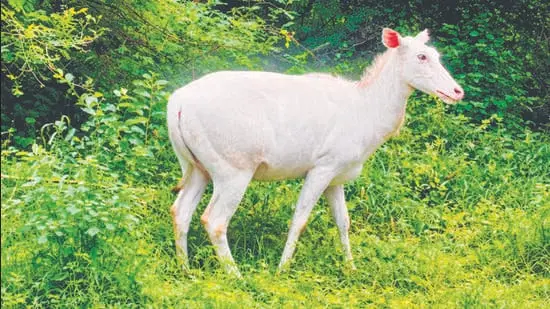
An albino nilgai (blue bull) –- a rare animal –- has reportedly been spotted several times amid the wilderness inside the Jawaharlal Nehru University (JNU) campus. The rare genetic variant stands out with its striking white coat against the typical grey-blue herd and experts said it is likely the only such albino in the capital, possibly even across the National Capital Region (NCR).
Dr Surya Prakash, a zoologist (PhD) from JNU, who has been studying the wildlife at the campus for nearly four decades, said the white-blue bull is an adult female, believed to be aged between 4-5 years. “Sightings along the campus of this nilgai are increasingly becoming more common. While we knew about its presence earlier, the calf is typically shy in nature and rarely ventures out to explore,” he said, adding efforts are being made at the campus to protect the animal.
“I, alongside the JNU Animal Welfare Society are working to ensure its safety from campus traffic and stray dogs within this southern Ridge habitat,” he said. “This is the only albino nilgai in Delhi and even likely in NCR. We cannot find records of such a blue bull from the past too,” he added.
Albino animals are born with a genetic condition which prevents the production of melanin, resulting in white or pale skin, fur, and feathers. They often have red or pink eyes.
“There is a basic difference between Leucistic and albino morphs. Albino animals will have red eyes and other exposed skin (particularly partially hair-free skin) in pink colour,” Prakash added, stating albinos also have poor immunity, making them more susceptible to naturally occurring diseases. This is why it is typically discouraged to carry out selective breeding with them.
Faiyaz Khudsar, scientist-in-charge of Delhi Development Authority’s (DDA) biodiversity parks programme said this sighting represents a new record for the region. “Such animals have entirely white fur and skin coat. While it is a new record for Delhi, similar observations have previously been reported from the states of Maharashtra and Rajasthan. In Rajasthan, such colour aberration was documented in three species of wild ungulates – nilgai, blackbuck, and Indian gazelle. These individuals were observed exhibiting normal behavioural activities in their natural habitats,” he said.
Sohail Madan, ecologist at the WildTales Foundation, also described the presence of the nilgai as a thrilling rarity for Delhi. “To the best of my knowledge, an albino nilgai has never been seen in Delhi before. Albinos occur in less than one in 10,000 births and is due to a recessive genetic mutation that strips away pigmentation. Ecologically, nilgai thrives in open grasslands and scrub forests, grazing on grasses and herbs while forming herds for protection. This ghostly white individual, with its typical diurnal behaviour of browsing at dawn and dusk, stands out dramatically,” Madan said, stating JNU’s nearly 1,000 acre campus serves a crucial urban green lung for Delhi, with diverse habitats.
“We must prioritise conservation by expanding green corridors, curbing encroachment, and fostering community-led restoration to ensure these natural wonders persist for future generations,” he added.