



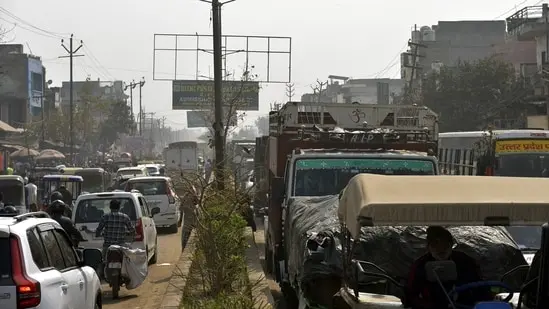
Delhi was ranked the world’s fourth most-polluted city —and the most polluted capital — in 2025, recording an annual average fine particulate matter (PM2.5) level of 99.6µg/m³, nearly 20 times the World Health Organization’s safe limit, according to a report released on Tuesday. India accounted for three of the five most-polluted cities globally and 29 of the top 50.
According to the annual World Air Quality Report 2025, released by Swiss air quality technology firm IQAir, Loni in Uttar Pradesh, with an annual average PM2.5 level of 112.5µg/m³, was the world’s most polluted city, followed by Hotan in China (109.6µg/m³) and Byrnihat in Meghalaya (101.6µg/m³).
“Loni, in India, was the most polluted city, recording an annual average PM2.5 concentration of 112.5µg/m³—a nearly 23% increase from 2024 and more than 22 times the WHO guideline. The world’s 25 most polluted cities were all in India, Pakistan and China, with India home to three of the four most polluted,” the report said.
The report made a distinction between the smaller “New Delhi” capital area and “Delhi” as a whole, finding New Delhi (82.2µg/m³) to be the world’s most polluted capital city again, followed by Dhaka (68µg/m³) in Bangladesh and Dushanbe (57.3µg/m³) in Tajikistan. In 2024, Delhi had an annual PM2.5 average of 108.3µg/m³, while New Delhi’s average was 91.8µg/m³, indicating marginal improvement.
India’s own “safe” limit for PM2.5 remains significantly higher at 40µg/m³, compared with WHO guideline of 5µg/m³.
According to the report, India ranked as the sixth most polluted country, with an average PM2.5 level of 48.9µg/m³. The most polluted five were Pakistan (67.3µg/m³), Bangladesh (66.1µg/m³), Tajikistan (57.3µg/m³), Chad (53.6µg/m³) and the Democratic Republic of the Congo (50.2µg/m³).
In 2024, India was ranked fifth globally, with an average of 50.6µg/m3.
“In 2025, India’s national average PM2.5 levels saw a modest 3% decline, dropping from 50.6µg/m³ in 2024 to 48.9µg/m³. While Delhi’s annual average concentration fell by 8%, the city still grappled with severe monthly spikes driven by seasonal smog and dust storms,” the report read.
Manoj Kumar, an analyst at the Centre for Research on Energy and Clean Air (CREA) raised concern over 115 Indian cities exceeding even India’s “lenient” air quality standards.
“Delhi being ranked the world’s most polluted capital in IQAir’s PM2.5 data shows the scale of the problem. A significant portion of this particulate pollution is from gaseous pollutants, and unless CAQM regulates these at the source, we are only addressing half the problem. A number of Indian cities with exceedingly high levels also continue to remain outside the scope of National Clean Air Programme (NCAP),” he said.
Also Read | Ghaziabad most-polluted city in India during 2025-26 winters, followed by Noida and Delhi: Report
Other cities in the National Capital Region (NCR) also fared poorly. Ghaziabad (89.2 µg/m³) ranked seventh globally, Noida (80.5 µg/m³) 18th, Greater Noida (77.2 µg/m³) 21st, and Gurugram (74.6 µg/m³) 23rd.
The IQAir report is based on global data for PM2.5, which are ultrafine inhalable particles having a diameter less than 2.5 micrometres, and included data from 9,446 cities across 143 countries. The report added 12 countries and territories that were not included in the previous edition.
The report, in its eighth edition, found that only 14% of global cities met the WHO standards, which was a decrease from 17% the previous year.
Only 13 countries met the WHO standards—French Polynesia, Puerto Rico, U.S. Virgin Islands, Barbados, New Caledonia, Iceland, Bermuda, Réunion, Andorra, Australia, Grenada, Panama and Estonia.
“Air quality is a fragile asset that requires active stewardship to protect public health,” said IQAir Global CEO Frank Hammes.
“The 2025 World Air Quality Report makes clear that without monitoring, we cannot fully understand what’s in the air we breathe. Expanding access to real-time data empowers communities to act. By reducing emissions and addressing climate change, we can drive meaningful, lasting improvements in global air quality,” he said.