



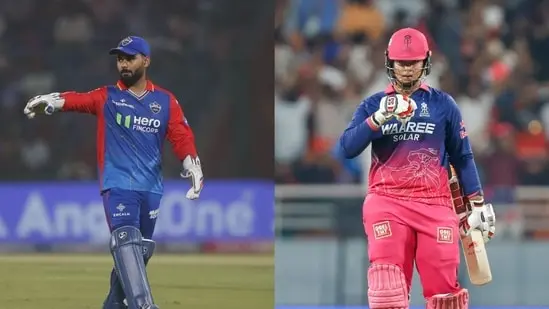
Rishabh Pant’s return to the Delhi Capitals is not just one of the biggest player movements after IPL 2026. It is also one of the clearest signs yet that the IPL market is beginning to correct itself. Pant was bought by Lucknow Super Giants for ₹27 crore at the IPL 2025 auction, the most expensive winning bid in IPL history. Two seasons later, he has returned to the Delhi Capitals for ₹15 crore. That is not a small adjustment. That is a ₹12 crore correction on one of India’s biggest cricket names.
The easy reading is to call it a homecoming. Pant, after all, is deeply tied to Delhi. He played nine seasons for the franchise, became one of its central figures, and captained the side across multiple seasons. But the money tells a sharper story. This deal is less sentimental than it looks. It shows that even a marquee Indian wicketkeeper-batter, even someone with Pant’s aura, reputation and leadership value, cannot remain immune from output-based correction.
That does not mean Pant is suddenly an ordinary asset. Far from it. A 27-year-old Indian wicketkeeper-batter with captaincy experience still carries obvious scarcity value in the IPL. He solves multiple problems at once: middle-order batting, keeping cover, leadership experience, brand pull and Indian-core stability. A ₹15 crore price is not cheap. But it is far closer to a rational cricketing number than the ₹27 crore tag that followed him into LSG.
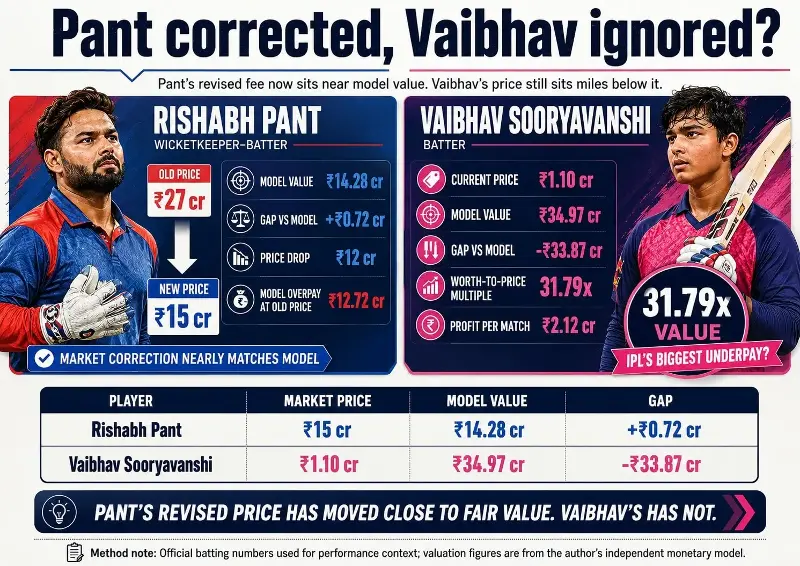
Our monetary model had already flagged this gap. At ₹27 crore, Pant’s rating-adjusted worth came to ₹14.28 crore. That left an overpay of ₹12.72 crore. The actual market has now cut him by ₹12 crore. In other words, the correction that has happened in the real IPL market is almost identical to the correction our model had projected. Pant’s new ₹15 crore price sits only ₹0.72 crore above his modelled worth.
That is the most important part of the deal. This is not merely a player being traded. It is a price being repaired.
Why Pant’s correction makes sense
Rishabh Pant’s 2026 batting numbers explain why the price had to come down. He finished the season with 312 runs in 14 matches, striking at 138.05, with a highest score of 68. Those are not disastrous numbers, but they are not ₹27 crore numbers either. For that kind of price, a franchise is not just buying presence. It is buying match-winning volume, high-end finishing, repeated impact, and season-defining output.
Pant did not produce that level of return.
By our impact model, Pant finished 39th on the season impact chart. His final impact score stood at 905.33, with a batting score of 320.13. Again, those are not failure numbers. They place him as a useful, important player. But the price tag was the problem. At ₹27 crore, he was carrying the financial burden of a tournament-defining superstar. His actual season looked closer to that of a solid high-value Indian player than the most expensive IPL asset ever.
That is why the revised ₹15 crore valuation feels justified. It does not punish Pant unfairly. It does not strip away his Indian player premium or captaincy value. It simply places him closer to the performance band he actually occupied. A ₹15 crore Pant is still expensive, still elite, still a major investment. But it is defensible. A ₹27 crore Pant, after that output, was not.
And this is where the wider market story begins.
If Pant’s corrected price is the IPL accepting that reputation and scarcity must still answer to performance, then Vaibhav Sooryavanshi sits at the opposite extreme. Pant was overpriced and has been corrected downward. Vaibhav is underpriced and, by the same logic, needs the most dramatic upward correction in the league.
The Vaibhav Sooryavanshi case
Vaibhav Sooryavanshi’s IPL 2026 season was not just good. It was financially absurd.
Rajasthan Royals paid him ₹1.10 crore. For that price, they got 776 runs in 16 matches at an average of 48.50 and a strike rate of 237.31. He hit one century, five fifties, 63 fours and 72 sixes. His highest score was 103. In pure batting terms, this was not a young player showing promise. This was a young player producing one of the most explosive seasons in IPL history.
The boundary profile makes the valuation gap even more extreme. Vaibhav’s 63 fours and 72 sixes gave him 135 boundaries for the season. His six-hitting alone accounted for 432 runs. He did not merely score quickly; he changed the scoring economy of matches. A batter striking at 237.31 across a full season is not adding value in small margins. He is altering powerplay strategy, forcing bowling changes, compressing risk windows, and giving his side match-winning tempo before the opposition can settle.
This is where the monetary comparison with Pant becomes brutal.
Pant’s revised market price is ₹15 crore. Our model’s worth for Pant is ₹14.28 crore. The market has now come almost exactly to that number. Vaibhav’s current price is ₹1.10 crore. Our model’s rating-adjusted worth for him is ₹34.97 crore. That means Rajasthan Royals received a ₹33.87 crore surplus on one player. His worth-to-price multiple is 31.79x.
In our monetary model, Vaibhav ranked third in overall season profit and first among underpaid overperformers. His ledger label was “major profit”. His total worth rank was fifth.
The impact model strengthens the same argument. Vaibhav finished second on the overall impact chart and first on the batting impact chart. His final impact score was 2490.35, with a batting score of 833.27. Pant’s final impact score was 905.33, with a batting score of 320.13. That means Vaibhav’s overall impact was roughly 2.75 times Pant’s, and his batting impact was roughly 2.60 times Pant’s.
Also Read: Scarred, doomed and broken: How the widely-hyped Rishabh Pant-LSG bonhomie went up in smoke
Yet Pant’s corrected price is ₹15 crore, while Vaibhav’s current price is ₹1.10 crore.
That is the market distortion. The argument is not that Pant is undeserving of ₹15 crore. The argument is that Pant’s correction proves the method. If a high-profile Indian player can fall from ₹27 crore to ₹15 crore because the market has moved closer to output-based valuation, then the same market cannot logically leave Vaibhav near ₹1 crore after a 776-run, 237.31-strike-rate season.
In terms of performance value, Vaibhav is not a ₹10 crore player. He is not even just a ₹20 crore player. Our model places him at ₹34.97 crore. That number may look outrageous in isolation, but it becomes far less outrageous once Pant’s correction is used as the reference point. Pant’s real-world market price has moved almost exactly to our modelled value. Vaibhav’s real-world price is still nowhere near his.
That is why the Pant deal matters beyond Pant. It gives the market a benchmark. It shows that IPL money is not frozen by reputation. Prices can be repaired. Premiums can be questioned. Contracts can be dragged closer to actual value.
And if that correction is fair for Pant, the next uncomfortable question is obvious: how long can the IPL market pretend that Vaibhav Sooryavanshi is worth ₹1.10 crore?
Because by every meaningful layer - runs, strike rate, boundary volume, impact score and monetary surplus - his season has already made the answer look ridiculous.
Method note
The monetary and impact valuation framework used in this article has been designed exclusively by the author. Official batting numbers have been used for runs, strike rate, boundaries and season aggregates, while the valuation layer is based on the author’s independent performance-impact model. The valuation figures are analytical estimates, not official IPL salary assessments or franchise valuations. They are intended to measure performance value relative to the contract price, not to predict actual auction or trade outcomes.