



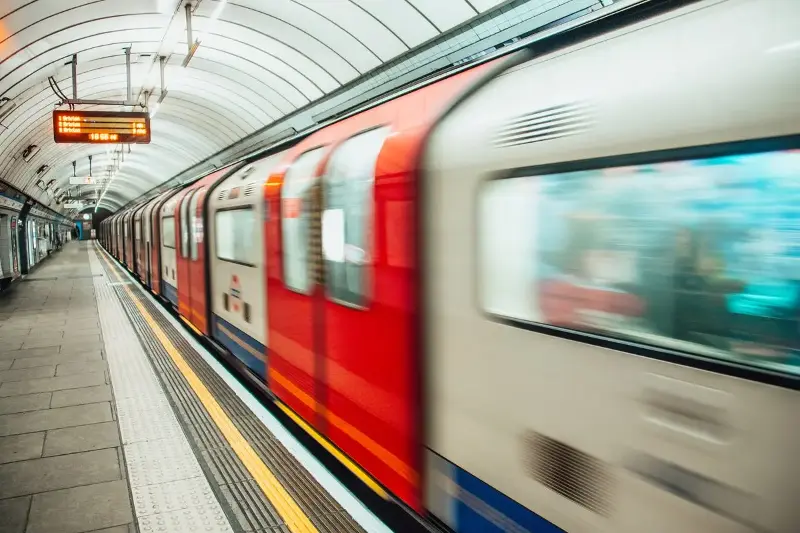
Passengers are being warned of tube strikes affecting the whole network in the lead-up to Christmas through to 2027, as Tube drivers plan walkouts.
The Rail, Maritime and Transport union (RMT) announced eight sets of 24-hour strikes starting in November, ending in February 2027 over plans for a voluntary four-day week for drivers.
Separately, service control workers will also walk out for 24 hours from just before midday on 20 November, affecting trains on the Piccadilly and District lines.
The RMT suspended planned strikes in March and May this year after progress in talks, but the union has so far made it clear that this round of strikes will go ahead.
The Tube drivers’ strikes land on some of the busiest days of the year, including the last weekend before Christmas Day.
Here’s everything we know so far about the upcoming strike dates.
When are the tube strikes?
There are two sets of strikes this winter: one date affecting mainly the Piccadilly line, followed by a larger set of dates affecting the whole network due to Tube drivers’ strikes.
The first strike planned this winter by some service control staff will cause severe disruption on the Piccadilly line and the Night Tube, as well as some disruption on the District line due to shared infrastructure.
November 2026
- 11.59am Friday 20 November to 11.59am Saturday 21 November 2026
Piccadilly Night Tube closures will continue on 21 and 22 November, but only between Hammersmith to Heathrow and Uxbridge, which is a planned closure unrelated to the strike.
All other Tube lines will operate as normal throughout this service control strike.
Some Tube drivers are also planning on striking on certain dates from November 2026 to February 2027.
If they go ahead, the 24-hour strikes will run from midday on the first day to midday the following day.
November 2026
- 12pm Thursday 26 to 11.59am Friday 27 November 2026
December 2026
- 12pm Thursday 17 to 11.59am Friday 18 December 2026
- 12pm Saturday 19 to 11.59am Sunday 20 December 2026
January 2027
- 12pm Monday 4 to 11.59am Tuesday 5 January 2027
- 12pm Wednesday 6 to 11.59am Thursday 7 January 2027
February 2027
- 12pm Wednesday 17 to 11.59am Thursday 18 February 2027
- 12pm Tuesday 23 to 11.59am Wednesday 24 February 2027
- 12pm Thursday 25 to 11.59am Friday 26 February 2027
Which lines are affected during the driver’s strike?
There will likely be some disruption across all Tube lines, but TfL said trains will run on most lines during the Tube driver’s strike, although it didn’t give further information.
The Elizabeth line, DLR, London Overground, buses and trams will be running as normal during the strikes but will be busier than usual.
What advice is being given to travellers?
Passengers are being told to plan ahead and check the live train timetables during the strikes.
TfL added that passengers should allow more time than usual to complete their journey.
Why are strikes taking place?
RMT has announced strike dates in retaliation over plans to impose new working arrangements, including a voluntary four-day week, which the union says would mean drivers face spending more time driving trains, longer duties, earlier starts and later finishes.
The union has also raised concerns that the proposals would pave the way for hundreds of job cuts, with initial rosters published for the Bakerloo line indicating significant reductions in staffing.
“London Underground is attempting to dress up a wholesale attack on drivers’ working conditions as a voluntary four-day week,” RMT general secretary Eddie Dempsey said.
“But there is nothing voluntary about a scheme that forces drivers to give up existing protections whether they work four days or five, and threatens those who refuse with displacement from their depots.
He added: “RMT is not opposed to a genuine four-day working week that benefits our members, but we will not accept it being used as a vehicle for job cuts, intensified working and the erosion of terms and conditions.”
Aslef, Britain's trade union for train drivers, said the switch to a four-day week would give train drivers an extra 35 days off a year.
“We are surprised that the RMT has, once again, decided to take strike action to try to prevent Underground drivers moving to a four-day week on a voluntary basis,” Finn Brennan, Aslef’s full-time organiser on London Underground, said.
He added: “The voluntary four-day week gives Tube train drivers an extra 35 days off every year with rosters based on a 34-hour week in return for some changes to working conditions and moving to electronic, rather than paper-based, systems for booking on for duty.
“We are in discussions with Transport for London about how the final details of this will work in practice.
“Management have agreed that anyone who wants to keep working a five-day week will be able to do so without suffering any detriment, and we will be holding them to that.
“A strike designed to stop people having the choice of a shorter working week and more time off is a strange choice to make.”
Nick Dent, director of customer operations for London Underground, managed by TfL, said: “We have engaged with our trade unions for months about our proposal for a new four-day working week.
“As a result of that engagement, drivers can now choose to remain on a five-day week with a guarantee of remaining at the same depot.
“This will give our colleagues a real, meaningful choice on their working pattern without having to change where they work.
“This will also mean less time at work for Tube drivers, while delivering a more efficient, reliable Tube service for our customers.
“Given that we have provided this new option after their feedback, we urge the RMT to put this proposal to their members.”