



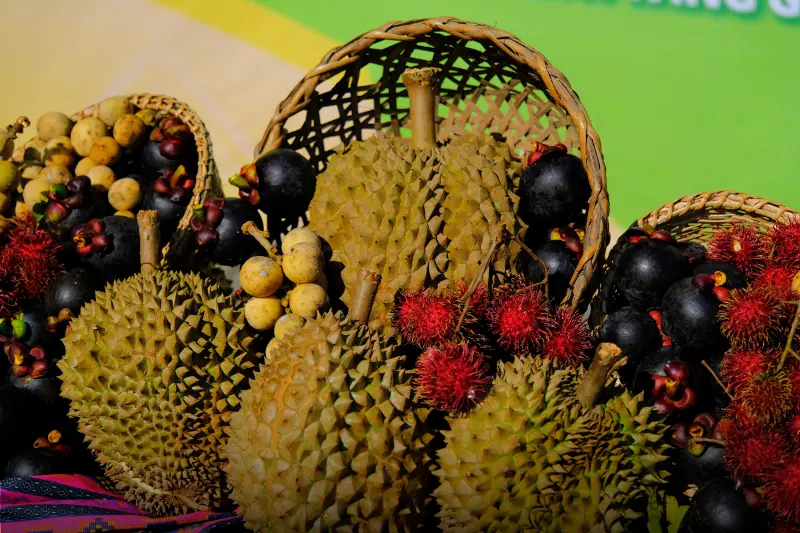
RESEARCHERS from the University of the Philippines Mindanao (UPMin) said they have developed a non-invasive artificial intelligence (AI)-based system to assess the maturity and quality of a durian fruit.
The Department of Science and Technology (DOST) said that the Philippines produces at least 80,000 metric tons of fresh durian annually, with production valued at nearly P6 billion.
The AI-based Non-Invasive Grading System for Durian (AIDurian) uses computer-operated visual scanning, acoustic analysis and deep learning to assess fruit ripeness, surface defects, locule count and shape.
Project leader Dr. Armacheska Satina said traditional durian grading relies on visual observation and acoustic tapping, which depend on the experience and judgment of classifiers.
“These methods are subjective and difficult to replicate consistently; grading can vary among classifiers and may become a bottleneck when skilled personnel are limited, particularly during peak handling periods,” Satina said.
AIDurian is integrated into two prototype platforms: Inspection of Durian Using AI, a mobile application for field-level inspection and decision support; and Durian Desktop-Oriented Non-Invasive Grading System, a desktop application for more comprehensive analysis.
The AIDurian project reported more than 80-percent accuracy in maturity classification and acoustic ripeness assessment, 93 percent in defect detection and nearly 98 percent in locule analysis.
“By automating selected grading tasks, AIDurian can help support more timely sorting, handling and marketing decisions while potentially reducing postharvest losses,” Satina said.
UPMin implemented the project under DOST’s I-Cradle program, with a budget of P11 billion. It was completed in early January 2026.
AIDurian is among the technologies to be featured at the National Science, Technology and Innovation Week, scheduled for Nov. 25 to 29 in General Santos City, South Cotabato.