


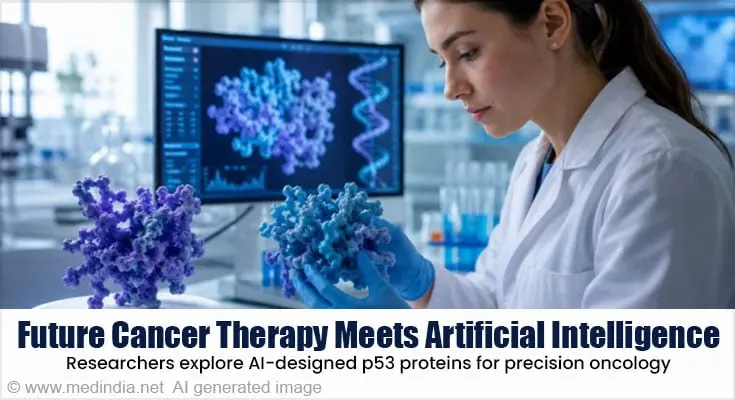
India, May 28 -- AI-Designed p53 Proteins may help improve future cancer treatment, but the research is still at an early and experimental stage. Researchers recently proposed that artificial intelligence could be used to design stronger versions of the p53 protein - one of the body's most important natural defenses against cancer. Scientists believe these engineered proteins may someday support more personalized cancer therapies by improving how tumors are detected and controlled
The publication was a hypothesis-based scientific paper, not a clinical trial. No patients were treated, and no laboratory treatment outcomes were reported. Instead, the researchers combined knowledge from cancer biology, immunology, artificial intelligence, and protein engineering to explore how future cancer therapies might be improved
Why Is the p53 Protein Important in Cancer?
The p53 protein helps protect the body from cancer by repairing damaged DNA and stopping abnormal cells from multiplying. Because of this role, scientists often call it the "guardian of the genome."
When the TP53 gene becomes damaged or mutated, cells may escape normal biological controls and continue growing uncontrollably. TP53 mutations are linked to nearly half of all human cancers.
Researchers believe restoring or strengthening p53 activity may become an important future strategy in precision cancer medicine.
How Could AI-Designed p53 Proteins Work?
The researchers proposed using artificial intelligence to design optimized versions of p53 proteins, sometimes called "superproteins." These engineered proteins may theoretically become more stable and better able to survive inside cancer cells.
AI systems can analyze large biological datasets and predict how proteins may fold, behave, or interact with cells. This may help researchers identify useful structural changes before laboratory testing begins.
The paper also discusses future use of 3D bioprinting, which could someday help create customized therapeutic proteins tailored to a patient's tumor profile.
Importantly, the researchers did not claim that AI-designed p53 proteins can currently cure or treat cancer in patients.
What Is the Oncodarwinian Hypothesis?
The study introduces the Oncodarwinian hypothesis, which suggests that cancer cells may develop survival strategies as a response to stress inside the body.
According to the authors, chronic inflammation, immune dysfunction, or tissue injury may create conditions that allow cancer cells to adapt and survive. Understanding these biological adaptations may help researchers identify future treatment targets.
The paper also proposes that stronger p53 activity could potentially improve communication between tumors and immune cells, helping the immune system recognize abnormal cells more effectively.
Key Limitations of AI-Based Cancer Protein Research
The researchers clearly stated that the work remains theoretical and experimental. No human studies, animal trials, or clinical treatment outcomes were included.
Further laboratory studies, animal research, and future clinical trials will be needed before AI-designed p53 therapies could move toward real-world medical use.
What This Could Mean for Future Cancer Care
Although still experimental, the research highlights growing interest in combining artificial intelligence, precision medicine, and cancer biology to improve future oncology treatments.
Scientists hope that AI-guided protein engineering may eventually support more targeted therapies with fewer unintended effects on healthy cells. The findings may also encourage future research into personalized cancer treatment approaches based on an individual tumor's genetic profile.
For patients and families, the study does not change current cancer treatment recommendations. Experts continue to recommend evidence-based screening, early diagnosis, and guideline-approved therapies while experimental AI-based cancer technologies undergo further scientific validation.