



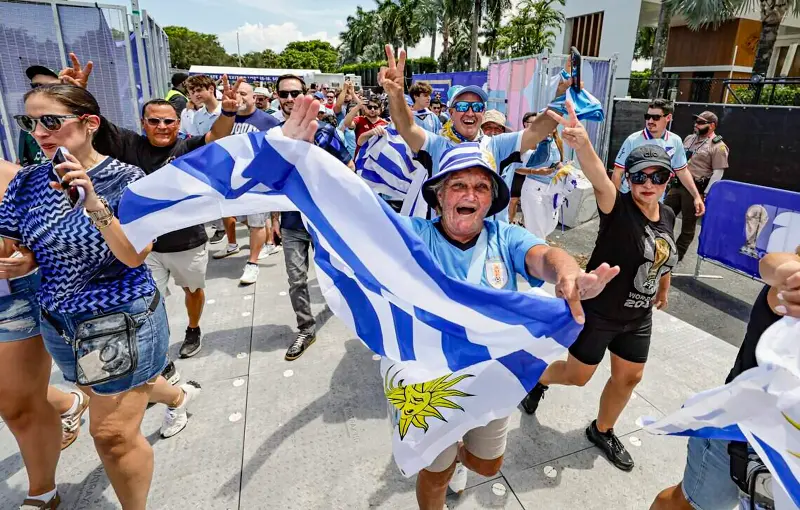
MIAMI GARDENS, Fla. — The thick book chronicling the broad history of major sports in South Florida may start to be written now. We are complete. The one glaring chapter that had been missing began to write itself Monday night with color and pageantry as Miami was home to a soccer match in the FIFA World Cup for the first time.
We have hosted the biggest stages across most every sport imaginable, but never before the biggest stage of them all in the most popular sport worldwide — the only game for which the whole planet cheers with a fervor that sounds and feels more like worship.
Monday it was the yellow sun and blue stripes of Uruguay’s flag flying alongside the Arabic on forest green of Saudi Arabia, the fans of each decked out in their national team’s colors. And, guaranteed, back home in Riyadh and Montevido and across those countries they were watching this match like Americans do Super Bowl Sunday.
Uruguayans turned out in much, much greater numbers in the crowd but the two sides were even in the numbers that mattered most, drawing 1-1 in the group-stage opener for each. The Saudis led as Abdulelah Al-Amri cashed the game’s first goal in the 41st minute as flag-waving Saudi fans chanted to a drumbeat. But favored Uruguay averted an upset loss with an 80th-minute equalizer by Maxi Araujo shook the net on a volley.
The Saudis should be thrilled with the draw, as favored Uruguay, La Celeste, dominated large patches of the match with 67%t overall possession, a 10-3 margin in shots, 14-4 in corner kicks, more than double the accurate passes and forcing nine saves of the busy Saudi goalkeeper.
Uruguay’s team flight Sunday from its Mexico training site to Miami was delayed due to missing documentation required for the charter flight, which FIFA blamed on “an airline permitting error in Mexico.” An effect, perhaps? The South American side was a heavy favorite over a Saudi team that is No. 60 in the current FIFA World Ranking vs. Uruguay’s No. 17.
The result was reflected by the two head coaches’ vastly differing postgame attitudes.
“An opponent we should have beaten,” Uruguay coach Marcelo Bielsa said plainly. “We gave away minutes in the first half that suggests we didn’t do things right. We had to win this match.”
Said Saudi coach Georgios Donis: “We were very tired at the end, but to play this type of game with this opponent and to get a point, it’s a positive for us.”
Hard Rock Stadium was a bit slow to fill Monday due to traffic issues, but the crowd would reach very near the stadium’s 65,000 capacity with an energetic 62,764 — solid for a 6 p.m. weekday start without a glamour club on the pitch, and with only 3,000 or so Uruguayans and far fewer Saudis residing in South Florida.
(Wait, did I say Hard Rock Stadium? Sorry. Hope FIFA doesn’t snatch my credential. It’s “Miami Stadium” officially during the tournament because Hard Rock is not a FIFA rights-holder. The temp name could be worse. Our games could be at “Generic Southern Florida Athletic Facility.” Let’s just call it Joe Robbie Stadium and move on. The Dolphins’ founding owner had this stadium built with international soccer in mind as well as football, and he would have been very proud Monday night.)
This is the game that made Miami history as our first World Cup match — the city was snubbed as a host for the 1994 U.S. World Cup — but the six games left here only get bigger and bigger.
Uruguay is back Sunday vs. Cape Verde — lightly regarded until earlier Monday when it tied World Cup co-favorite Spain 0-0 in the shock of the tournament thus far. Brazil, the forever powerhouse, plays Scotland on June 24. And on June 27 it’s Colombia with its massive and crazy-passionate South Florida fan base vs. Cristiano Ronaldo and Portugal in our last group-stage match that may well be winner-take-all for advancement.
Then, in the sudden-death knockout stage, Miami hosts a Round-of-32 match July 3, a quarterfinal game July 11 and the bronze (third-place) game on July 18. And there is a chance at least one or even all of those three could feature Argentina led of course by Inter Miami’s Lionel Messi in very likely his final World Cup as he turns 39 on June 24.
The magnitude of World Cup games in Miami can hardly be overstated. For a month-plus this is the biggest event in the world. Not just the biggest sporting event but the biggest event, period. This sport, this one game, is the closest thing Earth has to a common language, a shared love.
The buildup to this tri-hosted World Cup across the U.S., Canada and Mexico was not free of controversy, from an outcry over high ticket costs and price gouging on public transportation prices to American immigration policies that doubtless scared off many potential visitors.
All of that, though, including the politics always intertwined in a global event so massive, disappear by degrees as the games begin and the cheering and dreaming start.
The Olympic Games are the only sporting event comparable, perhaps, but I would gladly preach the World Cup is bigger and embraced more passionately.
Miami knows a variety of sports on a gigantic scale more than most big cities.
We have hosted 11 Super Bowls and myriad college football championships including the most recent one and three of five Hurricanes titles. We have hosted 16 NBA Finals games, 12 in the Stanley Cup Final and six World Series games. Inter Miami won the MLS Cup at home. Formula One and NASCAR races are here annually. Major tennis and golf events, too.
Canes football, the Heat, Dolphins, Marlins, Panthers and Inter Miami combined have delivered us 15 championships. The World Baseball Classic with Miami its hub city is big, too. But it isn’t this.
Nothing we’ve had as host, not even a Super Bowl in town, can equal the entirety of seven World Cup matches in a month’s time for global scale.
I’m proud to know Miami as one of America’s most diverse, most international cities at a time when immigrants are too easily and wrongly demonized. This has always been a perfect fit to be a World Cup city; now, FIFA has finally recognized that.
It’s only one chapter in Miami’s sports history, but it’s the one we’d been missing, and needed the most.