



Amazon Web Services (AWS) has unveiled a new developer tool called TorchNeuron to enable AI startups to deploy their applications on Amazon's Trainium application accelerators with minimal changes. The tool was announced on Monday, October 19, 2026, and is designed to make it easier for developers to shift AI workloads to Amazon's custom hardware, thereby minimising dependence on Nvidia.
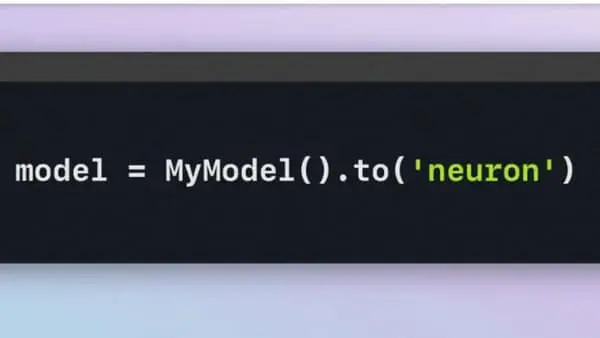
TorchNeuron is compatible with PyTorch, an open-source framework that is popularly used for creating and deploying AI models. The developers can deploy PyTorch applications to Trainium with just one configuration change and don't have to rewrite the code, according to AWS. The action targets Nvidia's software advantage, which has made its graphics processing units (GPUs) a popular option for AI computing.
Amazon targets Nvidia’s software advantage
Nvidia’s CUDA software platform allows developers to run AI applications on its GPUs and has helped establish the company as a dominant force in AI infrastructure. Its close integration with PyTorch has made Nvidia hardware a familiar choice for any developer.
According to Amazon, approximately 85% of AI applications are created using PyTorch. TorchNeuron is designed to ease the transition for developers experienced with the Torch framework to Trainium.
Amazon is also making an effort to reduce its reliance on one chipmaker for PyTorch. In its announcement, AWS said it would provide code changes to the primary PyTorch project to eliminate hardware-specific dependencies and make the framework more hardware-agnostic.
AWS pitches cost savings and cloud infrastructure
AWS is offering Trainium as a competitor to specialised cloud computing providers like CoreWeave, Nebius and Firmus, which have deep relationships with Nvidia-based infrastructure.
Brace also mentioned that Trainium can support AI training and inference, which could help reduce costs for a workload. Training is the process of creating an AI model, and inference is the act of using the trained model to produce predictions or perform tasks.
As an example, Brace cited Deepgram, an AI voice technology provider. After switching to Trainium, he claimed that the company achieves 70% higher audio-per-dollar performance with production-grade accuracy while leveraging native PyTorch support.
Can Amazon reduce Nvidia lock-in?
Amazon is not the first player in the game to provide alternatives to Nvidia for PyTorch developers. It is also possible to modify the application to run on hardware from other manufacturers, including Apple and AMD, and, in some cases, it may work without modification but with different performance specs.
The tougher task for Amazon will be encouraging developers to embrace Trainium without sacrificing the ease of use that has made PyTorch popular. Eliminating hardware-specific requirements may provide greater flexibility for developers but may also create extra configuration problems.
If Amazon pulls it off, TorchNeuron might threaten Nvidia's dominance in AI chips and in the software suite that requires developers to work on its chips.