



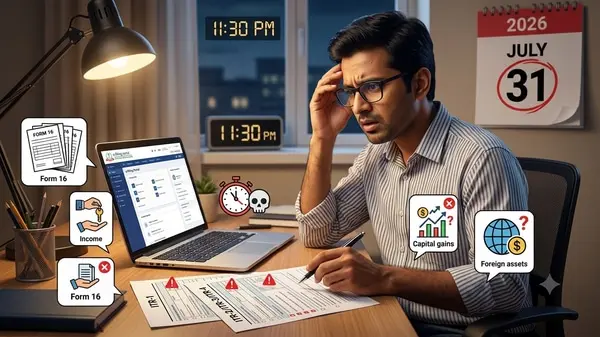
One of the biggest misconceptions, according to Adhil Shetty, CEO of BankBazaar, is that every salaried individual should file ITR-1.
"A common mistake is assuming that salary income automatically means ITR-1 is the right form," Shetty said. "Many taxpayers overlook other income they may have earned during the year, such as capital gains, rental income from a second house or foreign assets, all of which may require a different ITR form."
He added that taxpayers often use the previous year's return as a template without checking whether their financial situation has changed. "Even a single transaction can change the applicable ITR form," he said, adding that choosing the correct form based on income earned during the relevant financial year can help avoid delays or the return being treated as defective.
Why choosing the wrong ITR form can prove costly
Selecting an incorrect return form can have consequences beyond a simple filing error. A return filed using the wrong form may be treated as defective, requiring the taxpayer to rectify the mistake within the prescribed timeline. Failure to do so could delay refund processing or even invalidate the return.
Shetty said salaried taxpayers should not assume ITR-1 is the default choice simply because they earn a salary. Before filing, they should review all sources of income earned during FY26, including capital gains, rental income, interest income and foreign assets, to determine the appropriate ITR form.
Job switchers face a higher risk of tax mismatches
Employees who changed jobs during the financial year should be particularly careful, as salary and tax deducted at source (TDS) details may be spread across multiple employers.
He also advised taxpayers to report other income, such as bank interest, capital gains or freelance earnings, wherever applicable. If there is a tax shortfall because income from a previous employer was not considered while deducting TDS, the balance tax should be paid before filing to avoid interest or a tax demand later.
A five-point checklist before filing your return
Before clicking 'Submit', taxpayers should complete a few essential checks to reduce the chances of notices or refund delays.
Shetty recommends:
- Verify that PAN, Aadhaar and bank account details are correct.
- Match salary income and TDS with Form 16, Form 26AS and AIS.
- Confirm that the correct ITR form has been selected.
- Ensure all sources of income, including interest income, capital gains, rental income and income from previous employers, have been reported.
- E-verify the return within the prescribed timeline, as an ITR that is not e-verified is treated as invalid.
Shetty said taxpayers should avoid waiting until the final day, as last-minute filing increases the risk of technical issues on the e-filing portal and leaves little time to resolve discrepancies before the deadline. Filing early also provides a buffer to correct errors, respond to mismatches and complete the mandatory e-verification process without unnecessary stress.