



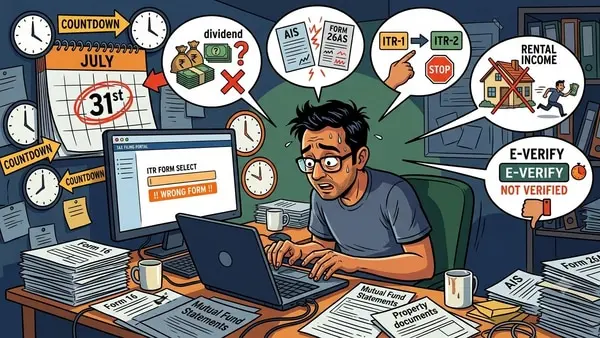
The tax department has repeatedly advised taxpayers to reconcile the information available in Form 26AS, the Annual Information Statement (AIS) and the Taxpayer Information Summary (TIS) before submitting their returns. Here are five common mistakes taxpayers should avoid.
1. Reporting only salary income
Many salaried taxpayers rely solely on Form 16 while filing their ITR. However, Form 16 only reflects salary income reported by the employer. Interest from savings accounts and fixed deposits, dividend income, rental income, freelance earnings and capital gains from shares or mutual funds must also be disclosed, wherever applicable.
Leaving out any taxable income can result in a mismatch with the Income Tax Department's records and may trigger a notice later.
2. Ignoring mismatches in AIS and Form 26AS
If income reflected in these records is omitted from the return, it may lead to additional tax demands or scrutiny.
3. Choosing the wrong ITR form
Selecting an incorrect ITR form is another common error. Using the wrong form can make the return defective or delay its processing.
For example, taxpayers with capital gains, foreign assets or multiple house properties may not be eligible to file ITR-1 and may need to use another applicable form instead. Taxpayers should ensure they select the form that matches their income profile.
4. Making incorrect deduction and capital gains claims
Claiming deductions without meeting the eligibility conditions or failing to report capital gains from shares, mutual funds or property transactions are frequent mistakes during ITR filing.
5. Forgetting to e-verify the return
Submitting the ITR is not the final step. Taxpayers must also complete e-verification within the prescribed time. If the return is not verified, it is treated as invalid, which means it is considered as not having been filed.
If an error is noticed before verification, taxpayers also have the option to discard the unverified return and file a fresh one, subject to the applicable timelines.
With only a few days left until the July 31 deadline, taxpayers should resist the temptation to file their returns in haste. Spending a few extra minutes to reconcile income details, choose the correct ITR form, verify deductions and complete e-verification can help avoid refund delays, tax demands and unnecessary notices from the Income Tax Department.