



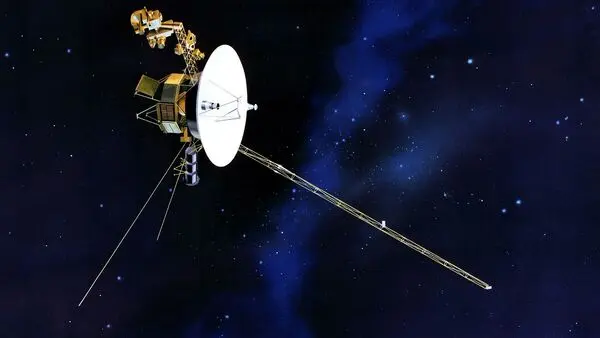
NASA's Voyager 1 spacecraft has reached a distance of one light-day from Earth, becoming the first human-made object to travel so far from the planet. Launched in 1977, the spacecraft is now approximately 16 billion miles (26 billion kilometres) away.
The milestone means that light, including communication signals sent between Earth and the spacecraft, takes about 24 hours to travel the distance in one direction.
In an article published by The Conversation, a space history curator responsible for the National Air and Space Museum's planetary science collection explains the significance of the achievement, Voyager 1's nearly five-decade journey and how the mission has transformed scientists' understanding of the solar system and interstellar space.
The milestone comes ahead of the 50th anniversary of the Voyager missions in 2027. Voyager 1 and its twin, Voyager 2, will complete 50 years in space on September 5 and August 20, respectively. They are currently the two oldest spacecraft still operating.
The spacecraft first explored the outer planets of the solar system before travelling towards its outer boundaries and eventually entering interstellar space — the region between stars.
Despite being built using technology from the 1970s, Voyager 1 has continued operating well beyond its expected lifespan.
However, the spacecraft's capabilities have gradually declined. Eight of its original 10 scientific instruments are no longer operating, while the power generated by its plutonium-238 source decreases every year. Technical failures and communication problems have periodically raised concerns about the future of the mission.
Voyager 1's journey from Jupiter and Saturn to interstellar space
NASA launched Voyager 1 on September 5, 1977, from its launch complex in Cape Canaveral, Florida, 16 days after the launch of its twin, Voyager 2. Although Voyager 2 was launched first, Voyager 1 quickly overtook it.
Each spacecraft is approximately the size of a small car and carries scientific instruments, including a magnetometer mounted on a boom extending more than 50 feet (15 metres).
According to The Conversation, the two probes explored Jupiter and Saturn, returning images with higher resolution than those captured by their predecessors, Pioneer 10 and Pioneer 11.
Their observations revealed details of Jupiter's turbulent atmosphere, faint rings around the planet, Saturn's rings and several of the planets' moons.
Voyager 2 subsequently travelled on to explore Uranus in 1986 and Neptune in 1989, completing a tour of the outer planets that did not include Pluto.
Voyager 1, meanwhile, followed a trajectory that took it towards Saturn's largest moon, Titan. On November 12, 1980, it passed within 4,034 miles (6,492 kilometres) of Titan and captured images showing a world covered by a dense atmosphere.
Decades later, NASA's Dragonfly mission is scheduled to launch in the mid-2030s to investigate Titan's atmosphere and surface.
The trajectory that enabled Voyager 1 to study Titan and other Saturnian moons also sent the spacecraft away from the plane in which the planets orbit the Sun. It has continued travelling in that direction ever since.
Voyager 1's milestones beyond the solar system
Voyager 1 crossed the orbit of Pluto in 1989. On February 14, 1990, before switching off its cameras for the final time, it captured 64 images that were combined to create the first "family portrait" of the solar system.
There is no universally agreed definition of what it means for a spacecraft to leave the solar system. However, Voyager 1 has gradually moved beyond the region dominated by the Sun's influence.
In December 2004, it crossed the "termination shock", the outer boundary associated with the high-energy particles that make up the solar wind.
On August 15, 2012, it moved beyond the protection of the Sun's magnetic field, becoming more exposed to cosmic radiation. As it crossed this boundary, its instruments detected a sparse layer of superheated plasma — charged gas atoms whose electrons have been separated from their nuclei. Scientists nicknamed this boundary the "Wall of Fire".
Voyager 1 has since been travelling through interstellar space, recording changes in the surrounding environment through its scientific instruments.
The mission has also faced several technical challenges, including memory failures, computer glitches, declining power and problems with its ageing propulsion system. At various points over the past decade, these issues threatened to end communication with the spacecraft.
NASA engineers have repeatedly found ways to keep the mission operating by using backup thrusters and rerouting data, according to The Conversation.
What does one light-day mean?
A light-day is a measure of distance, not time. It refers to the distance light travels in 24 hours.
For distances within the solar system, scientists commonly use the astronomical unit (AU), which is the average distance between Earth and the Sun. The Kuiper Belt, where Pluto is located, extends across a region roughly 30 to 50 AU from the Sun.
As distances increase beyond the solar system, scientists use light-years as a unit of measurement. One light-year is equivalent to about 5.88 trillion miles (9.46 trillion kilometres), or 63,241.1 AU.
The nearest star to the solar system, Proxima Centauri, is approximately 4.25 light-years away.
Voyager 1's one-light-day distance is therefore a significant milestone by the standards of human-made spacecraft, but remains a small fraction of a light-year.
The spacecraft is travelling at approximately 37,844.49 mph (60,773 kmph). At this speed, it would take another 300 years to reach the Oort Cloud, the distant region believed to surround the solar system. It would then take about 30,000 years to travel through it.
Even a journey towards the Alpha Centauri star system, which includes Proxima Centauri, would take about 75,000 years at Voyager 1's current speed, according to The Conversation.
The scale of these distances highlights the limitations of current space-travel technology. Until scientists develop technologies capable of carrying people between stars, robotic spacecraft will continue to serve as humanity's explorers of distant regions.
Voyager 1 carries a message from Earth
Beyond its scientific instruments, Voyager 1 also carries a message intended for any civilisation that might discover it in the distant future.
The spacecraft contains a gold-plated copper phonograph record, commonly known as the Golden Record. It carries greetings, messages, sounds and music, along with encoded images representing life on Earth.
The record was designed to communicate something about humanity and its planet to a potential recipient beyond Earth.
The Conversation's article notes that many people continue to view space exploration as an expression of humanity's peaceful aspirations. The Voyager missions have also allowed people to feel connected to a scientific endeavour that reaches far beyond the planet.
Although there may never be a response from another civilisation, the Golden Record represents an attempt to carry a part of human culture across the vast distances of space.
This article is based on a report published by The Conversation.