



Nintendo Switch 2 games published by Nintendo itself will soon be cheaper depending on where you buy them, the company has announced.
In a support post on the Nintendo of America website, the company says that going forward new first-party video games released exclusively for the Switch 2 will have a different price than their physical releases.
“Beginning in May 2026, and starting with preorders for Yoshi and the Mysterious Book, new Nintendo published digital titles exclusive to Nintendo Switch 2 will have an MSRP that is different from physical versions,” the support post reads. “[This] change simply reflects the different costs associated with producing and distributing each format and offers players more choice in how they can buy and play Nintendo games.”
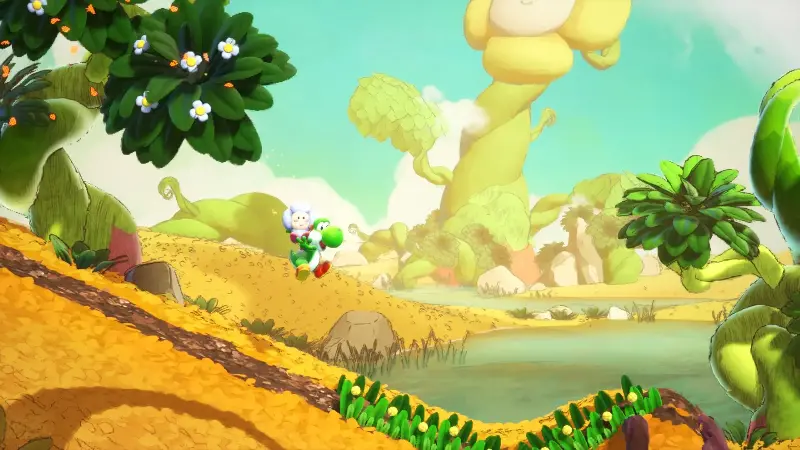
The upcoming platformer game “Yoshi and the Mysterious Book” for the Nintendo Switch 2, set to be released on May 21, 2026, is the first game set to be released under the new scheme, and will retail at $69.99 physically and $59.99 digitally on the Nintendo eShop, a saving of $10 for those who buy digitally.
This change also seems to be taking place in Australia and New Zealand, as reported by Vooks, while other regions such as Europe and Japan have had similar pricing schemes in place since the launch of the Nintendo Switch 2.
In a statement to IGN, Nintendo of America confirmed that “the cost of physical games is not going up.”
“This means that when Nintendo sells digital versions of Nintendo published games exclusive to Nintendo Switch 2 to consumers in the U.S., those prices will have an MSRP that is lower than their physical counterparts,” the company told IGN. There’s no word on if the company intends to lower the price of previously released games to match the new scheme, or if it solely applies to games going forward.
The new pricing scheme comes after a $10 price hike to first-party Nintendo games alongside the Switch 2, bringing most games up to $70 – or $80 in the case of Mario Kart World – instead of the Switch’s primarily $60 game releases. It means that those who buy digitally will seemingly see digital prices more similar to those of last-generation games, while those who buy physical copies will instead pay the higher price, which is in line with first-party pricing on the PS5 and Xbox Series X|S, as well as most third-party triple-A games.