



A decade-long mystery about apparent changes in Saturn’s rotation has finally been solved, thanks to observations from the most powerful space telescope ever built.
Scientists at Northumbria University have discovered why Saturn appears to spin at a different speed depending on how such is measured, and it has nothing to do with the actual rotation of the planet, but rather with its aurora.
The study reveals for the first time complex patterns of heat and electrically charged particles in Saturn’s aurora, showing that the entire system is driven by a self-sustaining feedback loop powered by the planet’s own northern lights.
The mystery dates back to 2004, when NASA‘s Cassini spacecraft in 2004 suggested the planet’s rotation rate was gradually changing– which should not have been possible, because planets cannot simply speed up or slow down their spin.
In 2021, astronomer professor Tom Stallard of Northumbria University and colleagues found that the apparent changes in Saturn’s roation were being driven by winds in the planet’s upper atmosphere, which were producing electrical currents that created the misleading auroral signal.
However, this discovery left one key question unanswered: what was causing those atmospheric winds? New research by Professor Stallard and colleagues across the UK and US has now provided the first direct evidence of the answer.
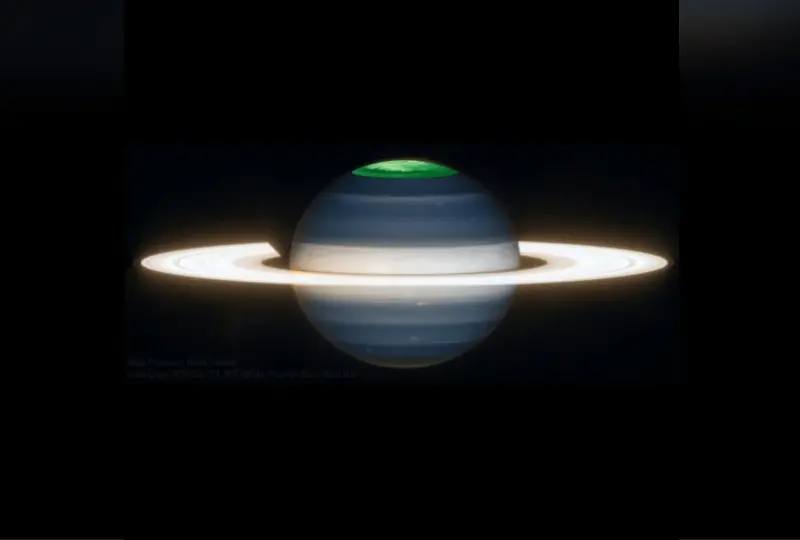
Using the James Webb Space Telescope (JWST), the team observed Saturn’s northern auroral region—the equivalent of Earth’s northern lights—continuously for a full Saturnian day.
They then analyzed the infrared glow from a molecule called trihydrogen cation, which forms in Saturn‘s upper atmosphere and acts as a natural thermometer, producing the first high-resolution maps of both temperature and particle density across Saturn’s auroral region.
Compared to earlier data, the improvement was extraordinary. Previous measurements had errors of around 50 degrees Celsius, roughly on a par with the differences the scientists were trying to detect, and were produced by combining broad regions of the hot polar aurora.
The new JWST data was ten times more accurate than previous measurements, revealing fine-scale patterns of heating and cooling across the aurora.
What the team found matched long-standing predictions— but only when the heat was concentrated exactly where the aurora enters the atmosphere. This led to a crucial discovery: Saturn’s aurora actively heats its atmosphere in specific regions. The heat generates winds, which then produce electrical currents. Those currents power the aurora itself, creating a continuous feedback loop.
“What we are seeing is essentially a planetary heat pump. Saturn’s aurora heats its atmosphere, the atmosphere drives winds, the winds produce currents that power the aurora, and so it goes on. The system feeds itself,” said Stallard in a statement.
“For decades, we knew something strange was happening with Saturn’s apparent rotation rate, but we could not explain it. We then showed it was being driven by atmospheric winds, but we still did not know why those winds existed. These new observations, made possible by JWST, finally give us the evidence we needed to close that loop.”
The study also points to a deeper link between Saturn’s atmosphere and its magnetosphere—the vast region of space shaped by the planet’s magnetic field, which could explain why the effect remains stable over long periods.
“This result changes how we think about planetary atmospheres more generally,” Professor Stallard added.
“If a planet’s atmospheric conditions can drive currents out into the surrounding space environment, then understanding what is happening in the stratospheres of other worlds may reveal interactions we have not yet even imagined.”
Do you have a tip on a science story that Newsweek should be covering? Do you have a question about Saturn? Let us know via [email protected].
Reference
Stallard, T. S., Moore, L., Melin, H., Smith, C. G. A., Agiwal, O., Chowdhury, M. N., Johnson, R. E., Knowles, K. L., Thomas, E. M., Tiranti, P. I., O’Donoghue, J., Mohamed, K., Mueller-Wodarg, I., Coxon, J. C., Badman, S. V., & Caggiano, J. A. (2026). JWST/NIRSpec Reveals the Atmospheric Driver of Saturn’s Variable Magnetospheric Rotation Rate. Journal of Geophysical Research: Space Physics, 131(3). https://doi.org/10.1029/2025JA034578