



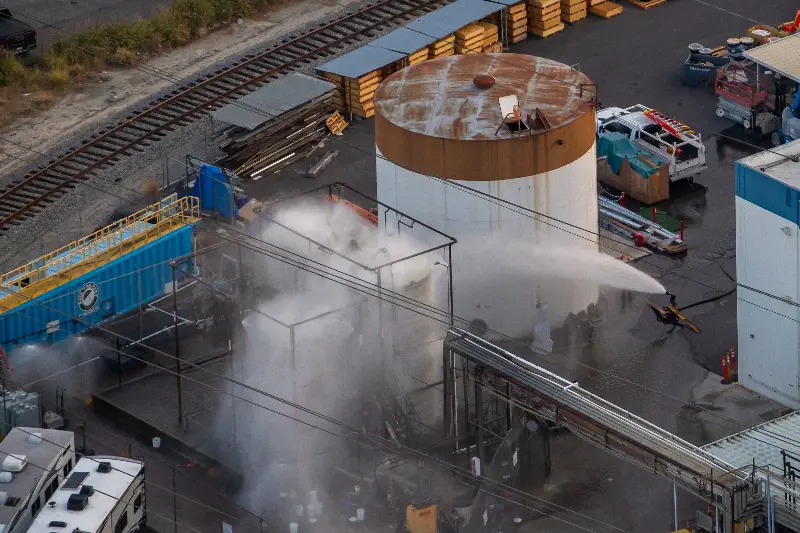
Orange County Fire Authority (OCFA) delivered “incredibly positive news” regarding the Garden Grove chemical tank emergency in Southern California on Monday, sharing that the tank, which had reached a temperature of at least 100 degrees Fahrenheit on Sunday, was beginning to cool as the threat of a catastrophic explosion had been “eliminated.”
Fire crews in Garden Grove, California, have been racing to stabilize the tank, which contains thousands of gallons of methyl methacrylate, a volatile industrial chemical used in plastics and aerospace manufacturing. The tank’s internal temperature climbed to at least 100 degrees on Sunday, which was the highest level the thermometer could record, Senator Tom Umberg said in a video update Sunday night, raising fears of a so-called “thermal runaway” reaction that could trigger a blast.
The overheating tank has forced the evacuation of over 40,000 people across Garden Grove and neighboring cities, as authorities previously warned that the situation could end either in an explosion or a large-scale chemical spill.
But even as officials caution the threat is ongoing, two developments—one structural and one environmental—are helping to lower the risk. On Monday morning, OCFA announced that the threat of a Boiling Liquid Expanding Vapor Explosion (BLEVE), the most catastrophic scenario with the chemical tank situation, had been eliminated.
“We are happy to report that the threat of a BLEVE is now off the table,” OCFA interim fire chief T.J. McGovern said in an update posted on X. “That threat has been eliminated.”
Despite this, evacuation zones are still in effect. A less catastrophic explosion could still occur, CNN reported.
Crack in Chemical Tank Provides Pressure Relief
The first break came from inside the tank itself.
Over the weekend, OCFA crews conducting a high-risk inspection discovered a crack in the tank’s structure. That crack acted as an unplanned pressure-release valve, allowing gases to escape and preventing the internal pressure from building to dangerous levels.
In Monday morning’s update, OCFA division chief Craig Covey verified that the crack had occurred and that it allowed a pressure release from the tank. Since then, the temperature has stabilized, falling to 93 degrees.
“That is incredibly positive news as we turn the corner on this incident,” Covey said.
The venting significantly reduced the risk of a catastrophic failure. A pressurized chemical tank behaves similarly to a sealed container under heat. As temperature rises, vapor pressure builds. If that pressure has no escape, the vessel can rupture violently.
Overnight Sunday, OCFA addressed false rumors circulating regarding the crack in the tank.
“We have seen reports claiming there are multiple cracks on the tank. To clarify, there is one known crack on the tank,” OCFA posted on X. “There is also peeling of the weather stripping on the exterior, but this is not an additional crack. There is currently no active leak, and continuous live atmospheric monitoring confirms there are no chemicals leaking.”
Garden Grove Weather Provides a Second Advantage
The second factor helping reduce risk is external: the weather.
While officials have focused primarily on cooling operations, environmental conditions in the area are also playing a role. Forecasts indicate that current relatively mild temperatures and limited wind activity will continue over the next few days, National Weather Service (NWS) Weather Prediction Center meteorologist Joe Wegman told Newsweek.
Over the next few days, high temperatures will be in the low 70s, with lows in the 50s. Lower ambient temperatures can slow the rate at which heat builds inside the tank, easing stress on the system and buying responders time to act. At the same time, light winds reduce the spread of any potentially hazardous vapors if small releases occur, keeping contamination more localized.
However, Wegman warned that even light winds could carry released chemicals into nearby populated areas. Wind gusts near Garden Grove are expected to top out around 20 mph over the next few days.
The calmer weather also reduces external variables that could complicate mitigation efforts, including erratic flame spread or rapid cooling inconsistencies.
Firefighters have been continuously spraying the tank with water to stabilize its temperature, a strategy that is more effective when not countered by intense heat or environmental fluctuations.
What’s Happening in Garden Grove
The Garden Grove emergency began on May 21, when a chemical tank at a GKN Aerospace facility began overheating and venting vapors into the air. A faulty valve has prevented crews from draining or neutralizing the contents, leaving them with few direct intervention options.
After that, temperatures inside the tank steadily climbed.
Methyl methacrylate is highly flammable and can produce toxic fumes, making both explosion and vapor release dangerous scenarios for nearby communities.
Authorities have described the incident as one of the most complex hazardous materials emergencies in recent California history, requiring continuous monitoring, surveillance, and coordinated response efforts across multiple agencies. Over 40,000 people have evacuated the area, with some of the evacuees describing an “unsettling” experience in which they were unable to return home to grab essentials.
“[It’s] an unsettling experience for all members in the community as we don’t know what will happen or when we can return home,” Garden Grove resident Ashley Clavijo previously told Newsweek.
Roseletty Feliciano had to purchase essentials, including clean clothes, because she only had her purse on her after evacuation orders were issued while she was at the gym. She told Newsweek she returned to find her neighborhood completely blocked off.
“Police should have given us a chance to get our things,” she said, adding that many hotels in the area were booked.
White House Responds to Chemical Tank Emergency
On Monday, a White House official confirmed that the Trump administration was “engaged” with the situation unfolding in Garden Grove.
“The President’s Administration is engaged and monitoring the situation in Garden Grove, CA. The U.S. EPA has integrated with the local Unified Command composed of state and local agencies, and has enabled air monitoring at 20 locations around the area,” the official told Newsweek. “FEMA has deployed a Liaison Officer to coordinate with officials and has also deployed a team to the State Emergency Operation Center to support incident contingency planning. FEMA has also activated the Interagency Modeling and Atmospheric Assessment Center to provide plume modeling of airborne hazards, informing incident leadership and contingency planning.”
The U.S. Environmental Protection Agency (EPA) immediately responded to the situation to offer support with air monitoring and air quality information at the request of the Orange County Health Care Agency, an EPA spokesperson told Newsweek on Monday.
“EPA has monitors located throughout the area and in the community, and all air monitors are currently showing non-detect,” the spokesperson said. “EPA is working closely with state and local authorities, including Orange County Fire Authority, the lead for this response. OCFA has reported that the tank has possibly cracked and released some pressure, removing the potential for a catastrophic explosion. Science experts are still evaluating this development.”
The federal response comes as California Governor Gavin Newsom has declared a state of emergency and requested a federal emergency declaration to unlock additional support.
Newsom said the move is intended to bring in more resources and funding to help stabilize the situation and assist displaced residents, as tens of thousands remain under evacuation orders with no clear timeline for returning home.
Newsweek reached out to Newsom’s press office by phone for comment on Monday.
State officials have mobilized emergency shelters, coordinated with federal agencies, and expanded monitoring efforts to ensure air quality remains safe outside the evacuation zone.
What Happens Next: Uncertainty Remains
Despite the emerging signs of reduced pressure, officials continue to warn that the danger is not over.
The tank remains unstable, and authorities have not confirmed whether the internal reaction has slowed or if another temperature spike could occur.
For now, evacuation orders remain in place, and crews are continuing around-the-clock operations to assess pressure levels and prepare for any outcome.