



NASA’s Artemis II mission, which was humanity’s first crewed voyage beyond low‑Earth orbit in more than 50 years, is set to conclude Friday night.
The four astronauts on the ship are returning to Earth following a landmark 10‑day journey around the Moon.
The mission will end with a high‑stakes splashdown in the Pacific Ocean off the coast of Southern California, and viewers can watch live coverage of the return beginning at 6:30 p.m. ET.
Why It Matters
NASA officials say Artemis II is a crucial proving ground for the systems and procedures needed to safely send astronauts back to the Moon later this decade.
Data gathered during the mission will inform Artemis III and later flights, which are expected to include actual lunar landings.
What To Know
Artemis II marks the most significant human spaceflight since the Apollo era and a major step toward NASA’s long‑term goal of sustained exploration beyond Earth.
Live streaming will be available on NASA+, YouTube, and multiple broadcast and streaming platforms, with splashdown targeted for approximately 8:07 p.m. ET, according to NASA.
The Artemis II mission launched on April 1 from Kennedy Space Center in Florida aboard NASA’s Space Launch System (SLS) rocket, carrying the Orion spacecraft and a four‑member crew.
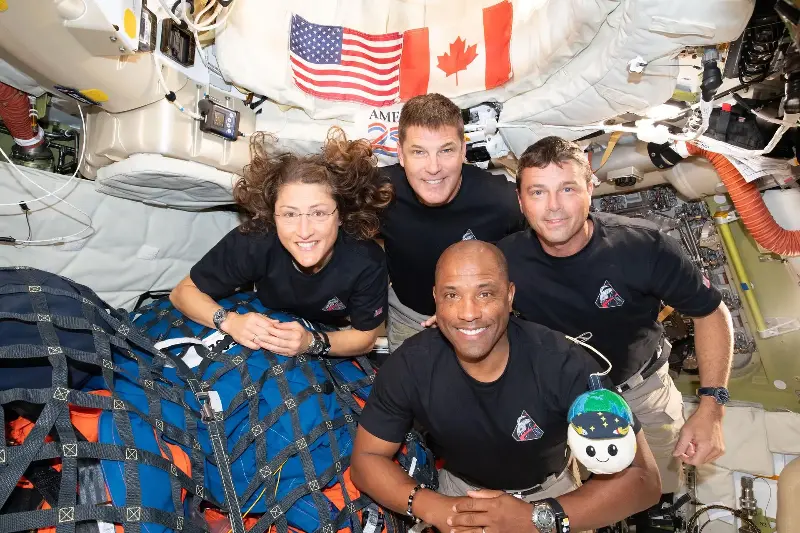
The astronauts include commander Reid Wiseman, pilot Victor Glover, and mission specialists Christina Koch and Jeremy Hansen of the Canadian Space Agency.
While they did not land on the Moon, they flew a precise “free‑return” trajectory, looping around the Moon and relying on Earth‑Moon gravity to guide them safely home while using minimal fuel.
The last time humans traveled to lunar distance was Apollo 17 in 1972.
During the mission, Artemis II has set multiple records and milestones. On April 6, the crew reached a maximum distance of more than 248,000 miles from Earth, surpassing the previous human distance record set during the Apollo 13 mission in 1970.
While flying behind the Moon, Orion briefly lost contact with Earth during a planned communications blackout, allowing crew members to observe the lunar far side, an area unseen directly by astronauts for decades. From that vantage point, the crew also witnessed a total solar eclipse as the Moon blocked the Sun from their perspective.
The astronauts captured imagery of “Earthset” rising above the Moon’s horizon and conducted detailed observations of the lunar surface, providing valuable data for future missions.
Artemis II also marked several personal firsts: Koch became the first woman to travel beyond low‑Earth orbit, Glover the first person of color, and Hansen the first Canadian to journey to the Moon.
As viewers prepare to watch the Artemis II splashdown Friday night, the astronauts remain aware that returning to Earth is widely considered the riskiest phase of the mission.
As Orion approaches Earth, it will slam into the upper atmosphere at roughly 24,000 to 25,000 miles per hour, generating extreme friction that heats the spacecraft’s heat shield to temperatures approaching 5,000 degrees Fahrenheit. During this phase, the spacecraft will experience a “plasma blackout,” cutting off communications with mission control for roughly 13 to 16 minutes.
Once through the atmosphere, a complex parachute sequence will deploy, slowing Orion from supersonic speed to roughly 17 miles per hour before hitting the ocean.
NASA is targeting splashdown at approximately 8:07 p.m. ET Friday in the Pacific Ocean off the coast of San Diego.
What People Are Saying
Artemis II commander Reid Wiseman, on X: “Nothing but gratitude for the men and women of this great nation. It is time to fly.”
Christina Koch, NASA astronaut and mission specialist, as reported by Ars Technica: “A destination is not just something we’re looking at. It is our strong hope that this mission is the start of an era where everyone, every person on Earth, can look at the Moon and think of it as also a destination.”
Victor Glover, the pilot on Artemis II, talking about launch day, as reported by Ars Technica: “It is actually a very long day. We wake up about eight hours before launch, and there’s a pretty tight schedule of things to get out there.”
What Happens Next
Following the splashdown, U.S. Navy recovery teams stationed aboard the USS John P. Murtha will secure the capsule. Additionally, Navy divers and helicopters will extract the astronauts and transport them to the ship for initial medical evaluations.
After medical checks, the crew will be flown back to shore and eventually return to NASA’s Johnson Space Center in Houston to begin their post‑mission debriefings.
Newsweek's reporters and editors used Martyn, our Al assistant, to help produce this story. Learn more about Martyn.