



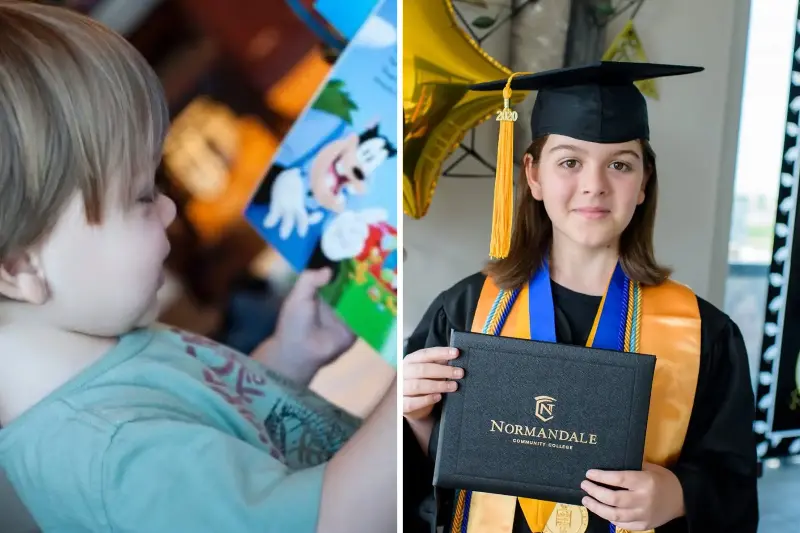
People always told me my son was smart, but I could never have dreamed what he would go on to achieve.
My son Elliott Tanner has just turned 18, an age where most boys are graduating high school and going off to college. Elliott, though, went through that almost 10 years ago.
When he was 8 years old, Elliott had completed all the high school graduation class requirements and needed something more. He can’t just stop school at 8—so we approached the local community college.
We met with the head of the math department and the dean of the STEM department, and they truly understood Elliott and welcomed him with open arms.
Elliott started full-time, on campus, just three weeks after his ninth birthday.
As his parents, my husband, Patrik, and I have always been proud of our son, but we didn’t realize at first just how advanced he was.
We would share pictures and tidbits on Facebook, and people would chime in amazed at how smart he was.
Elliott taught himself to read at 18 months old. He learned how to add and subtract aged 3, and was reading the Harry Potter series by 5 years old. All the little things added up.
He was physically advanced, too—and while the jury is out as to whether physical milestones predict giftedness, he held his head up at birth, learned to roll over at 4 weeks old, and was sitting up unassisted at 4 months old.
By 3, his favorite thing was to go to Target for workbooks, and he was doing work at a fourth-grade level.
When we realized he was gifted, we struggled to know what to do about school, what the right thing for him would be.
At first, we enrolled Elliott in a Spanish immersion school, to give him access to a third language, as we speak Swedish at home, as well as social and emotional learning opportunities by mixing with other children his age.
But he was already at a fifth-grade level across the board in the curriculum, and it wasn’t the right environment for him. We ended up pulling him out to homeschool him.
And that’s where his education accelerated.
I quickly learned that he didn’t need me to be a one-on-one teacher for him, but to facilitate his education. He loved workbooks, and would fly through every level we would get, sometimes in just days.
Instead, we started to slow down and expand by going on a lot of field trips, deep exploration in topics he was interested in—like space, where he wanted to learn everything he could, so we brought him to the Kennedy Space Center.
Hands-on projects and experiments had our kitchen looking like a science lab, and we set him up with mentors to talk to about math and science topics. He would shadow companies around Minneapolis to learn about different ways math, science, and coding worked in the world. There was just no slowing him down.
At the same time, it was important to us that Elliott was able to keep being a child. He still played with friends and experienced all the fun activities other kids would do—but he just loved learning. He would read himself to sleep with college-level textbooks. It brought him so much joy.
And Elliott thrived in college. The professors understood him and nurtured him, and students took him under their wings.
Sure, there was some surprise when a 9-year-old walked into the classroom on the first day, but the sensational part calmed down and was accepted by peers as any other student. It was, overall, a great experience.
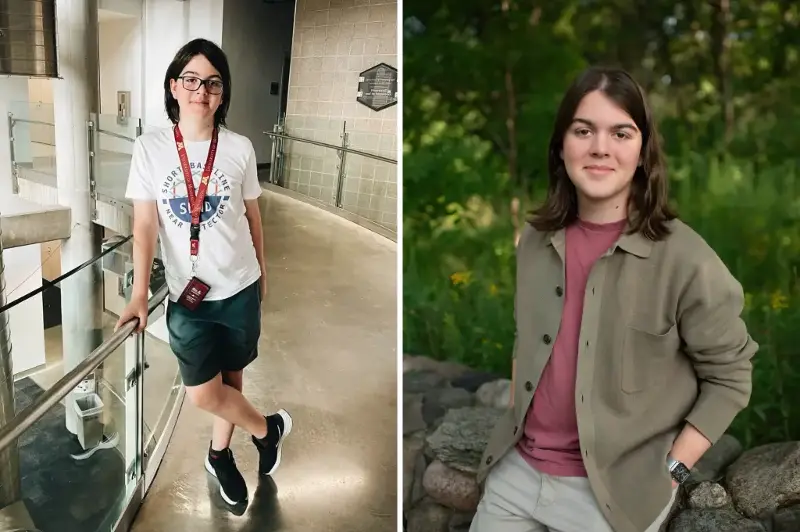
At the age of 11, Elliott graduated from Normandale Community College with an associate of science degree in math. Then, he was accepted to the University of Minnesota, where he completed a further four-year degree in physics with a math minor aged 13.
It’s already a major achievement for anyone—but Elliott was far from finished with education. He applied to Ph.D. programs and was accepted to the University of Minnesota, and, as his parents, we were relieved that we could stay in our home and not move our family across the country.
He started his Ph.D. program, where he ended up getting his Master’s degree at 15, and upgraded from Ph.D. student to candidate.
My son is now finishing up the last year of his Ph.D. journey as an experimental particle physicist researching dark matter. He holds leadership roles in graduate student organizations and serves as a teaching assistant.
He had always wanted to be a physics professor, so he is continuing in that direction—which will mean more years of research once he gets his Ph. D.—before ultimately being able to achieve that dream.
We are absolutely incredibly proud of Elliott. Not only because his passion and ability to learn are inspiring, but because he’s such a kind, down-to-earth, and caring person.
He didn’t miss out on his childhood because he had an education that met his level and pace. It only helped him thrive all around. We didn’t push, we were pulled!
Contact Newsweek editors on this story: Sirena Bergman and James Debens