



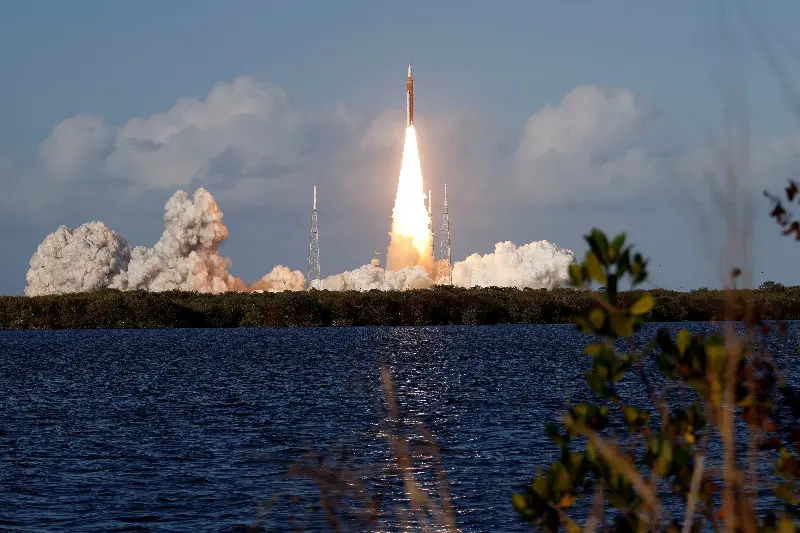
The four astronauts aboard NASA’s Artemis II mission have reached orbit around Earth, where they will spend about a day checking out the Orion capsule before beginning their journey toward the moon.
The crew is expected to remain close to Earth for roughly 25 hours, testing systems and performing early flight operations as the spacecraft circles the planet.
Later Wednesday, the rocket’s upper stage will separate, and the astronauts will manually fly Orion toward it to practice rendezvous and docking maneuvers, a key skill for future missions to the lunar surface. On Thursday night, the crew is scheduled to ignite Orion’s main engine, sending the spacecraft out of Earth’s orbit and onto a trajectory toward the moon, about 248,000 miles away.
Communication Briefly Disrupted
Mission Control briefly lost its communications link with the Orion capsule after the spacecraft switched from one tracking and data relay satellite to another. NASA officials said the issue was quickly resolved by resetting ground equipment, and communications were fully restored.
Orion Boosted Into Higher Orbit
About an hour into the flight, the rocket’s upper stage fired again, pushing the Orion capsule, Integrity, and its four‑astronaut crew into a higher orbit around Earth.
“The sun is rising on Integrity,” mission commander Reid Wiseman radioed.
Astronaut Christina Koch encountered a problem with the Orion capsule’s toilet system moments after activating it, prompting a brief consultation with Mission Control.
“The toilet shut down on its own, and I have a blinking amber fault light,” she told Mission Control.
Flight controllers advised the crew to temporarily use a handheld backup system—known as the Collapsible Contingency Urinal, or CCU—while engineers assessed the issue. The toilet, beneath a floor panel with a door and privacy curtain, is an upgraded version of a system first tested aboard the International Space Station (ISS) in 2020. One of the station’s similar toilets is currently out of service, while others remain operational.
Purpose of the Artemis II Mission
NASA’s Artemis II mission is designed as a critical test flight to prove that the agency’s new deep‑space systems can safely carry humans beyond low Earth orbit for the first time in more than five decades. The mission marks the first crewed flight of NASA’s Space Launch System rocket and the Orion spacecraft, with astronauts tasked with testing life‑support systems, navigation, communications and manual spacecraft controls during a multi‑day journey around the moon, according to NASA.
The crew will not land on the lunar surface, but the mission is intended to validate spacecraft performance before astronauts are sent on more complex missions.
Artemis II is a key step in NASA’s longer‑term plan to establish a sustained human presence on the moon and prepare for future missions to Mars. By flying astronauts on a free‑return trajectory around the moon and back to Earth, NASA aims to reduce risk for later missions that will involve lunar landings, surface operations and assembly of infrastructure in orbit.
President Donald Trump shared a message Wednesday ahead of the Artemis II mission around the moon, saying, “God bless our incredible Astronauts.”
Posting to Truth Social ahead of the Wednesday evening launch, the president praised the work of NASA and those who had worked to send a manned mission further than any before it.
Trump said that “for the first time in over 50 YEARS, America is going back to the Moon!” ahead of the mission, which will not see a lunar landing, but a loop around the moon.
“Artemis II, among the most powerful rockets ever built, is launching our Brave Astronauts farther into Deep Space than any human has EVER gone,” Trump wrote. “We are WINNING, in Space, on Earth, and everywhere in between — Economically, Militarily, and now, BEYOND THE STARS. Nobody comes close! America doesn’t just compete, we DOMINATE, and the whole World is watching. God bless our incredible Astronauts, God bless NASA, and God bless the Greatest Nation ever to exist, the United States of America!”
Artemis III, currently targeted for 2027, is planned as a crewed test flight in low Earth orbit. NASA has said the mission is intended to test rendezvous and docking operations between the Orion spacecraft and one or more commercial lunar landers, a critical capability for future moon missions.
The first crewed lunar landing under the Artemis program is expected to take place on Artemis IV, scheduled for 2028, following lessons learned from Artemis II and III. NASA says the stepped approach is designed to reduce risk as the agency works toward establishing a sustained human presence on the moon later this decade.
Reporting by the Associated Press contributed to this article.