



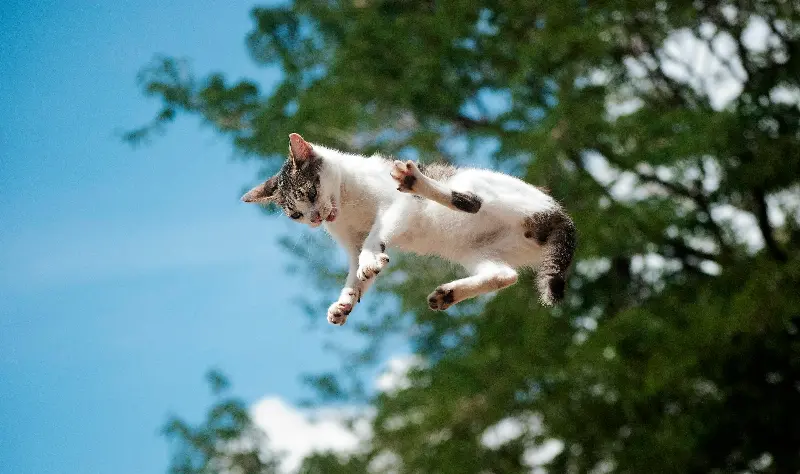
The reason why cats always land on their feet has just been revealed—and it could lead to improved spinal injury treatments in felines as well as the development of more agile robots.
A team of researchers from Yamaguchi University in Japan has discovered that this uncanny ability is all down to the thoracic spine being more flexible than the lumbar spine.
As cats tumble, their spine twists mid-air, seemingly contradicting the laws of physics. This complex maneuver, known as the air-righting reflex, protects them from serious injury during a fall.
To understand cats’ ability to perform this movement, the researchers examined the spines of five cat cadavers, separating the thoracic spine (upper/middle back) from the lumbar spine (lower back) and mechanically testing them under twisting forces to measure flexibility, strength and resistance to rotation.
They then used high-speed cameras to film two healthy cats as they dropped onto a soft cushion, placing markers on their shoulders and hips to track the movement of their body parts.
What they discovered is that the feline spine is not uniformly flexible. The thoracic spine is incredibly flexible and has a neutral zone—a range where it can twist almost freely up to nearly 50 degrees with very little effort. Meanwhile, the lumbar spine is much stiffer and acts as a stabilizer.
As they tumble mid-air, cats rotate their head and front legs toward the ground first because the thoracic spine is flexible and the front of the body is lighter. Then the back half follows, acting as a solid anchor that allows the cat to whip its front around without spinning out of control.
“These results suggest that trunk rotation during air-righting in cats occurs sequentially, with the anterior trunk rotating first, followed by the posterior trunk, and that their flexible thoracic spine and rigid lumbar spine in axial torsion are suited for this behavior,” the study authors wrote in their paper.
The findings may do more than just explain a curious pet trick. The research could improve mathematical models of animal movement, help vets treat spinal injuries and even lead to more agile robots.
Do you have a tip on a science story that Newsweek should be covering? Do you have a question about cats? Let us know via [email protected].
Reference
Higurashi, Y., Kaino, Y., Habara, M., Okamoto, S., Yoshizaki, K., Sakurai, M., & Morimoto, M. (n.d.). Torsional flexibility of the thoracic spine is superior to that of the lumbar spine in cats: Implications for the falling cat problem. The Anatomical Record. https://doi.org/10.1002/ar.70165