



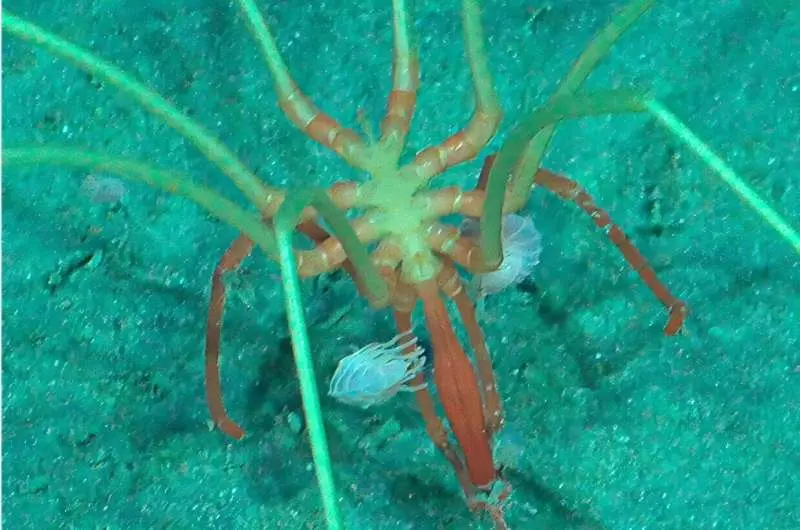
Some types of marine life appear to have it easy. While exploring thousands of meters below the waves in the Chilean Margin in the southeastern Pacific Ocean, scientists observed tiny shrimp-like crustaceans known as amphipods (Mesopleustes abyssorum) clinging tightly to much larger giant sea spiders (Colossendeis colossea) that were scuttling on the ocean floor.
Researchers led by Jorge Pérez-Schultheiss of the National Museum of Natural History of Chile were using the robotic submersible SuBastian to study deep-sea life when its cameras caught this unusual association. What made the sighting even more remarkable was that this hitchhiking behavior didn't happen just once, nor was it observed in only one location.
Uncharted waters
There is still so much about the deep sea that we do not know. Compared with shallow waters, these remote depths are relatively uncharted, leaving plenty of room for surprising new encounters.
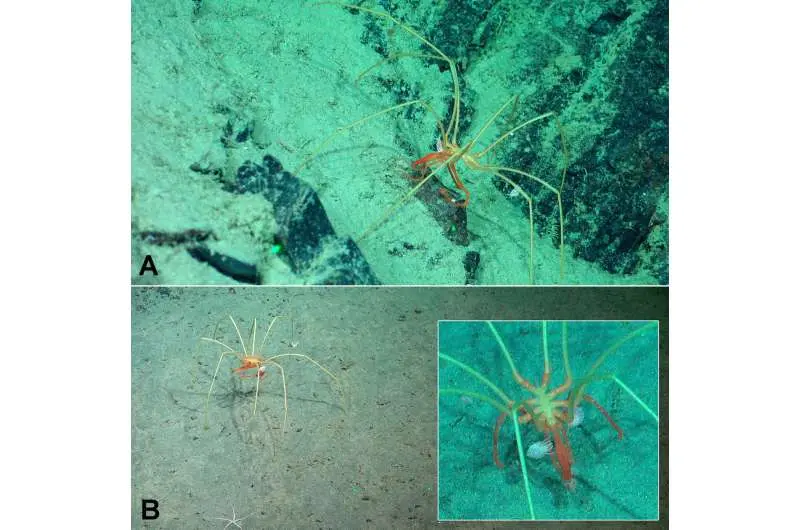
The first sighting occurred in a steep, rocky underwater canyon, 3,155 meters (10,351 feet) below the surface, as the team writes in a paper published in Ecology. Two larger individuals were attached to the sea spider's sensory and reproductive appendages, and a smaller female was farther back on one of its long walking legs.
Just four days later, the team saw the exact same behavior roughly 225 kilometers (140 miles) away at a depth of 2,698 meters (8,852 feet). There, a pair of large amphipods was tightly attached to another giant sea spider. They were using a long, claw-like structure at the end of their own limbs to maintain a firm grip. "The association may be common and widespread in the area," the scientists wrote.
Why hitch a ride?
The researchers do not yet know why this occurs, but the fact that they observed it more than once suggests that it may be more than just a random encounter. In their paper, they present a few compelling reasons why the crustaceans may be enjoying a free ride.
The amphipods could be riding sea spiders for easy transport across vast distances, as they are poor swimmers. These giant hosts may also serve as mobile meeting spots for finding mates, avoiding predators or accessing food particles in an environment where resources are scarce.
"Whether this interaction is accidental, a dispersal capacity for a nonmobile species, or a form of adaptation to seafloor environments with scarce food resources could be revealed with studies that involve more in situ observations, population genetic studies and trophic ecology," the researchers conclude.
Written for you by our author Paul Arnold, edited by Gaby Clark, and fact-checked and reviewed by Robert Egan—this article is the result of careful human work. We rely on readers like you to keep independent science journalism alive. If this reporting matters to you, please consider a donation (especially monthly). You'll get an ad-free account as a thank-you.
Publication details
Jorge Pérez‐Schultheiss et al, Hitch‐hiking in the deep sea: Amphipods embrace sea spiders in the Southeast Pacific Ocean, Ecology (2026). DOI: 10.1002/ecy.70443
Who's behind this story?

Paul Arnold
BSc Biology from University of London. BBC documentary producer with world travel experience. Freelances from southern Spain. Full profile →

Gaby Clark
MA in English, copy editor since 2021 with experience in higher education and health content. Dedicated to trustworthy science news. Full profile →

Robert Egan
Bachelor's in mathematical biology, Master's in creative writing. Well-traveled with unique perspectives on science and language. Full profile →
© 2026 Science X Network
Citation: Deep-sea crustaceans caught hitching rides on giant sea spiders (2026, September 17) retrieved 17 September 2026 from https://phys.org/news/2026-09-deep-sea-crustaceans-caught-hitching.html
This document is subject to copyright. Apart from any fair dealing for the purpose of private study or research, no part may be reproduced without the written permission. The content is provided for information purposes only.