



Just like gloves, molecules can have left- and right-handed—or mirror-image—forms. Because the left- and right-handed molecules are still very similar, scientists have had trouble separating them from each other. But a team of researchers in Japan might have found a solution. In their new study, published in Science Advances, the team successfully separated an equal mixture of mirror-image molecules created by replacing hydrogen with deuterium in one form.
Separation issues
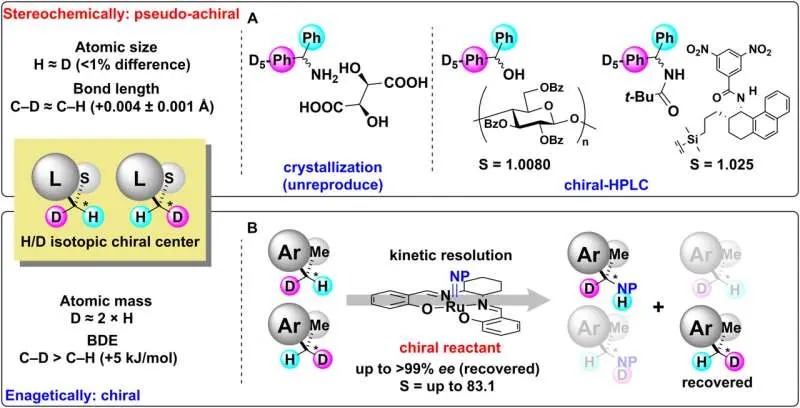
Researchers sometimes replace hydrogen in certain molecules with deuterium (H/D substitution). Deuterium is an isotope of hydrogen that contains both a proton and a neutron in its nucleus. Switching out the hydrogen in some molecules can change the properties slightly, making the altered molecule useful in applications ranging from drug development to material engineering. Yet, these mirror-image molecules, also referred to as enantiomers, are so similar that standard separation methods struggle to separate them.
The authors of the new study write, "Although recent advances in spectroscopic techniques, including anisotropic NMR in chiral oriented media, have enabled the enantiodiscrimination of certain isotopically chiral molecules, these methods are primarily analytical and do not offer a practical solution for the preparative resolution of such compounds."
Some attempts at separation were unreliable, and specialized chromatography generally provided weak separation. One attempt was more successful but required 65 passes through a recycling chromatography system. Practical separation of H/D substitution compounds has so far remained elusive. This has limited researchers to mainly making these molecules through carefully controlled synthesis rather than by separating existing mixtures.
Selective reactivity for resolving mirror-image molecules
The team involved in the new study got the idea to take advantage of a subtle difference in the bond dissociation energy between hydrogen and deuterium with carbon, which they described as "the only energetic handle available for stereochemical discrimination." The method combined a catalyst's preference for molecular orientation with the greater difficulty of breaking carbon–deuterium bonds than carbon–hydrogen bonds. This led them to find a ruthenium-based catalyst that selectively reacted with one mirror-image form faster than the other.
They tested the ruthenium catalyst on equal mixtures of isotope-created mirror images of a compound called 2-ethylnaphthalene, using a reaction that adds a nitrogen-containing group. A test with another molecule separated one form 83 times faster, indicating a large difference in reaction rates between the two forms. The recovered material was estimated to contain more than 99.9% of one mirror-image form.
Chromatography and mass spectrometry supported estimates of enrichment, and chemical conversion followed by NMR measurements independently checked one example. This separate validation example gave a measured 93:7 ratio, closely matching the predicted 94:6 ratio. This agreement also suggests that short-lived reaction intermediates largely retain information about the starting molecule's handedness.
Most enrichment values, including the strongest result, were inferred from reaction products rather than measured independently in the recovered molecules. Performance also varied substantially with molecular structure, with some compounds separating less effectively. Still, with some further testing, the method could supply isotope-labeled building blocks for pharmaceutical research. One of the molecules in the current study is used in synthesizing the diabetes drug tofogliflozin and was successfully separated in the tests, offering a promising starting point.
The study authors write, "This work thus provides a practical platform for accessing highly enantioenriched isotopically chiral molecules, thereby expanding opportunities for systematic studies of isotopic chirality and its future applications in chemistry, biology, and functional molecular systems."
Written for you by our author Krystal Kasal, edited by Gaby Clark, and fact-checked and reviewed by Robert Egan—this article is the result of careful human work. We rely on readers like you to keep independent science journalism alive. If this reporting matters to you, please consider a donation (especially monthly). You'll get an ad-free account as a thank-you.
Publication details
Tatsuya Uchida et al., Optical resolution of H/D isotopic chirality via asymmetric C–H amination, Science Advances (2026). DOI: 10.1126/sciadv.aed4187
Who's behind this story?
Krystal Kasal
Freelance science writer with Master's in physics. Five years clinical research and physics education experience. Science communicator. Full profile →
Gaby Clark
MA in English, copy editor since 2021 with experience in higher education and health content. Dedicated to trustworthy science news. Full profile →
Robert Egan
Bachelor's in mathematical biology, Master's in creative writing. Well-traveled with unique perspectives on science and language. Full profile →
© 2026 Science X Network
Citation: Mirror-image molecules are difficult to separate from their counterparts, but a new catalytic method might be the answer (2026, October 21) retrieved 21 October 2026 from https://phys.org/news/2026-10-mirror-image-molecules-difficult-counterparts.html
This document is subject to copyright. Apart from any fair dealing for the purpose of private study or research, no part may be reproduced without the written permission. The content is provided for information purposes only.