



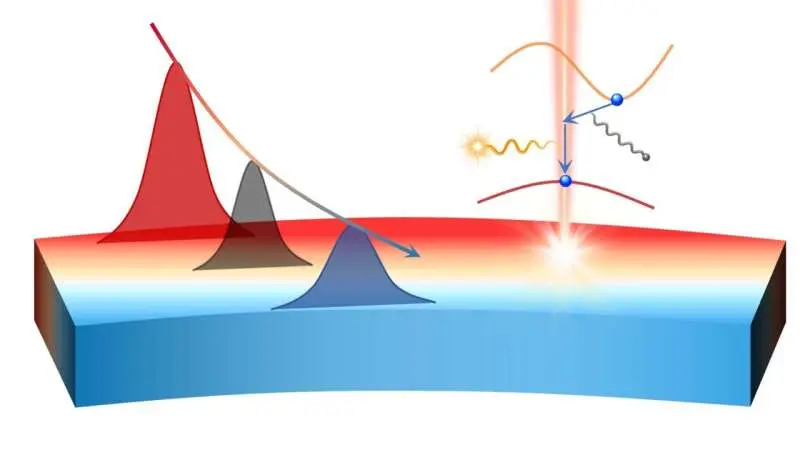
In a new Physical Review Letters study, researchers have demonstrated that bending diamond nanostructures can tune the light they emit without doping.
Diamond is an ultrawide bandgap semiconductor with high carrier mobility, high thermal conductivity, deep-ultraviolet light emission and stable single-photon emission. These properties make it a potential candidate for next-generation electronic and optoelectronic devices.
However, properties such as its bandgap and light emission are difficult to tune because doping in diamond poses limitations. Elastic strain engineering, which stretches or compresses a material without permanently deforming it, has emerged as an alternative.
But controlling strain at the nanoscale is difficult, and light emission in diamond depends on lattice vibrations called phonons, which makes the process complex.
The researchers in this study bent diamond nanoribbons to create a strain gradient, a gradual variation from compression to tension across the ribbon. Their aim was to study how the strain affects the emitted light.
Phys.org spoke with the corresponding author, Lin Yang from Peking University.
"My research explores how mechanical deformation changes atomic vibrations and energy transport in materials. This led us to ask whether those changes could also help control light emission in diamond ... The ability to bend nanoscale diamonds opened an opportunity to explore that question," said Yang.
Bandgaps, phonons and strain
Semiconductors are broadly classified into two categories based on their bandgap, the energy gap between the valence and conduction bands: direct and indirect.
In direct semiconductors, electrons can drop straight across the bandgap and emit a photon with energy equal to the bandgap. In indirect semiconductors like diamond, the electron must also change momentum, which a photon cannot supply, so it needs help from lattice vibrations called phonons.
"Phonons are packets of collective atomic vibration within a crystal ... These vibrations help determine which light-emitting transitions can occur," explained Yang.
Semiconductor properties are usually tuned through doping, but this approach works poorly in diamond.
"Many dopants bind charge carriers so tightly that they cannot be readily released at room temperature," said Yang.
Elastic strain engineering offers another route. Stretching or compressing a crystal lattice changes the spacing between its atoms, which in turn shifts its energy bands and therefore the bandgap. While bulk diamond is brittle, previous studies have shown that nanoscale diamond can withstand elastic strains of up to about 10%.
Conventional strain engineering applies uniform strain, which primarily shifts the electronic bands. How a strain gradient, which varies across a structure, affects both the bands and the phonons involved in light emission has been less explored.
Straining diamond without breaking it
The researchers started with a single-crystal, undoped diamond grown using chemical vapor deposition. This was then carved into nanoribbons using a focused ion beam while retaining the continuous crystal structure.
"A thin ribbon can bend sharply with relatively small stretching or compression across its thickness," said Yang.
The nanoribbon was bent with a microprobe, and its ends were fixed to supports using platinum to hold the bend and prevent it from springing back.
"When a ribbon bends, the outer side stretches while the inner side compresses. This changes the spacing between atoms differently across the ribbon," explained Yang.
The strain across the bent ribbon was calculated to peak at 1.49%, well within diamond's elastic limit.
To measure the electronic and vibrational properties of the bent nanoribbon, the team used scanning transmission electron microscopy combined with electron energy loss spectroscopy (STEM-EELS). In this method, a focused electron beam passes through the material, and the energy lost by the electrons reveals the local bandgap and phonon energies.
These measurements were compared with first-principles calculations of diamond's band structure under strain and molecular dynamics simulations of how phonons behave under strain gradients.
Finally, to measure the emitted light directly, the team performed cathodoluminescence measurements at 80 K (−193 degrees Celsius). They excited the ribbon with an electron beam and collected the emitted light at three positions with different strains. This allowed them to track how the energy, intensity and spectral width of the emission changed with strain.
From phonons to photons
The STEM-EELS measurements showed that the bandgap narrowed from 5.30 eV in the compressed region to 4.80 eV toward the stretched region, across a strain difference of about 1.9%. The calculations traced this to the conduction band shifting down in energy under tension, while the valence band remained nearly unchanged.
Following the bandgap, the emission peak shifted from 4.93 eV on the stretched side to 5.01 eV on the compressed side.
Phonon energies also decreased from the compressed to the stretched region, by up to about 7 meV depending on the type of vibration. This affected the brightness of the emission, which was 36% weaker on the compressed side. The researchers attribute this to the higher phonon energies there, since fewer high-energy phonons are thermally available at 80 K to assist light emission.
The simulations further showed that the strain gradient broadens the phonon spectrum. In unstrained diamond, a phonon with a given momentum has a single, well-defined energy. Under a strain gradient, the atomic spacing varies across the ribbon, so the same phonon spans a range of energies.
Correspondingly, the emission peak broadened to about 0.70 eV, compared with less than 0.20 eV in unstrained diamond.
"Together, these changes open additional pathways for light emission over a wider range of photon energies, contributing to the broader spectrum we observed," explained Yang.
Looking ahead, Yang noted that several steps remain.
"Moving toward a practical device requires integrating the diamond nanoribbon with a compact actuator that can precisely and repeatedly control its deformation," he said. "Our demonstration used an electron beam, so an important next step is to investigate whether similar control can be achieved with optical pumping or electrical injection."
The team also plans to design strain gradients that tailor the emission spectrum and to study how the emission responds as the deformation changes over time.
"Extending this approach to other wide-bandgap semiconductors would help determine how broadly the mechanism applies and identify suitable materials for mechanically tunable photonic devices," concluded Yang.
Written for you by our author Tejasri Gururaj, edited by Sadie Harley, and fact-checked and reviewed by Robert Egan—this article is the result of careful human work. We rely on readers like you to keep independent science journalism alive. If this reporting matters to you, please consider a donation (especially monthly). You'll get an ad-free account as a thank-you.
Publication details
Yuxuan Zhang et al, Phonon-Assisted Broadband Light Emission in Strain-Gradient-Modulated Diamond Nanoribbons, Physical Review Letters (2026). DOI: 10.1103/gcf5-chmf.
Who's behind this story?

Tejasri Gururaj
Freelance science writer with MS in Physics. Explores diverse scientific disciplines through research-driven writing. Full profile →

Sadie Harley
BSc Life Sciences & Ecology. Microbiology lab background with pharmaceutical news experience in oil, gas, and renewable industries. Full profile →

Robert Egan
Bachelor's in mathematical biology, Master's in creative writing. Well-traveled with unique perspectives on science and language. Full profile →
© 2026 Science X Network
Citation: Bending nanoribbons tunes diamond's light emission without doping (2026, September 30) retrieved 30 September 2026 from https://phys.org/news/2026-09-nanoribbons-tunes-diamond-emission-doping.html
This document is subject to copyright. Apart from any fair dealing for the purpose of private study or research, no part may be reproduced without the written permission. The content is provided for information purposes only.