



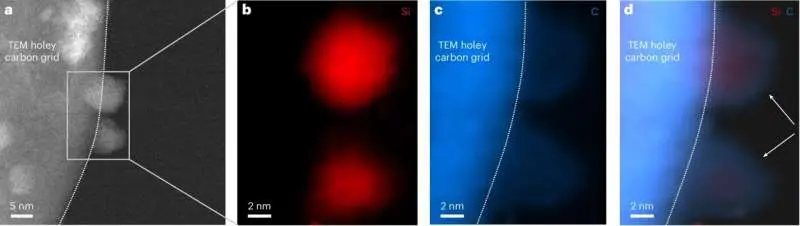
Silicon carbide (SiC) dust is one of the most important ingredients in cosmic dust, the tiny particles floating throughout the cosmos that eventually give rise to new planets and stars. This compound of silicon and carbon is forged in the atmospheres of dying stars, especially carbon-rich ones, but exactly how has long remained a mystery.
In a study published in the journal Nature Astronomy, researchers detail how they recreated the conditions of dying stars nearing the end of their lives in the laboratory to get some answers. And they discovered that hydrogen plays a pivotal role in triggering the chemical reactions that lead to the formation of silicon carbide grains.
Star in a box
Mimicking the conditions of these stars in the lab is no small feat, and the researchers spent several years designing the experiment, which included building custom-made equipment. They called it the Stardust machine, an ultra-high-vacuum system that can recreate the chemical conditions near carbon-rich dying stars, where dust formation begins.
In their experiment, they first vaporized silicon and carbon to create a hot gas of individual atoms. Then they introduced hydrogen gas at different concentrations to determine how much was needed to trigger a reaction. To identify the molecules that formed, they tracked these reactions using infrared spectroscopy and mass spectrometry.
What they found was that atomic carbon reacts with hydrogen to create simple hydrocarbons like acetylene. These then react with silicon through several chemical pathways to produce gas-phase silicon carbide (SiC2). Finally, these molecules clump together to form solid dust grains. "SiC2 was the only gas-phase precursor identified. It is considered to be a key species for the formation of silicon carbide grains in the inner layers of the envelope of C-rich stars," explained the research team in their paper.
Hydrogen is essential
Through their experiments, the scientists discovered that without high levels of hydrogen, carbon and silicon mostly stayed separate. But when it was added, the chemistry changed. "Our findings reveal the central role of molecular hydrogen in the formation of SiC2, and they contribute to a deeper understanding of silicon carbide dust formation processes in evolved stars."
Looking ahead, the researchers say their results could help improve how we interpret astronomical observations of dying stars and the chemistry of the surrounding gas. Comparing lab results with data from telescopes could also give scientists a better understanding of how silicon carbide dust forms and evolves in space, from simple molecules to solid grains.
Written for you by our author Paul Arnold, edited by Gaby Clark, and fact-checked and reviewed by Robert Egan—this article is the result of careful human work. We rely on readers like you to keep independent science journalism alive. If this reporting matters to you, please consider a donation (especially monthly). You'll get an ad-free account as a thank-you.
Publication details
Guillermo Tajuelo-Castilla et al, The important role of hydrogen in the formation of silicon carbide in evolved stars, Nature Astronomy (2026). DOI: 10.1038/s41550-026-02854-1. On arXiv: DOI: 10.48550/arxiv.2605.03575
Key concepts
Circumstellar dust


© 2026 Science X Network
Citation: Recreating dying stars reveals hydrogen's key role in cosmic dust formation (2026, May 13) retrieved 13 May 2026 from https://phys.org/news/2026-05-recreating-dying-stars-reveals-hydrogen.html
This document is subject to copyright. Apart from any fair dealing for the purpose of private study or research, no part may be reproduced without the written permission. The content is provided for information purposes only.