



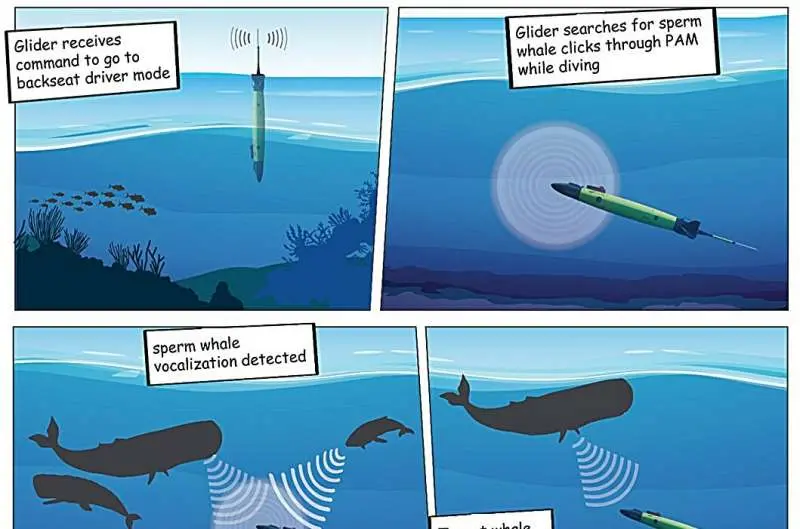
An autonomous underwater glider is giving us a new and effective way to track sperm whales by tuning into their clicks and silently following them. To study these large oceanic predators, researchers need to monitor their movements and social interactions for months at a time. But that's not easy, because they swim deep and stay underwater for long periods, making them hard to reach.
Current tracking methods have several limitations and are not without their problems. For example, tags can fall off, and boats can be noisy, which can disturb the animals. And fixed sensors moored in the water have their downsides too, because the whales can just swim away from them.
To overcome these challenges, researchers developed a tracking system that uses an autonomous underwater glider. Unlike a submarine or other underwater vehicles, it has no propeller but moves quietly by changing its buoyancy.
Developing a backseat driver
What the team did, as they detail in a paper published in Scientific Reports, was develop a system that changes the glider's course based on the sound it hears. They refer to it as a backseat driver, because it can step in and adjust the glider's behavior. So how does it work?
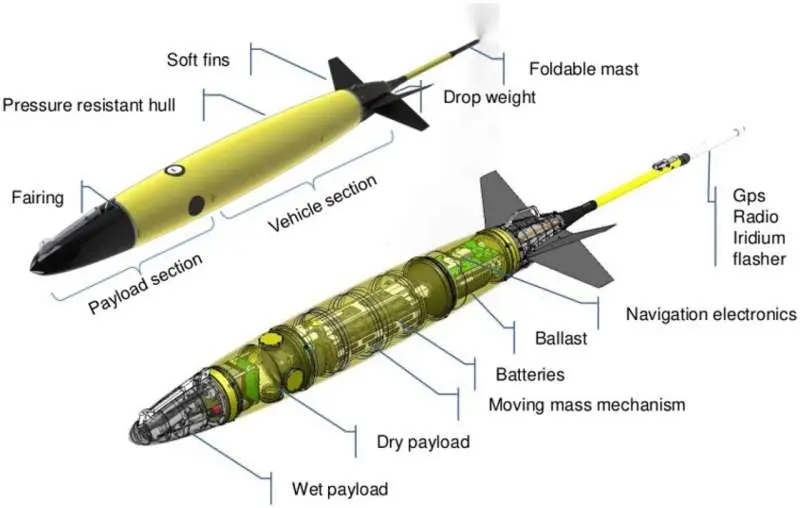
An onboard Jetson Nano computer is connected to an array of four underwater microphones (hydrophones) and detects sperm whale clicks and distinguishes them from other ocean noise.
When it hears a whale's clicks, it measures the time it takes for them to hit each of the hydrophones and calculates the direction of the animal. It then communicates with the glider's main computer to adjust its course. If several whales are clicking at once, the onboard processing software can separate the individual sources and select which one to follow.
"The glider provides a long-term record of clicks and coda signals from multiple whales while distinguishing the sources of these signals," wrote the scientists in their paper.
Sea trials
To test their system, the team first performed trials in a shallow bay off the coast of Toulon, France. They played back recorded whale clicks in a controlled experiment, and the glider successfully detected them and changed its course in real-time with little delay.
Then, in a field trial off Dominica in the Caribbean, a known sperm whale habitat, the glider demonstrated its ability to distinguish between different whales based on their clicks. "Our results demonstrated the capability to self-control the glider through acoustic event detection," added the team.
If the system is eventually deployed, it should allow scientists to collect months of valuable data, all while keeping a respectful distance to avoid changing whales' natural behavior.
Written for you by our author Paul Arnold, edited by Gaby Clark, and fact-checked and reviewed by Robert Egan—this article is the result of careful human work. We rely on readers like you to keep independent science journalism alive. If this reporting matters to you, please consider a donation (especially monthly). You'll get an ad-free account as a thank-you.
Publication details
Roee Diamant et al, Backseat driver architecture to passively follow sperm whales by their voices with an autonomous underwater glider, Scientific Reports (2026). DOI: 10.1038/s41598-026-43138-y
© 2026 Science X Network
Citation: A silent robot shadows sperm whales by listening to their clicks (2026, April 30) retrieved 30 April 2026 from https://phys.org/news/2026-04-silent-robot-shadows-sperm-whales.html
This document is subject to copyright. Apart from any fair dealing for the purpose of private study or research, no part may be reproduced without the written permission. The content is provided for information purposes only.