



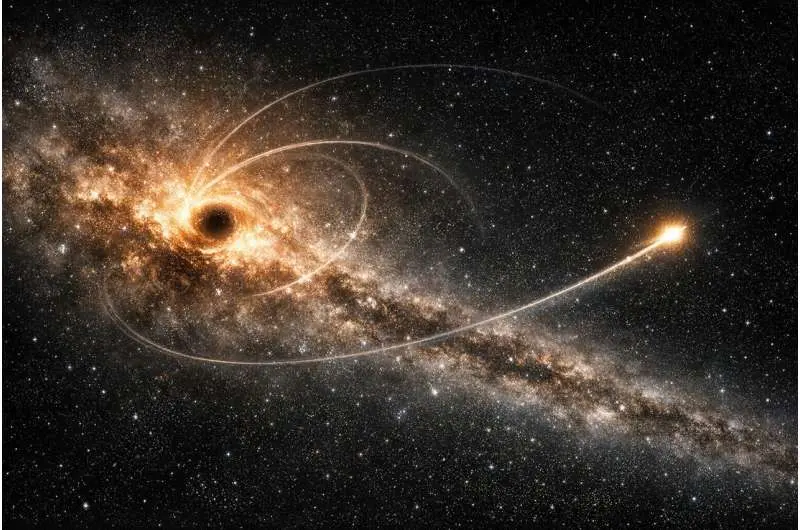
Chinese astronomers report the discovery of DESI-HVS1, which may be an old metal-poor hypervelocity star of galactic center origin. The finding, based on the data from the Dark Energy Spectroscopic Instrument (DESI) and ESA's Gaia satellite, was detailed in a research paper published April 23 on the arXiv pre-print server.
What are hypervelocity stars and where to find them?
Hypervelocity stars (HVSs) have substantially higher velocities (usually exceeding 500 km/s) than the rest of the stellar population of a galaxy, which allows them to even escape their host galaxies. They are usually produced by the so-called Hills mechanism when a binary system is disrupted by a supermassive black hole (SMBH) in the center of a galaxy.
Given that the galactic center, with its SMBH's strong gravitational potential, is one of the most dynamically extreme environments in the Milky Way, it produces frequent dynamical interactions. Due to this, it may be a good place to search for new hypervelocity stars. However, to date, only a few such stars can be directly linked to a galactic center origin, as uncertainties in distances and proper motions limit the precision of backward orbit integrations for these distant HVSs.
Ejected from the center of our galaxy
Now, a team of astronomers led by Shunhong Deng of the University of Chinese Academy of Sciences, has identified a star that may be a HVS ejected from the galactic center. They report the discovery of DESI-HVS1—an old, low-mass, metal-poor F-type star, which they classified as a HVS candidate.
"In this Letter, we report the discovery and detailed analysis of DESI-HVS1, the first candidate GC-origin HVS that is old, low-mass, and late-type, identified using spectroscopy from DESI DR1 and precise astrometry from Gaia DR3," the researchers write.
The properties of DESI-HVS1
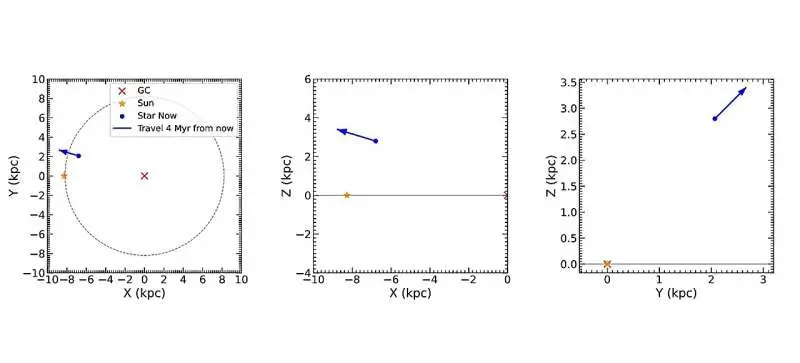
According to the paper, DESI-HVS1 is located some 12,300 light years away and has a galactocentric total velocity of approximately 523 km/s, therefore comparable to the escape speed at its position. The astronomers noted that the present-day position and velocity vector of DESI-HVS1 suggest motion away from the galactic disk and outward from the inner Milky Way.
The collected data indicate that DESI-HVS1 passed within 1,300 light years of the galactic center about 12.9 million years ago, with an inferred ejection velocity of 682 km/s. Its orbit remains strongly ballistic, exhibiting a clear turning point near the perigalacticon and only a single crossing of the galactic midplane.
The study also found that DESI-HVS1 has a mass of 0.76 solar masses, effective temperature of 6,198 K, and metallicity at a level of -1.64 dex. The age of this star is estimated to be some 14.1 billion years.
Based on these results, the authors of the paper concluded that DESI-HVS1 is the first old, low-mass and metal-poor HVS candidate consistent with a galactic center origin through the Hills mechanism. Thus, if confirmed, this discovery will extend the known population of galactic center-ejected HVSs beyond the previously identified young and massive stars.
Written for you by our author Tomasz Nowakowski, edited by Sadie Harley, and fact-checked and reviewed by Robert Egan—this article is the result of careful human work. We rely on readers like you to keep independent science journalism alive. If this reporting matters to you, please consider a donation (especially monthly). You'll get an ad-free account as a thank-you.
Publication details
Shunhong Deng et al, An Old, Low-mass, Metal-poor Hypervelocity Star Candidate Consistent with a Galactic Center Origin, arXiv (2026). DOI: 10.48550/arxiv.2604.21646
Journal information: arXiv
© 2026 Science X Network
Citation: DESI-HVS1 is an old hypervelocity star ejected from the galactic center, observations suggest (2026, May 1) retrieved 1 May 2026 from https://phys.org/news/2026-04-desi-hvs1-hypervelocity-star-ejected.html
This document is subject to copyright. Apart from any fair dealing for the purpose of private study or research, no part may be reproduced without the written permission. The content is provided for information purposes only.