



In most parts of Europe, bees have become less widespread during the last 100 years, according to a new study published in the journal Proceedings of the National Academy of Sciences.
Researchers led by Carlos Martínez-Núñez at the Doñana Biological Station in Spain analyzed more than 4 million records spanning a century to see how wild pollinators are faring across the continent.
Over the years, there have been a number of reports on the decline of bee populations from regions like Britain, Belgium and the Netherlands. What has been missing is a continent-wide picture.
Europe's disappearing bees
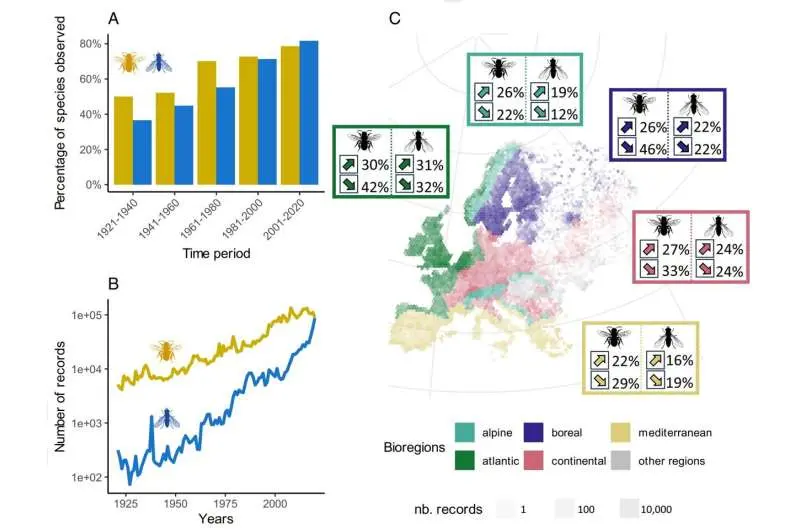
The research team gathered over 4 million records covering about 88% of European bee and hoverfly species. They tracked both the number of species and the geographical areas where insects were found. "Species richness alone provides an incomplete picture of biodiversity change," the authors write.
The results paint a complex picture.
Across Europe, bees are disappearing from places they once called home. On average, bee species have become about a third less widespread over the last 100 years. Hoverflies fared a little better, with an overall increase in their geographical spread during the last century. However, this increase appears to have occurred mainly in the earlier decades.
The Atlantic and Continental regions, covering areas like Britain, France and Central Europe, saw declines in the number of species recorded. Both regions have undergone major changes in land use over the last century, which may have contributed to these losses.
Meanwhile, bee species have disappeared from more areas in northern and southern Europe, with declines becoming more pronounced in recent decades.
While traits like body size or diet had little impact on where species were found, temperature seemed to play a small role. For example, cold-adapted bees tended to decline more steeply than warm-adapted species.
A glimmer of hope
But there was a bright spot in the data: the Alpine region. There, some warm-adapted pollinator species have spread into new areas, possibly moving up higher mountain slopes as temperatures rise.
And that wasn't the only good news to come out of the research. Over 90% of the species from historical records have still been recorded in the last two decades.
The findings could help conservationists identify which species are most at risk and where action is needed. And with so many species still surviving, there is hope that interventions can help prevent further declines and allow populations to recover.
"As many threatened pollinator species decline, targeted conservation strategies will be essential to prevent further erosion of biodiversity and pollination services."
Written for you by our author Paul Arnold, edited by Gaby Clark, and fact-checked and reviewed by Robert Egan—this article is the result of careful human work. We rely on readers like you to keep independent science journalism alive. If this reporting matters to you, please consider a donation (especially monthly). You'll get an ad-free account as a thank-you.
Publication details
Carlos Martínez-Núñez et al., Historical trends show more declining than increasing species among European pollinators, Proceedings of the National Academy of Sciences (2026). DOI: 10.1073/pnas.2600774123
Who's behind this story?
Paul Arnold
BSc Biology from University of London. BBC documentary producer with world travel experience. Freelances from southern Spain. Full profile →
Gaby Clark
MA in English, copy editor since 2021 with experience in higher education and health content. Dedicated to trustworthy science news. Full profile →
Robert Egan
Bachelor's in mathematical biology, Master's in creative writing. Well-traveled with unique perspectives on science and language. Full profile →
© 2026 Science X Network
Citation: A century of records paints a worrying picture for Europe's bees (2026, October 20) retrieved 20 October 2026 from https://phys.org/news/2026-10-century-picture-europe-bees.html
This document is subject to copyright. Apart from any fair dealing for the purpose of private study or research, no part may be reproduced without the written permission. The content is provided for information purposes only.