



Accurate experiments on how ocean warming affects marine life are vital to ensure we can best prepare for the future, protect our food sources, and help safeguard ocean ecosystems. But some of these experiments may miss how species actually respond to rising temperatures. According to a meta-analysis published in the journal Proceedings of the Royal Society B: Biological Sciences, the way these changes are studied may not match the reality of our warming seas.
To predict how marine species such as fish and coral reefs might respond to chronic ocean warming, scientists typically put them in a tank and raise the temperature. Many turn up the heat in just a few hours or days and, from these results, extrapolate how they will fare decades into the future.
While these calculations provide a baseline, they may not reflect the real world because the ocean is warming over a much longer period.
Scientists at Simon Fraser University in Canada wanted to know if the ramping rate, which is the speed at which water is warmed up in experiments, undermines their accuracy.
Ramping speed matters
To find out, they screened more than 1,000 papers and identified 48 studies with sufficient information to analyze. These studies included 175 experiments on marine life. They looked at how fast the scientists warmed the tanks and compared those speeds to marine heat wave warming rates. Additionally, they tracked health markers such as survival and the number of babies each animal had.
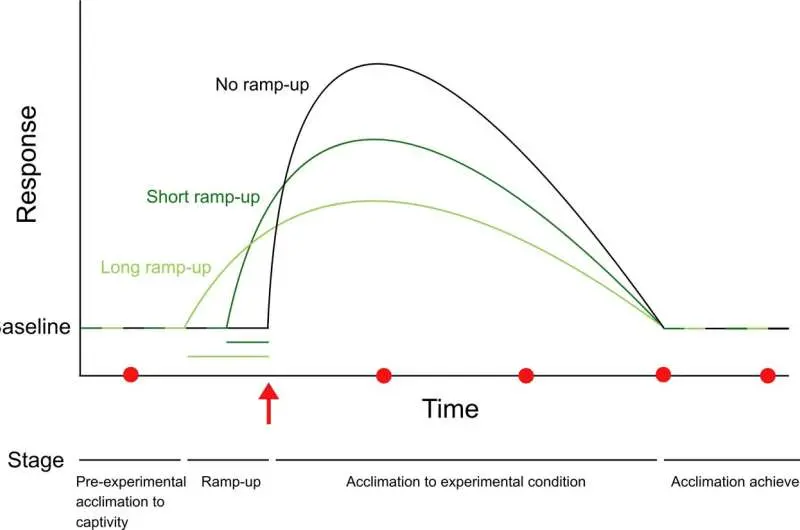
The team discovered serious flaws in many of the experiments. First, nearly half of the studies couldn't be analyzed because their authors never reported how fast they raised the temperature. Of the studies that did report it, 29% didn't use ramping. Essentially, the animals were just dropped in hot water. And where ramping was used, researchers often found that warming the water was as fast, or even faster, than natural marine heat waves.
Not getting the warming speed right results in wide-of-the-mark predictions. In experiments with abrupt warming, reproduction was often more severely affected than in gradual warming experiments, while survival generally declined regardless of warming speed. The effects of warming on different responses, such as survival and photosynthesis, also varied depending on temperature change and ramping rate.
"Experiments aiming to predict the effects of chronic warming simulate instead the effects of acute heat stress," explained the team in their paper.
Some of the 48 studies used slower, more realistic speeds. In these experiments, the results changed noticeably. For example, species that seemed less affected in fast-warming tests often had stronger negative effects when temperatures rose more gradually. The authors suggest that these slower experiments may better reflect what is actually happening in the oceans over long periods.
Rethinking how we study ocean climate change
Even so, the team that conducted the meta-analysis suggests that the best way to get an accurate picture of what will happen in the future is to study animals in their natural habitats. "Marine communities naturally exposed to predicted future conditions are likely to provide the best insights into the effects of chronic ocean warming," said the researchers.
Written for you by our author Paul Arnold, edited by Gaby Clark, and fact-checked and reviewed by Robert Egan—this article is the result of careful human work. We rely on readers like you to keep independent science journalism alive. If this reporting matters to you, please consider a donation (especially monthly). You'll get an ad-free account as a thank-you.
Publication details
Isabelle M. Côté et al, Do climate change experiments yield relevant insights into responses to chronic ocean warming?, Proceedings of the Royal Society B: Biological Sciences (2026). DOI: 10.1098/rspb.2025.2573



© 2026 Science X Network
Citation: Why ocean warming experiments may be making misleading predictions (2026, May 11) retrieved 11 May 2026 from https://phys.org/news/2026-05-ocean.html
This document is subject to copyright. Apart from any fair dealing for the purpose of private study or research, no part may be reproduced without the written permission. The content is provided for information purposes only.