



People often look to dogs' behavior, especially their facial expressions, for indications of their states of mind. Numerous studies show that this is a popular interpretation strategy. However, modern dog breeds vary greatly in size and structure, and few studies have explored how breed-specific morphology might affect humans' ability to assess visual cues from the faces of different breeds of dogs.
Now, for the first time, a collaborative research team including scientists from Israel, Czechia, and Hungary has used eye-tracking to compare the visual attention patterns of humans observing photographs of normocephalic and brachycephalic dogs. A research paper detailing the team's findings appears in Frontiers in Veterinary Science.
The popularity of brachycephalic breeds
Brachycephalic dog breeds such as bulldogs, pugs, and Boston terriers have short snouts, wide, round skulls, and large foreheads that make their faces appear somewhat flat. Such breeds have compressed airways that make them unable to breathe easily or even normally.
However, brachycephalic breeds are tremendously popular among dog owners. In the US, the American Kennel Club reports that bulldogs and French bulldogs have been among the top five most popular dog breeds among registered dogs from 2013–2025, with French bulldogs ranking as the most popular breed each year from 2022–2025.
The researchers note that the flat appearance of the faces of brachycephalic dogs "compresses the spatial arrangement of key features relative to mesocephalic and dolichocephalic breeds. These pedomorphic, infant-like proportions have been suggested to elicit nurturing responses and positive effects in human observers. However, the same structural changes may constrain the range of facial movements available for social signaling and may also alter how humans perceive their expressions."
Eye-tracking as a way of measuring human attention
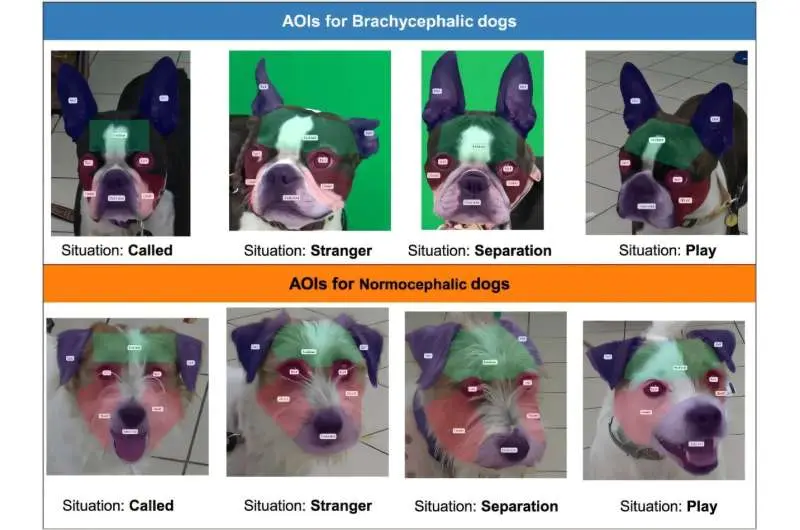
Previous research involving general quantification of human visual attention has used eye-tracking, which records where observers direct their focus while viewing a visual stimulus. The resulting analysis identifies areas of interest (AOIs) that show details of which regions were specifically viewed, how many times, and for how long.
However, finding few studies detailing human visual scanning of dogs' faces for clues about their behavior and feelings, the research team behind the current work decided to investigate the associations between dogs' craniofacial morphology and general human attention to their faces, whether observers prioritized attention to specific facial regions, and how observers' self-reported AOI prioritization compared to measurements of eye-tracking.
They worked with 44 undergraduate students (16 female, 28 male) from Braude College of Engineering in Karmiel, Israel. Twenty-three (52.3%) of the volunteers reported that they did not own a dog, while 15 (34.1%) owned normocephalic dogs, and six (13.6%) owned brachycephalic dogs.
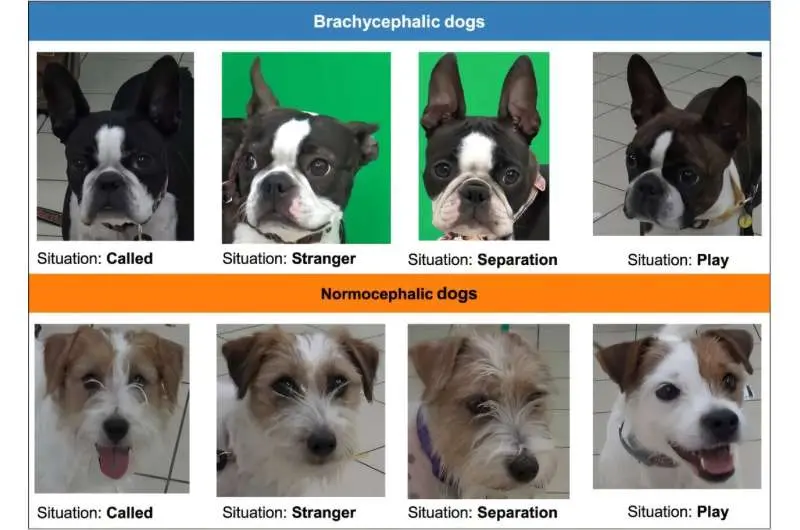
One at a time, while the researchers measured their gazes using a Tobii Pro Spark eye tracker attached to the bottom of a 24-inch display screen, the volunteers viewed images of the faces of Boston terriers (a brachycephalic breed) and Jack Russell terriers (a normocephalic breed) photographed in four different situations, two positive and two negative: called by name, play, separation from owner, and threatened by a stranger.
The volunteers answered follow-up questions about the situation they believed they were observing in each image and about the facial areas on which they had focused to evaluate each dog's internal state.
Greater cognitive processing recorded for images of brachycephalic breeds
Among the notable results, neither the volunteers' gender nor dog ownership status played a statistically significant role in the findings.
Multiple eye-tracking metrics showed that volunteers made 42% more visual visits to the brachycephalic dogs' images, recorded 46% more saccades (rapid, involuntary eye movements that shift an observer's gaze between focal points) while looking at them, and spent 45% more total time gazing at images of brachycephalic dogs than of normocephalic dogs.
However, the volunteers' average fixation time between the two breeds differed by only 1.3%. The researchers observe, "The minimal difference in average fixation duration suggests that the increased attention to brachycephalic dogs reflected more frequent sampling rather than deeper processing per individual fixation."
Furthermore, the foreheads and ears of brachycephalic dogs attracted the volunteers' attention faster than those of their normocephalic counterparts. Interestingly, volunteers also self-reported giving higher attention to the dogs' snout areas than the recordings actually reflected.
The researchers acknowledge a number of limitations within the study, including presentation of the images within a fixed order lacking counterbalancing, possible strategic (rather than spontaneous) viewing patterns resulting from the sequential image-questionnaire format, lack of context in the viewed images due to their being closely cropped to highlight the dogs' heads, and demographic homogeneity among the study volunteers.
In conclusion, the team emphasizes the importance of objectively measuring the volunteers' gaze, writing, "Substantial discrepancies emerged between self-reported and objectively measured attention: Participants fixated more on the eye region than they believed, while overestimating their attention to the snout area.
"These results highlight the communicative challenges posed by extreme breeding and indicate that humans face greater difficulty in interpreting the faces of short-nosed dogs."
Among the team's suggestions for future research are a wider breed range "spanning the cephalic spectrum to assess whether the 'intensive sampling' strategy observed here represents a general response to brachycephaly," diverse study participants, and head-mounted tracking technology.
Written for you by our author Stephanie Baum, edited by Sadie Harley, and fact-checked and reviewed by Robert Egan—this article is the result of careful human work. We rely on readers like you to keep independent science journalism alive. If this reporting matters to you, please consider a donation (especially monthly). You'll get an ad-free account as a thank-you.
More information
Julia Sheidin et al, Analysis of human-oriented facial signals of the domestic dog using eye tracker technology, Frontiers in Veterinary Science (2026). DOI: 10.3389/fvets.2026.1829873
© 2026 Science X Network
Citation: Reading brachycephalic dogs' facial expressions requires extra cognitive processing by humans (2026, May 26) retrieved 26 May 2026 from https://phys.org/news/2026-05-brachycephalic-dogs-facial-requires-extra.html
This document is subject to copyright. Apart from any fair dealing for the purpose of private study or research, no part may be reproduced without the written permission. The content is provided for information purposes only.