



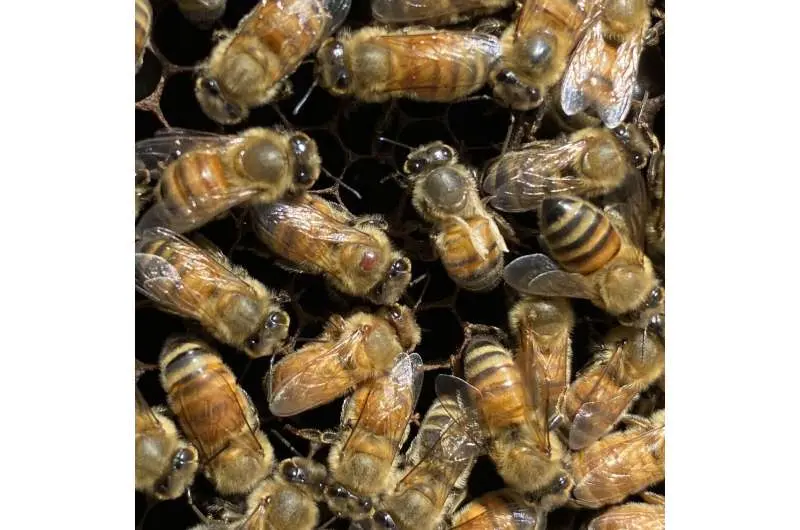
The ability to detect viruses and other harmful pathogens is highly advantageous for animals, as it can guide their behavior and prevent them from illness, and—in severe cases—death. When it comes to species that live in organized groups, such as bees, ants and some other insects, it can be even more crucial, as it can prevent the spread of pathogens across entire colonies.
Past studies suggest that honeybees (Apis mellifera) can detect contamination in their surroundings from indirect cues, such as changes in smell or taste. Whether they can directly sense the presence of viruses outside of their body, however, remains poorly understood.
Researchers at the USDA-ARS Honey Bee Breeding Genetics and Physiology Laboratory recently carried out a study assessing the ability of honeybees to pick up the presence of viruses in food sources. Their findings, published in Biology Letters, suggest that bees can in fact detect viruses in foods, and—in some cases—they even tend to prefer contaminated foods.
"Liz Walsh, ARS Research Scientist, and I initially came up with this project thinking about studies looking at how bees can be exposed to viruses at flowers and feeding sites and wondering if bees avoid contaminated food," Mike Simone-Finstrom, senior author of the paper, told Phys.org.
"Animal behavior studies are something that we both love to do and are perfect learning opportunities for students. There was an opportunity to host a high school student to work with them on a science fair project. We thought that the question of 'Can bees detect viruses in their food?' was something that we could start to address with a relatively straightforward project, then follow up on initial results if they were interesting."
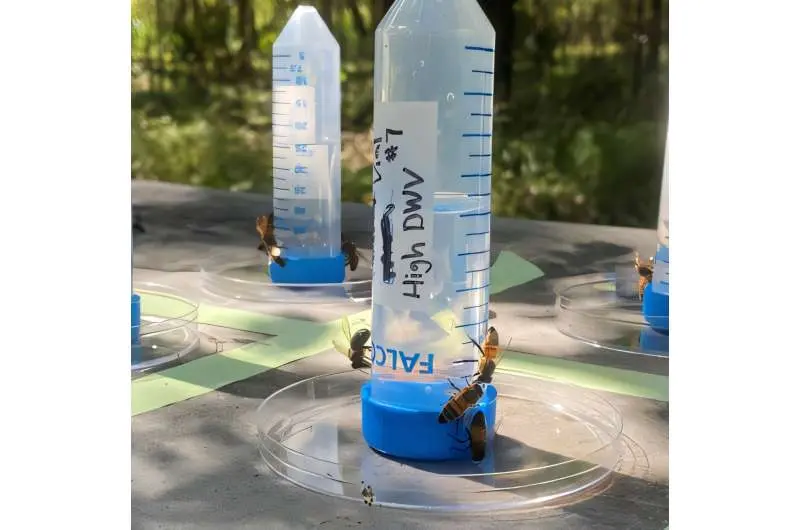
The team's bee feeding experiments
The main objectives of this recent study were to determine if bees can detect viruses in their food and if this influences their feeding behavior. More specifically, the researchers wondered, "If bees pick up hints of a virus in food, do they avoid eating it?"
Concurrently, Simone-Finstrom and his colleagues also wanted to see if results that they gathered in a laboratory setting were aligned with how honeybees behave in the wild. To do this, they combined experiments at their research facility with field observations of honeybee colonies.
"To find out if bees can detect viruses in the food and whether they avoid them or are attracted to them, we simply gave them a choice," explained Simone-Finstrom. "We put bees in cages in the laboratory and gave them the choice between control sugar syrup with no virus, or sugar syrup laced with different types of viruses that infect honey bees. We measured how much they ate of each of the two diets."
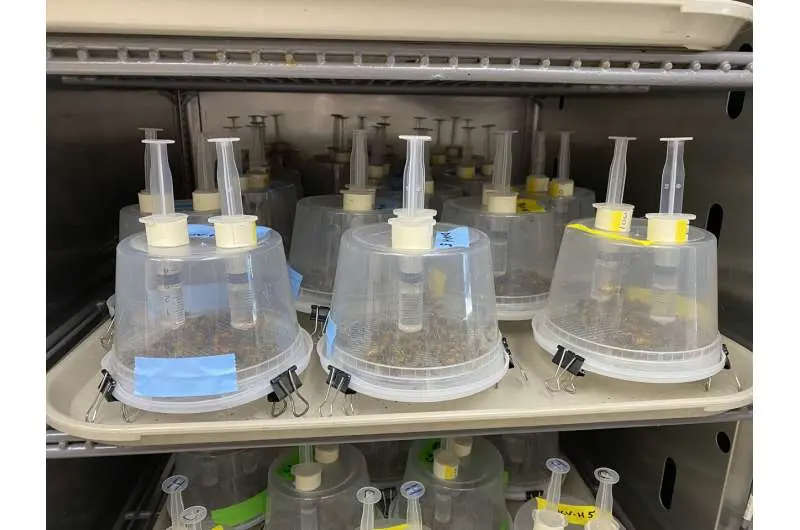
If honeybees ate the same amount of food from each diet, the researchers concluded that they had no preference, suggesting that they did not sense the presence of viruses. In contrast, if they ate more of the control syrup than the contaminated one, this would suggest that they detected the virus and avoided it.
"In the field, we did a similar test, looking at whether or not bees preferentially visited feeders at a table with different doses of virus, no virus, or just water," said Simone-Finstrom. "We counted the number of bees that visited each feeder along with how much they ate of each solution. The nice thing about a lot of animal behavior studies is that you can do this work a lot of times, just watching what the animals are doing, taking notes, and recording straightforward types of data (numbers of bees at a specific location, amount of food consumed, etc.)."
Informing future research and disease management
Overall, the results of the team's experiments suggest that honeybees do detect the presence of viruses in food sources. Surprisingly, however, detecting a virus did not always prompt them to avoid a food. In fact, in some circumstances, they appeared to preferentially choose contaminated foods.
"We did not initially suspect that they were able to do so, much less that they would then be attracted to the virus in food solutions," said Simone-Finstrom. "While we are excited and energized by our findings that were recently published, this really is just the beginning. The best experiments answer some questions while creating more, and open new avenues for research and its application to the real world."
Remarkably, the team found that bees that took on different roles within a colony responded differently to contaminated foods. For instance, nurse bees—young worker bees responsible for feeding larvae and the queen bee—tended to avoid contaminated foods in summer but preferentially fed on foods contaminated with three distinct viruses in autumn.
Forager bees—older worker bees responsible for collecting nectar, pollen, water and propolis outside the hive—appeared to consistently prefer solutions with a high concentration of a specific virus, known as the deformed wing virus (DWV).
The researchers' interesting observations could be explored further in future experiments and field studies. Ultimately, they could help to better understand what influences the feeding behavior of bees and devise new strategies to prevent or limit the spread of diseases in honeybee colonies.
"A strong body of honeybee research from many different scientists shows that bees can detect diseased individuals, but this is attributed to symptom detection rather than actually detecting the disease (or virus, in this case) itself," said Walsh. "The implications of these findings are large on both basic and applied scientific scales. For instance, these results lead to additional research questions which could help form better conservation management practices in ecosystems where insects share nectars or food sources."
The findings of this recent study also offer some indication of beekeeping strategies that could facilitate the transmission of viruses across colonies. For instance, given that bees with different roles respond differently to viruses in foods, open feeding (i.e., using the same container of sugar syrup to feed all bees in a colony), could contribute to the proliferation and transmission of viruses.
"On a basic scientific level, the current findings lead to additional mechanistic questions—how do bees physiologically detect viruses? Are some bees able to detect viruses better than others?" added Walsh. "We intend to pursue additional research based on these findings. Additional research includes plans to delve more into the mechanism bees use to detect viruses, how foraging recruitment to virus-spiked food sources works, and how much risk shared food sources have for virus transmission between colonies."
Written for you by our author Ingrid Fadelli, edited by Stephanie Baum, and fact-checked and reviewed by Robert Egan—this article is the result of careful human work. We rely on readers like you to keep independent science journalism alive. If this reporting matters to you, please consider a donation (especially monthly). You'll get an ad-free account as a thank-you.
Publication details
Alexandria N. Payne et al, Attraction versus avoidance: honeybees vary in response to virus-contaminated food, Biology Letters (2026). DOI: 10.1098/rsbl.2025.0630
© 2026 Science X Network
Citation: Bees can detect viruses in food sources, but don't necessarily avoid them (2026, May 2) retrieved 2 May 2026 from https://phys.org/news/2026-04-bees-viruses-food-sources-dont.html
This document is subject to copyright. Apart from any fair dealing for the purpose of private study or research, no part may be reproduced without the written permission. The content is provided for information purposes only.