



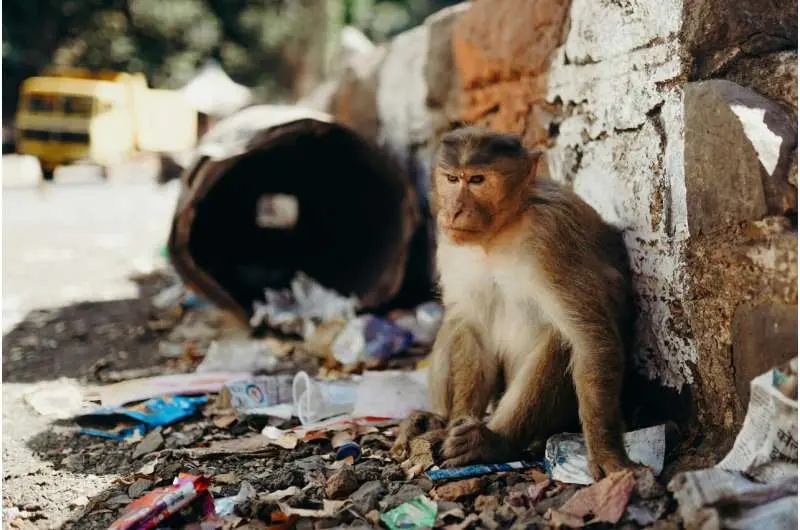
The rise in infertility is not limited to humans, as environmental stressors are quietly undermining the reproductive potential of different forms of life. A recent review published in npj Emerging Contaminants investigated how today's environmental challenges are shaping the reproductive capacity of both humans and animals.
From the analysis emerged two major forces—synthetic chemicals and warming climate—that are not acting in isolation but as a unit, placing growing pressure on fertility and fecundity (biological capacity of an organism to reproduce) across a wide spectrum of species.
The effects range from skewed sex ratios and poorer egg and sperm quality to developmental abnormalities and falling population numbers. The impact is not limited to a single generation; it carries its mark into future generations and tends to worsen when chemical exposure and climatic changes hit together.
The twin threats to fertility
Unless one is a creature living at the very bottom of the sea, escaping synthetic chemicals is next to impossible. These far-from-biologically-inert molecules, once released, find their way into living systems through the food we eat, the air we breathe, or via direct absorption into the body.
REACH—short for Registration, Evaluation, Authorisation and Restriction of Chemicals—is the European Union's primary framework for safeguarding human health and the environment from the risks posed by chemical substances. It does this by systematically assessing the safety of chemicals used in the region.
Of the 140,000 synthetic chemicals registered, more than 1,000 are known as endocrine-disrupting chemicals (EDCs), substances with chemical structures similar to those of hormones that can mimic or block natural hormones from attaching to receptors. Since hormones are key chemical messengers that regulate vital bodily processes, any interference in their signaling can disrupt metabolism, growth, and even reprogram epigenetic pathways, triggering ripple effects that can spread across species and ecosystems. These chemicals are extremely potent even at lower concentration, as the authors equate them to a whisper that is powerful enough to redirect a hurricane.
Studies show that warming temperatures, largely driven by climate change, are contributing to a global loss of biodiversity. This environmental stressor undermines the ability of living organisms to reproduce, both directly and indirectly. Rising heat can also intensify the toxicity of pollutants, causing harmful chemicals to build up to higher concentrations within an organism's tissues, where they can exert greater damage.
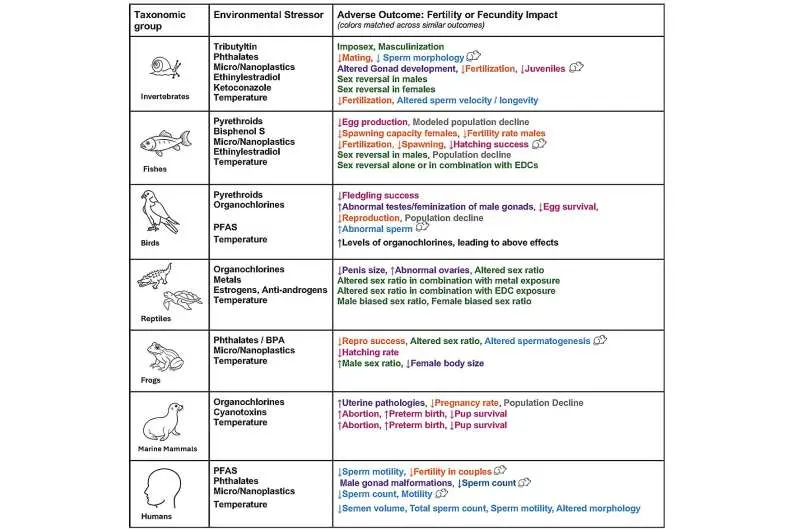
To better understand the scale of these impacts, the researchers went beyond a single species and instead compiled and analyzed a large body of existing scientific data to identify broad patterns. They drew evidence from across the evolutionary spectrum, including invertebrates, fish, birds, reptiles and amphibians, mammals, and humans.
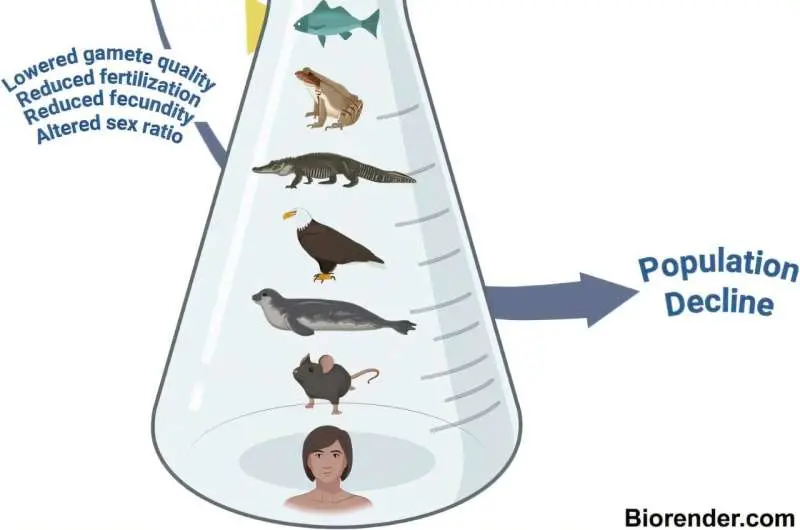
The combined burden of climate change and synthetic chemicals has left a damaging footprint on the reproductive health of nearly every life form examined in the study.
For example, a chemical used in boat paint triggers a condition called imposex in female snails, causing them to grow male reproductive organs and rendering entire populations infertile. In fish, exposure to estrogen-mimicking chemicals has caused males to develop female traits, in some cases leading to the complete collapse of local populations.
Reptiles like sea turtles rely on nest temperature to determine the sex of their offspring, and rising temperatures are now producing almost exclusively female hatchlings in some green sea turtle populations. Birds have not been spared either, as pesticides like DDT caused eggshells to become so thin they shattered during incubation, devastating huge populations of birds like the peregrine falcon. For seals and sea lions, the crisis comes from two directions: shrinking sea ice has been linked to late-term abortions and premature births, while chemical exposure has been associated with uterine tumors and lower pregnancy rates.
In humans, exposure to PFAS, which are also known as forever chemicals, has been linked to reduced chances of conception and poorer embryo quality during IVF treatments. At the same time, studies have reported the presence of microplastics in human testes and semen, with higher concentrations associated with lower sperm counts and reduced motility.
The study exposes the cross-species impacts of environmental stressors. Only coordinated global action to keep temperatures, plastics, and EDCs in check can protect our biodiversity and preserve our planetary health.
Written for you by our author Sanjukta Mondal, edited by Gaby Clark, and fact-checked and reviewed by Robert Egan—this article is the result of careful human work. We rely on readers like you to keep independent science journalism alive. If this reporting matters to you, please consider a donation (especially monthly). You'll get an ad-free account as a thank-you.
More information
Susanne M. Brander et al, Impacts of environmental stressors on fertility and fecundity across taxa, with implications for planetary health, npj Emerging Contaminants (2026). DOI: 10.1038/s44454-026-00032-6
© 2026 Science X Network
Citation: Invisible fertility crisis: Chemicals and climate change threaten reproduction across species (2026, April 28) retrieved 28 April 2026 from https://phys.org/news/2026-04-invisible-fertility-crisis-chemicals-climate.html
This document is subject to copyright. Apart from any fair dealing for the purpose of private study or research, no part may be reproduced without the written permission. The content is provided for information purposes only.