



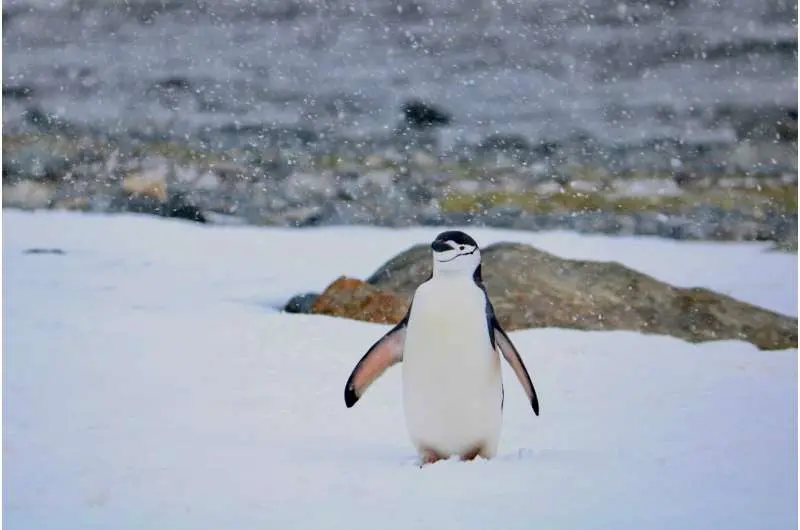
Zavodovski, a volcanic island in Antarctica, is silently witnessing a shift in the local ecosystem. Known as home to the world's largest penguin colony, this island has long been under the watchful eye of scientists. One such study has now led to a bittersweet discovery.
In 2023, a team of researchers sailed to Zavodovski Island during the penguin incubation period and documented the entire area with a drone, capturing thousands of high-resolution images that they later combined with satellite imagery collected at roughly five-year intervals between 2011 and 2025. Together, these provided the researchers with an updated view of how the island's penguin population had changed over the years.
The images revealed a steep decline in one of the island's penguin populations. Between 2011 and 2025, chinstrap penguin numbers on Zavodovski Island fell by nearly 63%, dropping from approximately 542,000 pairs to 201,000 pairs. Subantarctic macaroni penguins, on the other hand, increased by more than 28% between 2011 and 2016, becoming the island's most abundant penguin species.
The change marks the largest shift in penguin populations ever recorded at a single Antarctic location. The decline is severe enough that chinstrap penguins may need to be reclassified globally, moving from Least Concern to Endangered.
The researchers point to regional ocean warming as the main culprit, as rising temperatures have cut into Antarctic krill supplies. For chinstrap penguins, which rely almost entirely on these tiny crustaceans for food, the dwindling supply has put entire colonies under pressure.
The findings are published in Current Biology.
Living indicators of change
Antarctica remains one of the last pieces of land inhabited solely by animals, not humans. Despite being oceans away from human civilizations, the echoes of our activities reach the unique, untouched land in the form of climate change, collapsing icebergs and a rapidly changing physical ocean environment.
For decades, scientists have used penguins as an indicator of overall ecosystem health because changes in ocean temperature, chemistry, or weather patterns shift populations of krill and fish, the primary food sources of black- and white-bellied penguins, which in turn impacts them.
For this study, six researchers made the journey to Zavodovski Island to get a closer look at its enormous penguin population. They set up camp during the birds' incubation period and surveyed the nesting grounds using a multirotor drone, flying over almost the entire island.
Thousands of aerial photographs, each overlapping the next by 70%, gave researchers a detailed view of the island's penguin colonies. To investigate what was happening beyond the nesting grounds, they used satellite tags to track breeding penguins' feeding areas and compared these with fishing restrictions and ocean temperatures.
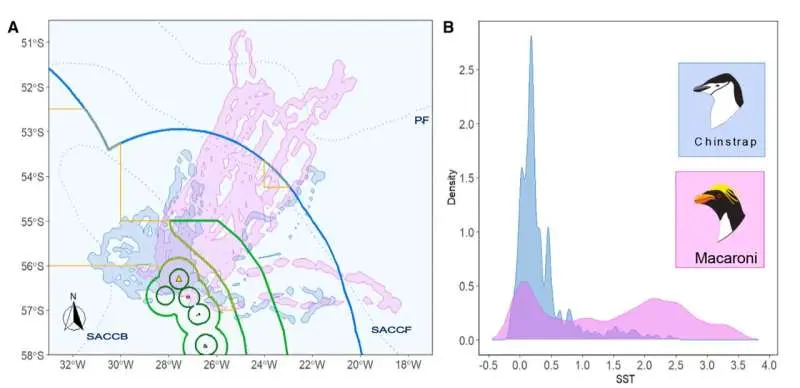
With hundreds of thousands of penguins to count, manual tallying was impractical, so the researchers developed an algorithm to process the drone images. The algorithm also distinguished the two species automatically: Chinstraps appeared bluish, with guano rings around their nests, while macaronis had darker black backs and nested more densely.
Macaroni beat the odds
The data pointed to regional ocean warming and the resulting decline in Antarctic krill as the main drivers of the chinstrap penguin collapse. The researchers found no evidence that the 2016 volcanic eruption on Zavodovski Island or competition for krill from fishing fleets, macaroni penguins or humpback whales was the primary cause. These changes show Zavodovski might be moving from an Antarctic to a subantarctic state.
Macaroni penguins have overtaken chinstraps to become Zavodovski Island's most abundant penguin species, marking the largest population shift recorded at a single Antarctic location. Their varied diet gives them more flexibility when food supplies change, and they can venture farther into warmer currents to feed. Chinstrap penguins, on the other hand, rely almost exclusively on krill, leaving them more vulnerable to food shortages that threaten their survival and breeding success.
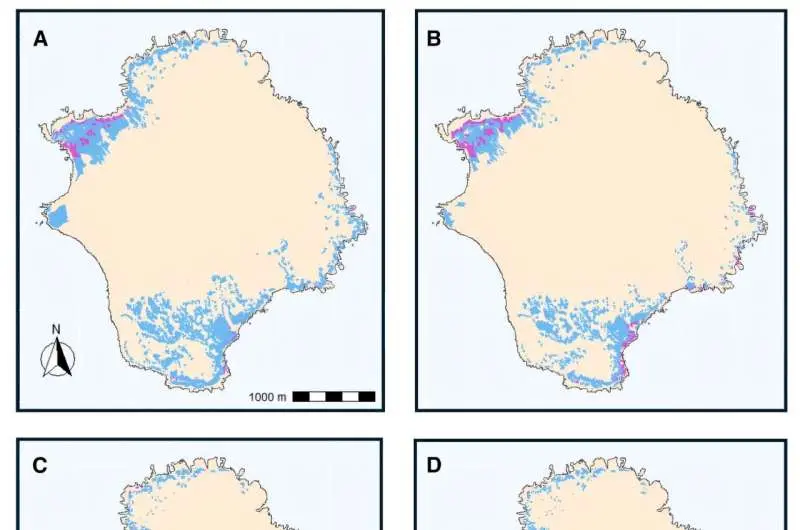
The data also revealed that Zavodovski lost more than 250,000 breeding pairs overall, so it is no longer the world's largest penguin colony. That title now belongs to the Adélie colony at Cape Adare in the Ross Sea.
Written for you by our author Sanjukta Mondal, edited by Sadie Harley, and fact-checked and reviewed by Robert Egan—this article is the result of careful human work. We rely on readers like you to keep independent science journalism alive. If this reporting matters to you, please consider a donation (especially monthly). You'll get an ad-free account as a thank-you.
Publication details
Norman Ratcliffe et al, Population declines and changes in community composition at the world's largest penguin colony, Current Biology (2026). DOI: 10.1016/j.cub.2026.09.010
Who's behind this story?
Sanjukta Mondal
Master's in Chemistry. Freelance science journalist and communicator. Published in Chemistry World, BioSpace, and The Hindu. Full profile →
Sadie Harley
BSc Life Sciences & Ecology. Microbiology lab background with pharmaceutical news experience in oil, gas, and renewable industries. Full profile →
Robert Egan
Bachelor's in mathematical biology, Master's in creative writing. Well-traveled with unique perspectives on science and language. Full profile →
© 2026 Science X Network
Citation: World's largest penguin colony loses its title after decline of more than 250,000 breeding pairs (2026, October 13) retrieved 13 October 2026 from https://phys.org/news/2026-10-world-largest-penguin-colony-title.html
This document is subject to copyright. Apart from any fair dealing for the purpose of private study or research, no part may be reproduced without the written permission. The content is provided for information purposes only.