



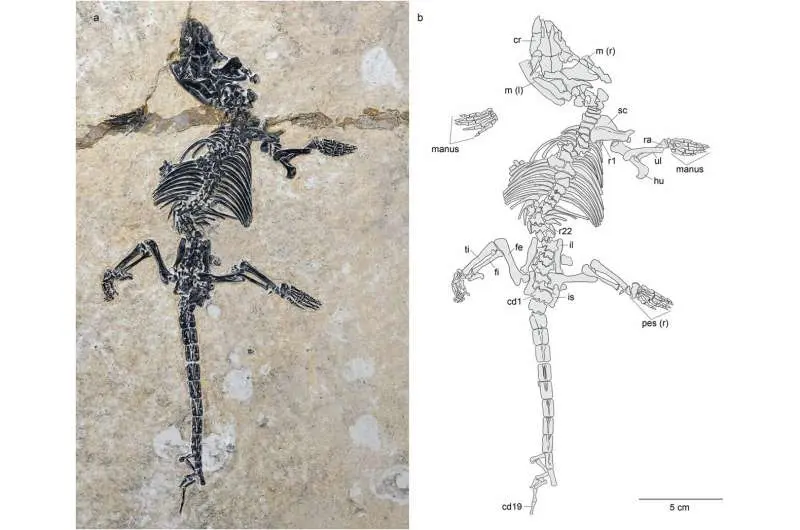
What may have looked like a cross between a platypus and a beaverlike rodent and lived around 120 million years ago? Dongoconodon platycauda, a newly discovered fossil mammal from northeastern China. Beyond its unusual features, such as evidence of webbed paddling feet and a rudderlike tail, this semiaquatic mammal had a surprise waiting for scientists in its jaw: a third generation of teeth.
Most mammals, including humans, dogs, cats and horses, are diphyodonts. That is, they get a set of baby teeth and then, later, their adult teeth. Paleontologists long assumed that having two sets of teeth evolved early in mammalian evolution. But Dongoconodon platycauda appears to upend this rule.
The fossil was recovered from the Jiufotang Formation in Liaoning, China, in 2016. To get a closer look at its features, researchers led by Shundong Bi from Yunnan University examined the skeleton using high-resolution CT scans. The team also measured its long leg bones and compared those proportions against a database of 124 living mammal species to reconstruct how it moved.
Mystery of the extra teeth
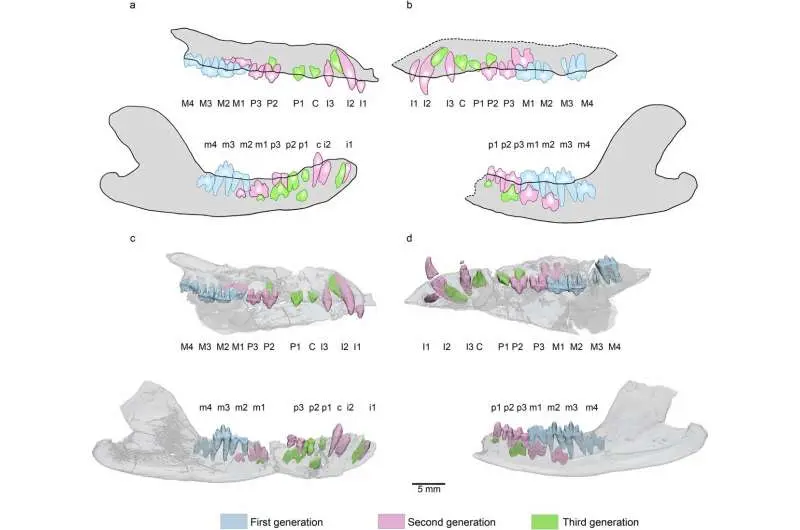
In their study published in Nature Communications, the headline discovery was evidence of three generations of teeth. Some teeth had already erupted and were being worn down by chewing, while replacement teeth were still developing inside the jawbone.
But unusually, in one position, a tiny enamel cap was found beneath a replacement tooth, suggesting a third generation was forming. Evidence of three generations appeared across all four tooth types: incisors, canines, premolars and front molar-like teeth.
A surprising connection
And that wasn't the last major surprise. Scans revealed a delicate bar of bone, known as ossified Meckel's cartilage, linking its lower jaw directly to its middle ear bones. This is considered strange because in modern mammals, these tiny ear bones are detached from the jaw and function exclusively for hearing. The fossil suggests how this separation happened, with the cartilage beginning to detach from the jaw before it separated from the middle ear bones.
When it came to moving through water, its broad hands and feet with flattened finger bones resembled the webbed feet of modern platypuses. And the boxlike tail bones closely match those of modern nutria. So the study authors believe the animal used its forefeet to paddle and its tail to steer. "The new fossil shows adaptations for semiaquatic life, with hands and feet like the platypus that were similarly webbed," wrote the research team.
Although this is all about one fossil, discovering at least two major novelties in a single specimen hints that early mammalian evolution may have been an even more experimental process. "This diversity indicates that key mammalian traits did not necessarily evolve in a tightly linked fashion."
Written for you by our author Paul Arnold, edited by Gaby Clark, and fact-checked and reviewed by Robert Egan—this article is the result of careful human work. We rely on readers like you to keep independent science journalism alive. If this reporting matters to you, please consider a donation (especially monthly). You'll get an ad-free account as a thank-you.
Publication details
Shundong Bi et al, A polyphyodont, semiaquatic eutriconodontan mammal from the Early Cretaceous of China, Nature Communications (2026). DOI: 10.1038/s41467-026-77339-w
Who's behind this story?

Paul Arnold
BSc Biology from University of London. BBC documentary producer with world travel experience. Freelances from southern Spain. Full profile →

Gaby Clark
MA in English, copy editor since 2021 with experience in higher education and health content. Dedicated to trustworthy science news. Full profile →

Robert Egan
Bachelor's in mathematical biology, Master's in creative writing. Well-traveled with unique perspectives on science and language. Full profile →
© 2026 Science X Network
Citation: One ancient swimming mammal fossil and two evolutionary surprises, including a third set of teeth (2026, October 8) retrieved 8 October 2026 from https://phys.org/news/2026-10-ancient-mammal-fossil-evolutionary-teeth.html
This document is subject to copyright. Apart from any fair dealing for the purpose of private study or research, no part may be reproduced without the written permission. The content is provided for information purposes only.