



Approximately 9,000 years ago, human communities in Southwest Asia underwent a dramatic transformation, known as the Neolithic revolution. This period was marked by pronounced changes in how they lived and sourced food, with a shift from living on the move, hunting and gathering to permanently residing in one place, farming and herding of animals.
Around that time, humans started selectively breeding and domesticating various species of animals, some of which were raised as livestock. Archaeological remains suggest that in the Zagros mountains, a mountain chain in present-day Iran, goats and sheep (collectively known as caprines), were among the earliest animals to become domesticated.
The early consumption of meat among humans is well-documented and is known to date back at least 2.6 million years ago. In contrast, uncovering signs of the consumption of milk or milk-derived products (i.e., dairy) among ancient communities has proved more challenging.
A recent paper by researchers at Muséum national d'Histoire naturelle, Université Paris-Saclay, University of Tehran, National Museum of Iran and other institutes, published in Nature Human Behaviour, offers evidence of the early use of milk and of milk-derived products among Neolithic communities living in the Zagros mountains. This evidence was gathered by analyzing fat molecules preserved in pottery and proteins trapped in dental plaque that was preserved for millennia.
"The area between the northern and central Zagros Mountains on the Iranian Plateau is a cradle for goat domestication and eastward spread of agropastoralism," Emmanuelle Casanova, Hossein Davoudi and their colleagues wrote in their paper. "However, the early exploitation of ruminant milk by pastoral communities in the Zagros remains insufficiently studied."
A cradle of goat and sheep domestication
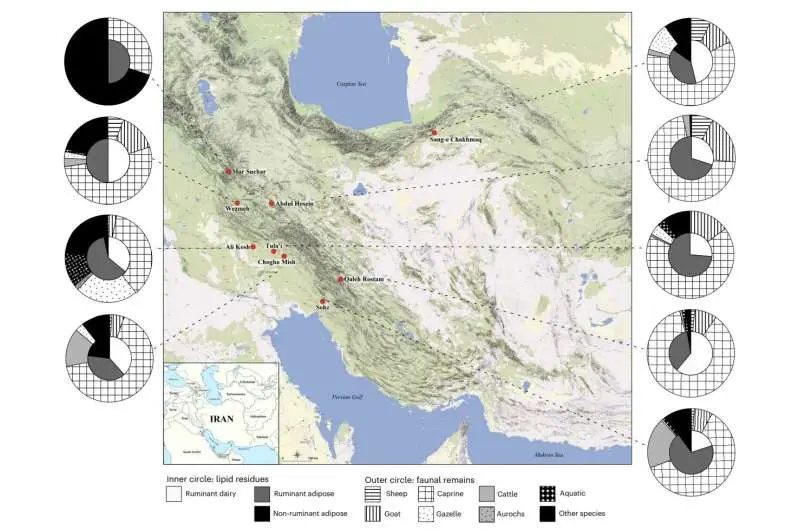
As part of their study, Casanova, Davoudi and their colleagues used chemical techniques to analyze pottery fragments that were collected from Neolithic archaeological sites in the Zagros mountain range, in Iran. They were able to extract ancient residues of fats (i.e., lipids) that were absorbed into these fragments, which appeared to have once been used to store milk-derived products.
They also analyzed dental plaque (i.e., calculus) attached to the skeletal remains of people living in the Neolithic time. They found that milk proteins had been preserved in the calculus, which offered further evidence that Neolithic populations in the Zagros mountains had consumed dairy.
"We show residues of caprine dairy products that were detected from the analysis of lipid residues in pottery vessels and protein residues in human dental calculus," wrote Casanova, Davoudi and their colleagues.
"These results, combined with the faunal spectra and radiocarbon analyses directly on the dairy residues, show that sheep and goat dairy products were widely exploited in the Zagros from the seventh millennium BC. This pattern parallels the contemporaneous exploitation of cattle milk in Anatolia. Neolithic communities in both regions reveal similarly complex dynamics of early ruminant milk use, marking the emergence of independent yet synchronous trajectories in the diffusion of agropastoral lifeways."
New signs of ancient pastoral communities
This recent study offers some of the earliest evidence of sheep and goat dairy among the Neolithic population that was residing in the Zagros mountains over 9,000 years ago. Other archaeological research carried out in the Turkish region of Anatolia offers hints of dairy consumption around the same historical period.
These works shed new light on a pivotal moment in human history, the period when humans started not only domesticating animals but also consuming their milk for sustenance. Future research could build on the recent results gathered by Casanova, Davoudi and their colleagues and set out to search for other signs of early dairy consumption in neighboring geographical regions.
Written for you by our author Ingrid Fadelli, edited by Gaby Clark, and fact-checked and reviewed by Robert Egan—this article is the result of careful human work. We rely on readers like you to keep independent science journalism alive. If this reporting matters to you, please consider a donation (especially monthly). You'll get an ad-free account as a thank-you.
Publication details
Emmanuelle Casanova et al, Caprine dairy exploitation on the Iranian Plateau from the seventh millennium BC, Nature Human Behaviour (2026). DOI: 10.1038/s41562-025-02396-y.
© 2026 Science X Network
Citation: Evidence points to early goat and sheep dairy consumption in Neolithic Iran (2026, February 20) retrieved 20 February 2026 from https://phys.org/news/2026-02-evidence-early-goat-sheep-dairy.html
This document is subject to copyright. Apart from any fair dealing for the purpose of private study or research, no part may be reproduced without the written permission. The content is provided for information purposes only.