



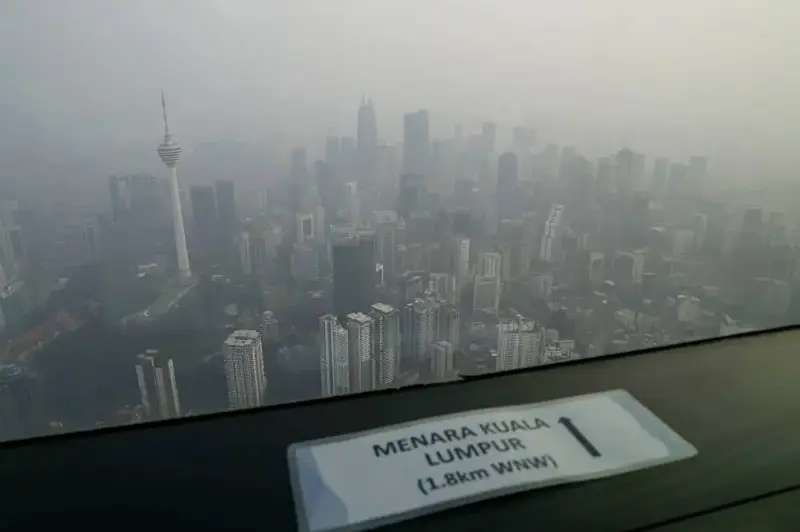
PETALING JAYA - Malaysia risks incurring losses of between RM20 million and RM50 million a day if the haze persists, due to rising healthcare costs, disruptions to economic activities and declining worker productivity.
The estimated losses, which could reach RM600 million to RM1.5 billion a month, were cited by Sunway University economics professor Yeah Kim Leng, according to a report by English daily newspaper The Star.
He said tourism and aviation were among the sectors worst affected, as air pollution could reduce tourist arrivals by up to eight per cent, while also disrupting agriculture, transportation and construction.
Yeah also referred to the 2013 haze episode, which was estimated to have caused RM1.57 billion in losses, including healthcare costs and lost income.
Malaysia University of Science and Technology economics expert Professor Emeritus Dr Barjoyai Bardai said the estimated daily losses were reasonable as an initial indicator, but did not represent a verified actual figure.
"If the haze persists for a month and daily losses are indeed between RM20 million and RM50 million, the indicative total losses could reach RM600 million to RM1.5 billion," he told Sinar.
He said the actual amount would depend on the duration of the haze, pollution levels, affected areas and businesses' ability to adapt their operations.
He added that a more accurate assessment would require data on healthcare, the workforce, tourism, transportation and agriculture to prevent the same losses from being counted more than once.
"Malaysia previously suffered losses of RM801.9 million during the August to October 1997 haze episode, including lost productivity during the state of emergency in Sarawak and a decline in tourist arrivals.
"If the RM802 million figure recorded in 1997 is adjusted using Malaysia's Consumer Price Index, it would be equivalent to approximately RM1.47 billion, based on a comparison of the annual indices for 1997 and 2025," he said.
Barjoyai stressed that the country could not simply rely on changes in wind patterns, but needed to strengthen early detection, fire prevention and enforcement cooperation with Indonesia and Asean.
"Experience from the 1997 haze and subsequent episodes shows that Malaysia should not rely solely on emergency measures once air quality has reached hazardous levels," he said.
Meanwhile, Universiti Sains Islam Malaysia public health medicine expert Associate Professor Dr Mohd Hafiz Jaafar said his study in Selangor found that increased hospital and clinic visits during the haze season resulted in additional costs of approximately RM14.6 million between 2012 and 2015.
He said the estimated national cost of haze-related illnesses rose from RM21 million in 1997 to RM410 million in 2013.
"Haze also affects the heart and blood vessels, costs that have yet to be fully accounted for," he said.
He explained that losses also increased when sick leave, lost income, student absenteeism and reduced productivity among employees who reported for work but were unable to perform their duties effectively were taken into account.
The impact is felt not only by large industries but also by families forced to bear treatment costs and lost income.
The haze threat remains as West Kalimantan, Indonesia, continues to be shrouded in smoke, with 419 hotspots detected over the 24-hour period up to Wednesday, according to Indonesian media reports citing the Meteorology, Climatology and Geophysics Agency (BMKG).