


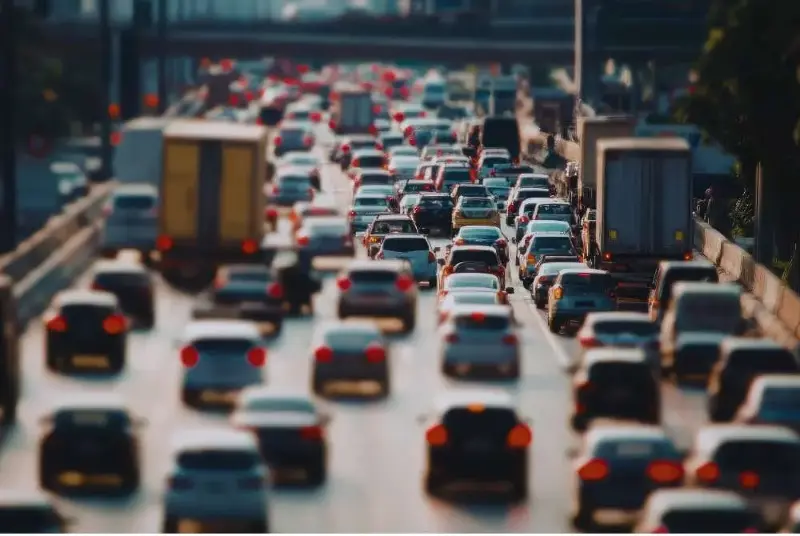
SHAH ALAM – Traffic congestion is often viewed as a daily inconvenience, but road safety experts warn that poorly assessed road designs, inadequate maintenance and driver behaviour can turn busy roads into potential accident hotspots.
They said authorities should go beyond widening roads or adding flyovers by identifying specific safety risks, particularly at junctions, merging lanes and downhill stretches where vehicles may struggle to stop safely.
Malaysia University of Science and Technology School of Transportation and Logistics dean Associate Professor Dr Khairir Khalil said heavy vehicles travelling downhill could gain momentum, creating a dangerous situation if their brakes failed, overheated or were poorly maintained.
He said drivers might not have sufficient distance to stop before reaching a queue of vehicles waiting at a red light, leaving motorists with little opportunity to avoid a collision.
"Thus, in terms of the design, there should have been sufficient length of flat road at the approach of the traffic light," he told Sinar Daily.
Khairir also highlighted the risks where traffic lanes merge or decrease in number, forcing motorists to change lanes while navigating limited space.
Queues extending into approaching traffic and vehicles turning into residential or commercial areas could create conflicts with through traffic, increasing the potential for collisions involving multiple vehicles.
He said the Public Works Department (JKR), Malaysian Institute of Road Safety Research (Miros) and relevant traffic authorities should immediately conduct comprehensive safety audits, prioritising road gradients, corner angles and radii, visibility distances and surface conditions.
Reports of sand and gravel on roads should also be investigated, he added.
While larger infrastructure projects such as additional lanes and flyovers may require time to implement, Khairir suggested immediate measures including prominent speed-limit warning signs, speed-reduction markings and flashing blue warning lights.
An emergency stopping lane for heavy vehicles could also be considered to address possible brake failures. Regular inspections should ensure that heavy vehicles comply with safety requirements covering brakes, indicator lights and load limits.
Persiaran Mokhtar Dahari in Selangor is one example of a road where congestion and accident concerns have drawn public attention.
Several accidents were reported along the road between Oct 9 and Oct 19, including a 12-vehicle crash involving a lorry and 11 cars at the Alam Budiman traffic-light junction on Oct 9, a collision involving four vehicles on Oct 16 and a lorry that overturned near the Alam Budiman exit on Oct 19.
The incidents have renewed concerns over road safety, including whether road gradients, junction layouts, traffic queues and vehicle conditions are being adequately assessed to identify and address potential hazards.
Meanwhile. Universiti Kebangsaan Malaysia traffic psychology and road safety expert Professor Dr Rozmi Ismail said accidents could result from a combination of human behaviour, road conditions, technical factors and vehicle-related issues.
He said road and technical factors accounted for around 20 to 30 per cent of accidents, while human factors could contribute to as much as 80 per cent. However, he stressed that these factors often interacted rather than operating independently.
Speeding, impatience and drivers forcing their way into queues could increase risks, particularly during congestion or adverse weather conditions.
"Road safety requires courtesy, patience and compliance with traffic rules," he said when contacted.
Rozmi said road maintenance also remained a concern, with potholes and faulty traffic lights potentially creating hazards when repairs were delayed.
He called on authorities to regularly assess road conditions, identify locations where accidents repeatedly occurred and prioritise those requiring urgent intervention.
"The authorities should not wait until an accident results in a death before taking action," he said.
He added that road improvements should be guided by studies identifying the specific problems at each location, whether they involved narrow junctions, unsafe gradients, poor road conditions or other design concerns.
Rozmi also said reducing congestion required alternatives to road expansion, particularly in urban areas where space was limited.
Better public transport could help reduce reliance on private vehicles, provided services were reliable, clean, convenient and frequent enough to meet commuters’ needs.