



The last time a Tyrannosaurus rex broke the auction record, it vanished for two years. Stan, sold at Christie’s in 2020 for $31.8 million, went to an undisclosed buyer and dropped out of public view. Palaeontologists spent that stretch not knowing whether one of the best-studied T. rex skeletons had gone into a vault forever.
On Tuesday, Sotheby’s in New York offers the next one. Nicknamed Gus, the specimen was unearthed on a ranch in Harding County, South Dakota. Bidding opens at $19 million, and its published estimate runs to $30 million or more. If it clears the top of that range, Gus becomes the most expensive fossil ever sold.
The headline number is the easy part. What the sale does to it as a scientific object is harder, and less cinematic, than “disappears from research.”
What is actually being sold
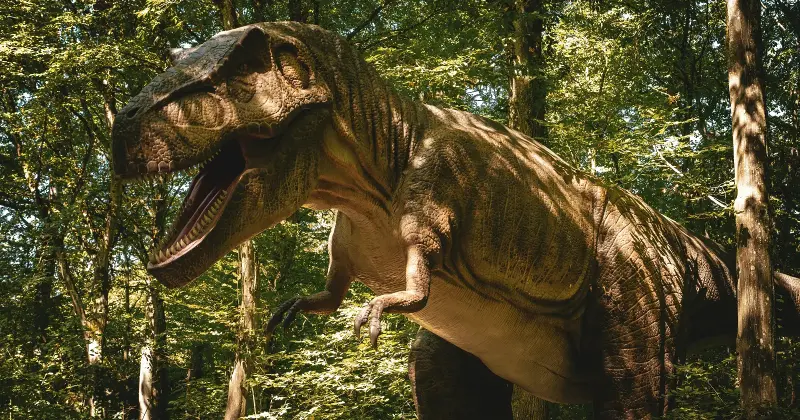
Gus is large and unusually intact. The mounted skeleton runs about 38 feet long and stands more than 12 feet tall, and its 183 bone elements make it about 61 per cent complete by bone count, or 75 to 80 per cent by mass. Sotheby’s calls it one of the most complete T. rex fossils ever found. The skull alone is 54 inches long, preserves about 82 per cent of its bones, and carries bite marks from another T. rex.
Both Sue, at roughly 90 per cent complete, and Stan, at about 70 per cent, are more complete than Gus, and both were sold at auction. Sotheby’s hedged its phrasing for good reason: Gus is one of the most complete found, not the most complete ever offered.
Provenance is well documented. The first bone, a metatarsal from the foot, turned up in 2021 on the 6,500-acre ranch of Gary and Dana Licking. Theropoda Expeditions, a Texas commercial firm, ran the dig under Thomas Heitkamp. Gary Licking, known as Gus, died in February 2022, a year into the excavation, before the full skeleton emerged. The fossil carries his name.
One detail in the listing shows how commercial this market has become. Sotheby’s is selling Gus with what it calls full rights, meaning the skeleton contains no casts scanned from other dinosaurs and no attached intellectual property. That matters because the standard way to fill gaps in a T. rex is a cast of Stan, whose scans the Black Hills Institute owns. A fossil sold clean of anyone else’s copyright is worth more.
A bone is now also a licensing question.
Why “disappear from research” is the sharper worry
What worries researchers is quieter than a fossil vanishing into a vault. A privately owned specimen cannot enter the scientific literature. The Society of Vertebrate Paleontology, the largest professional body in the field, holds in its bylaws that selling a scientifically significant fossil is not condoned unless it stays within a public trust. Its journal will not describe specimens held outside a permanent public collection, because others must be able to re-examine the material.
A specimen in a private atrium can be admired but usually not studied, published on, or checked by anyone else, which for research is close to not existing. No work has yet been published on Gus, CNN reports, because most scientists will not formally study a privately held specimen.
Stuart Sumida, a biology professor at California State University, San Bernardino and the society’s president, told CNN there is no guarantee a privately bought Gus would ever be seen publicly again. Before the Stan sale, the society had written to Christie’s asking that bidding be limited to public institutions. That request was ignored.
What Stan’s disappearance actually taught us
Stan is why the “lost forever” frame needs care. After two years off the map, the buyer turned out to be Abu Dhabi, and Stan is now the centrepiece of the Natural History Museum Abu Dhabi, which opened in November 2025 with a research programme attached.
The worst case did not happen.
The reassurance only goes so far. A private sale can land anywhere, from a public museum with scientists on staff to a collector who never lets a researcher near it. Even in Stan’s better outcome, the original skeleton’s scans remain the Black Hills Institute’s property.
The discipline is not perfectly united here either. A minority of researchers argue that legally acquired private specimens can still contribute to science and should not be off-limits. The society’s stricter line is the dominant one, but it is a position, not a law of nature.
Who can and cannot bid
At these prices, the field of buyers is short, and public science is mostly not in it. Steve Brusatte, a palaeontologist at the University of Edinburgh, has noted that no public institution can realistically compete at $30 million. Susannah Maidment, a senior researcher at London’s Natural History Museum, told CNN she has heard of private sales above $50 million.
A counterpoint is worth keeping in view. David Hone, a palaeontologist at Queen Mary University of London, has argued that a museum could dig up a specimen like Gus for a fraction of the price if a landowner worked with researchers rather than a commercial excavator. A million dollars, he told CNN, is more than enough to find and extract a T. rex. Much of the scarcity is manufactured by how these fossils reach the market.
Sue, the 1997 sale that started this era, points to the one path that has worked. She sold for $8.3 million to a public-private consortium built around Chicago’s Field Museum, with corporate money filling the gap, and has been studied ever since. That model needs partners willing to fund public access, and has not been repeated at today’s prices.
What to watch
The hammer price will lead the coverage, and the record stands at $44.6 million, set by Apex the Stegosaurus in 2024, now at the American Museum of Natural History. Whether Gus beats it is the least interesting question.
The one that matters is whether the buyer commits to keeping the skeleton where scientists can reach it. So far, that single variable decides whether Gus becomes a specimen or a trophy. It will not be settled on Tuesday night.
The post A T. rex unearthed in South Dakota could sell for up to $30 million at auction — and scientists fear that if a private collector buys it, one of Earth’s rarest records may disappear from research appeared first on Space Daily.