



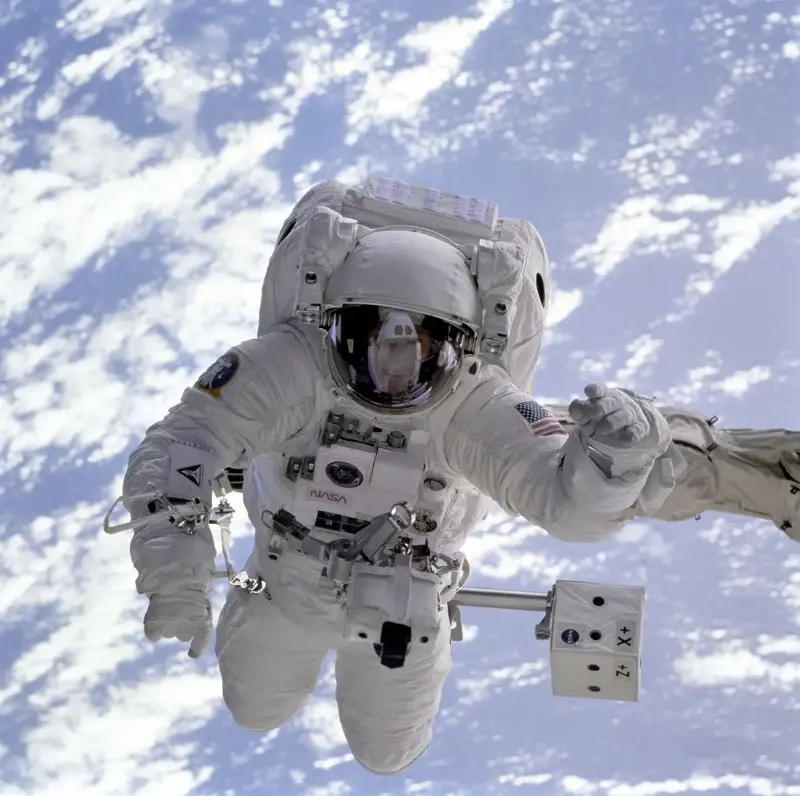
We tend to picture astronauts drifting weightlessly in “zero gravity,” as if the pull of the Earth simply stops a few hundred kilometres up. It does not. The International Space Station orbits deep inside Earth’s gravity, at an altitude where the pull is still nearly 90 per cent as strong as it is on the ground. What looks like weightlessness is something else entirely: the station and everyone aboard it are falling around the planet at about 28,000 kilometres per hour.
The distinction sounds like a technicality, but it is the whole reason orbits work, and it is worth getting straight.
Gravity does not switch off up there
The space station flies at an average height of a little over 400 kilometres. That feels high, but it is small next to the size of the Earth itself, which is about 6,400 kilometres in radius. Gravity does weaken with distance, yet over that relatively short climb it barely drops.
At the station’s altitude, Earth’s gravity is still around 90 per cent of its strength at sea level. NASA puts it in plain terms: someone who weighed 100 pounds on the ground would still weigh about 90 pounds at the top of an imaginary ladder reaching the station. If the ISS could somehow be propped up on a giant tower and held still, the astronauts inside would stand on the floor and feel very nearly their normal weight. Gravity is not missing. It is almost all still there.
So why do they float?
The answer is that the station is not being held still. It is falling, and it never stops falling.
Isaac Newton captured the idea centuries ago with a thought experiment about a cannon on a very high mountain. Fire the cannonball gently and it arcs down to the ground nearby. Fire it harder and it lands farther away, its path curving as the ground curves beneath it. Fire it hard enough and the ground curves away just as fast as the ball falls, so it keeps missing the Earth and comes all the way around. That is an orbit: a projectile falling continuously toward the planet while moving sideways fast enough to keep overshooting it.
The space station is doing exactly this. It is constantly being pulled toward the Earth, but it is travelling sideways so quickly that it never gets closer to the surface. And because the station, the crew and every loose object inside are all falling together at the same rate, nothing presses on anything else. Astronauts do not push down on the floor, so they float. It is the same sensation as the brief drop at the top of a rollercoaster, or a lift with the cable cut, except that here it never ends.
The speed is the trick
This only works because of how fast the station is going. At about 28,000 kilometres per hour, roughly 7.7 kilometres every second, the ISS laps the entire planet in around 90 minutes. Its crew see a sunrise or sunset about every 45 minutes, some 16 of each in a day.
That sideways speed is the crucial ingredient. Slow the station down and its curved fall would no longer match the curve of the Earth, and it would spiral back toward the ground. Fast enough, and the fall becomes a permanent circle. Weightlessness is not the reward for leaving gravity behind. It is the reward for going sideways quickly enough to keep falling past the horizon.
Why scientists say “microgravity”
Because gravity is clearly still acting, researchers avoid the phrase “zero gravity” and use microgravity instead. Inside a freely falling spacecraft the apparent gravity is not exactly nothing, but it is tiny, on the order of a millionth of what we feel on the ground. Small residual forces remain, from the faint drag of the thin upper atmosphere, from tides across the length of the station, and from the crew simply moving about.
That leftover atmospheric drag has a real consequence. Even at 400 kilometres the air is not a perfect vacuum, and it slowly saps the station’s speed, lowering its orbit over time. Left alone, the ISS would gradually sink and eventually reenter. To prevent that, it is periodically nudged back up to a higher orbit, a reminder that even the fastest fall is not entirely free.
Why the distinction matters
Getting this right is more than pedantry. It explains why anything in low orbit is always, in a sense, falling, and why spacecraft need real speed rather than mere height to stay up. It is why the same weightless feeling can be produced for half a minute at a time in aircraft that fly steep dives, the so-called vomit comets, without going anywhere near space. And it clarifies that the effects microgravity has on the human body, the loss of bone and muscle and the shifting of fluids toward the head, come from that endless free fall, not from any distance from the Earth.
So the next time astronauts appear to hang motionless in their cabin, it is worth remembering what is actually happening. They are not floating in an absence of gravity. They are plunging around the world at nearly eight kilometres a second, and simply never landing.
The post We think of astronauts as floating in zero gravity, but the International Space Station is still deep inside Earth’s pull, where gravity is nearly 90% as strong as it is on the ground. What looks like weightlessness is really the station and its crew falling around the planet at about 28,000 kilometres per hour. appeared first on Space Daily.