



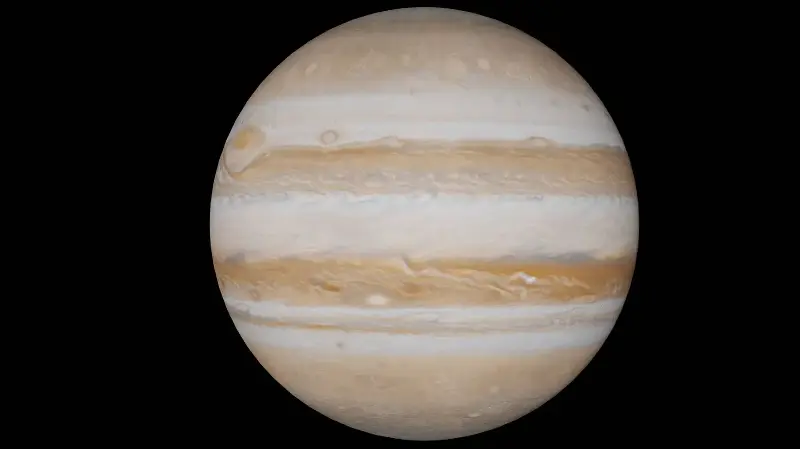
Jupiter was roughly twice its current size, and by some estimates as much as two and a half times, around 3.8 million years after the solar system’s first solid material formed. That is the central finding of a study by Konstantin Batygin of Caltech and Fred C. Adams of the University of Michigan, published in Nature Astronomy on 20 May 2025, which also puts the planet’s magnetic field at that time at around 50 times its present strength.
Reading the size off two small moons
The researchers did not model Jupiter’s formation directly. Instead they worked backward from something measurable today: the orbits of Amalthea and Thebe, two small moons that circle Jupiter closer than Io. Those orbits carry a slight tilt, the residue of gravitational nudges from Io and Jupiter’s other large moons accumulated over billions of years.
By calculating how much tilt Io’s tugging could have produced over that time, and comparing it with the tilt actually observed, Batygin and Adams could work out what Jupiter’s angular momentum, spin and internal structure needed to be when those moons’ orbits were established, near the point when the solar nebula, the disc of gas and dust that fed the young planets, was dissipating. That calculation implied a larger, faster-spinning young Jupiter with a radius of roughly two to two and a half times its current 69,911 kilometres.
The approach’s main strength, according to Caltech’s summary of the paper, is that it avoids the usual soft spots in planet formation modelling: assumptions about gas opacity, the rate at which the planet accreted material, or the mass of its rocky core. Angular momentum, by contrast, is conserved and directly tied to orbital geometry that can actually be observed.
Where the stronger magnetic field comes from
A magnetic field 50 times stronger sounds like an odd side effect.
It follows fairly directly from the size finding. Jupiter’s field is generated by convection in its interior, in a layer of hydrogen compressed to the point that it conducts electricity like a metal. A larger, hotter, faster-spinning young Jupiter, still flush with the heat of its own formation, would have driven that convection far more vigorously than the older, more settled planet does now. Batygin and Adams put the young field at around 21 millitesla, versus roughly 0.4 to 0.5 millitesla today.
A field that strong would have carved out a considerably larger magnetosphere around the infant planet, with consequences the paper does not attempt to fully trace, for how charged particles, dust and the moons themselves were arranged in Jupiter’s immediate surroundings during that period.
A separate, older claim: the planet is still shrinking
Coverage of the study has often paired it with a second claim: that Jupiter is presently shrinking by around 2 centimetres a year. That figure is real, but it is not something this study measured, and it should not be read as a continuation of the dramatic early contraction the paper describes.
The 2-centimetre figure comes from Caltech’s own public outreach materials on Jupiter and Saturn, and rests on the Kelvin-Helmholtz mechanism: a gas giant with no solid surface generates heat as it slowly contracts under its own gravity, radiating away more energy than it receives from the sun. This is a long-established idea in planetary physics, not a new result.
It is also less settled at the level of precision that “2 centimetres a year” implies. Different assumptions about Jupiter’s present internal heat flow, a quantity first pinned down by Voyager’s infrared measurements in the early 1980s and refined since, produce contraction estimates that vary considerably depending on which flux value a given calculation uses.
What is well established is the mechanism and its direction: Jupiter is still slowly losing the heat left over from its formation, and that loss is accompanied by continued, gradual contraction. The exact current rate, and when this slower phase of shrinking began relative to the far larger contraction described in the new study, is not something Batygin and Adams’ paper addresses.
What the finding is useful for
The value of pinning down Jupiter’s early radius and field strength is less about Jupiter in isolation and more about the constraints it places on everything that formed around it. Jupiter’s gravity shaped the orbits of the other giant planets and helped determine which smaller bodies were flung out of the solar system entirely and which settled into stable paths. A benchmark for the planet’s size and magnetic environment at the moment the solar nebula cleared gives modellers of that broader process a fixed point to work from, rather than a range of formation scenarios that were previously difficult to distinguish between.
Batygin has described the result as a benchmark rather than a final answer, one that narrows how the solar system’s early history can be reconstructed without resolving every open question about how Jupiter itself came together in the first place.
The post We tend to think of Jupiter as permanently giant, but a 2025 study found it used to be twice its current size, with a magnetic field 50 times more powerful, and it is still quietly shrinking by about 2 centimetres every year appeared first on Space Daily.