



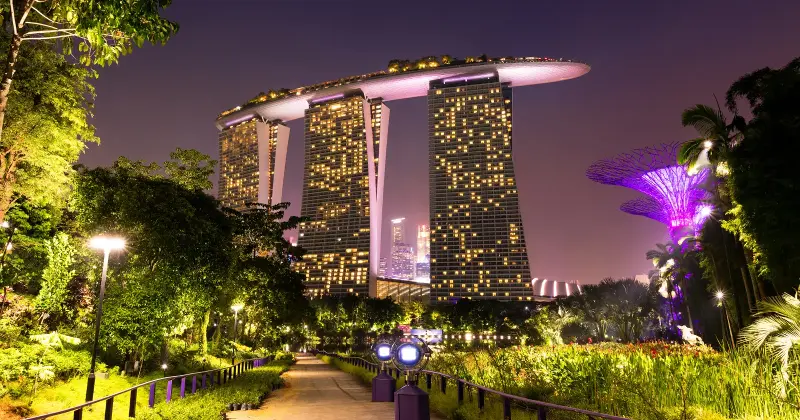
Singapore is approximately 730 square kilometres in area, smaller than the city of London and substantially smaller than metropolitan New York. Its resident population is approximately 5.9 million people. By every standard measure of urban geography, it is one of the most densely populated countries on Earth.
It is also, by every standard measure of urban greening, one of the most heavily forested. Approximately 47 per cent of the country’s total land area is covered by some form of vegetation, distributed across more than 300 parks and four nature reserves. The comparable figure for most major world cities is between 10 and 25 per cent. London is approximately 21 per cent. New York is approximately 24 per cent. Tokyo is approximately 8 per cent.
The combination is not accidental.
The decision
On 16 June 1963, the founding Prime Minister of Singapore, Lee Kuan Yew, planted a Mempat tree at a traffic roundabout known as Farrer Circus. Singapore’s per-capita GDP at the time was comparable to that of a sub-Saharan African state. The country had no natural resources, no agricultural hinterland, and a population of approximately 1.8 million people.
Four years later, on 11 May 1967, Lee announced what he called the Garden City vision. The policy was unusual by the standards of contemporary post-colonial development planning. Most newly independent states in the 1960s prioritised industrial infrastructure, housing, and sanitation, in roughly that order. Urban greenery, where it appeared at all in development plans, was treated as a decorative concern that could be addressed after the more pressing economic priorities had been resolved.
Lee took the opposite view. He decided that trees were not decoration. They were infrastructure, on the same level of seriousness as the port and the airport, and the country would invest in them accordingly.
The results of that decision, sixty years later, include the highest urban green cover in the world, a wildlife recovery that has brought species back to the country that had been considered locally extinct for decades, and a national policy framework that has now been turned, with substantially less success, to the problem of feeding the country.
What came back
The Garden City programme produced an outcome that none of its original designers had specifically anticipated. Smooth-coated otters, presumed locally extinct in Singapore for most of the late 20th century, returned in 1998 and have grown to a population of more than 170 individuals. Oriental pied hornbills, functionally extinct in the country by the 1960s, re-established a breeding population in the early 2000s. Long-tailed macaques, which had survived the country’s mid-20th-century deforestation in remnant forest patches, recovered to the point where the species’ increasingly confident urban presence is now a recurring management challenge.
The Garden City vision Lee Kuan Yew articulated in 1967 has, in retrospect, turned out to be substantially more biologically consequential than its founder seems to have anticipated.
The next problem
The success of the trees has prompted the Singaporean government to attempt to apply the same approach to a substantially more difficult problem.
The country produces less than 10 per cent of its food domestically and imports more than 90 per cent of what it consumes. In 2019, the Singapore Food Agency announced what it called the 30 by 30 target, committing the country to produce 30 per cent of its nutritional needs locally by 2030.
The trees were one thing. Food has turned out to be substantially harder.
How Singapore is attempting to do for food what it did for trees, what the 30 by 30 target has actually achieved, why the government is currently reviewing whether the target is still reachable, and what the country’s experiment tells us about the practical limits of urban self-sufficiency, is the subject of our companion video on Singapore’s experiment in growing food where there is no land to grow it.
This short video traces what happened next.
The post Singapore has the highest green cover of any major city on Earth at 47 per cent, achieved through a deliberate six-decade urban forestry programme that began in 1967 when the country’s founding Prime Minister decided that trees were essential infrastructure, and the country is now attempting to apply the same approach to food production, with substantially less success than the trees appeared first on Space Daily.