



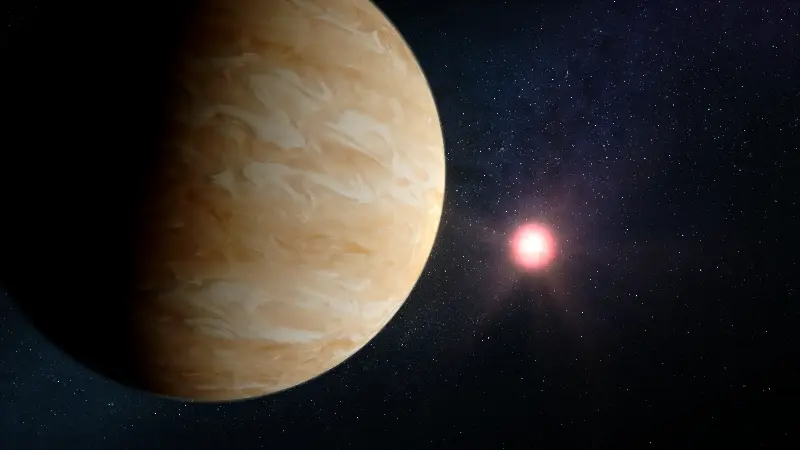
The Solar System gives us a familiar catalogue of planets: small rocky worlds close to the Sun, then gas and ice giants farther out. For a long time, that local inventory shaped the imagination. A planet could be Earth-like, Mars-like, Jupiter-like, Neptune-like. Then exoplanet surveys began finding something that sits awkwardly between those categories.
These worlds are often called sub-Neptunes, or sometimes grouped with super-Earths depending on their size and mass. They are larger than Earth but smaller than Neptune. They appear again and again in data from missions such as Kepler, yet there is no example of one orbiting the Sun. A review by Jacob Bean, Sean Raymond and James Owen put the problem plainly: planets between Earth and Neptune are among the most common types revealed by exoplanet surveys, but the Solar System gives astronomers no nearby specimen to inspect.
That absence is part of the difficulty. We can measure some of these planets’ sizes and, for a smaller set, their masses. But a radius between Earth and Neptune does not by itself tell us whether the planet is a rocky core with a thin hydrogen envelope, a water-rich world under high pressure, a mini-Neptune with a deep atmosphere, or something more complicated. The category is observationally common and physically unresolved.
A missing middle in our own system
Neptune is about 3.9 times Earth’s radius. Many sub-Neptunes are smaller than that but still too large to be explained as simple scaled-up versions of Earth. A 2024 paper led by Everett Schlawin described sub-Neptunes as the most common type of planet currently known in the Milky Way, while also emphasizing that their compositions remain hard to pin down because planets with very different interiors can share similar bulk densities.
The phrase “most common” needs a little care. Transit surveys are better at finding large planets close to their stars than small planets in wide orbits, so the discovered population is not the same thing as a perfect census of the Galaxy. Even with that caution, the repeated appearance of worlds in this size range has changed the old Solar-System-based picture. The missing middle is not a curiosity. It may be one of the standard outcomes of planet formation.
That is why sub-Neptunes are more than a naming problem. If they are common, then the Solar System is unusual in one important respect: it lacks the kind of planet that many other systems appear to produce readily. Explaining that absence may eventually say as much about our own planetary history as it does about the planets around other stars.
The radius gap
Kepler data also revealed that small close-in planets are not smoothly distributed by size. In 2017, Benjamin Fulton and colleagues used California-Kepler Survey data to report a gap between about 1.5 and 2 Earth radii. Planets smaller than the gap tend to look like rocky super-Earths. Planets larger than it are often interpreted as having enough low-density gas or volatile material to swell their observed radius.
That gap is one clue to how sub-Neptunes may be made and unmade. A planet that begins with a rocky core and a light hydrogen-helium envelope can be reshaped by its star. High-energy radiation can strip away part of the atmosphere. Heat leaking from the planet’s interior may also help drive atmospheric escape. Over time, two planets that began somewhat alike could diverge: one left as a bare or nearly bare rocky world, the other retaining enough gas to remain a sub-Neptune.
But this is not a solved story. Different formation histories can lead to similar present-day sizes. Some sub-Neptunes may be gas-rich. Others may be water-rich. Some may have atmospheres enriched with heavier molecules rather than mostly hydrogen and helium. The radius gap narrows the possibilities, but it does not identify every planet’s interior.
Atmospheres that hide themselves
The obvious way forward is to study their atmospheres. When a planet passes in front of its star, a tiny fraction of starlight filters through the planet’s atmosphere. Molecules absorb specific wavelengths, leaving a spectral pattern. In principle, that lets astronomers identify gases and infer temperatures, clouds and chemistry.
In practice, sub-Neptunes have often been uncooperative. GJ 1214 b, a warm sub-Neptune about 48 light-years away, became a textbook example because its earlier transmission spectra were nearly featureless. The likely reason was not that the planet had no atmosphere, but that aerosols, clouds or haze were blocking the view. A 2023 James Webb Space Telescope analysis by Eliza Kempton and colleagues found evidence consistent with a high-metallicity atmosphere and thick reflective clouds or haze, showing both the power and the limits of the new observations.
Other cases are similarly complicated. Schlawin’s 2024 study of GJ 1214 b reported possible methane and carbon dioxide features, while also treating the result as tentative and calling for more observations. A 2019 study led by Bjorn Benneke found that another sub-Neptune, GJ 3470 b, showed water absorption and an atmosphere that did not fit simple Solar System analogies. Each observation adds information, but none turns the whole class into something simple.
Not just small Neptunes
The name “sub-Neptune” can mislead by making these planets sound like miniature versions of Neptune. Some may be. Many may not. Neptune has a particular history, orbit, composition and atmosphere. A close-in sub-Neptune orbiting a different kind of star may be heated, stripped, inflated, clouded and chemically processed in ways that do not map neatly onto anything nearby.
That is why mass and radius are only the beginning. Two planets can have the same size while hiding different interiors. One could be rich in water or other volatiles. Another could be a rocky core wearing a hydrogen envelope. A third could have lost much of its original atmosphere and retained a heavier secondary one. Without atmospheric spectra, orbital context and better population statistics, the label remains broad.
A 2020 review called sub-Neptunes one of the first fundamentally new planetary classes identified through exoplanet work, precisely because they force astronomers away from Solar System analogies. They are not simply a new entry on an old list. They are evidence that the old list was local.
A common planet we barely know
The next decade of observations is likely to make the category less blurry. JWST can measure some atmospheres that older instruments could not. Future large telescopes may help with smaller planets and fainter signals. Population studies will keep testing how stellar radiation, planet mass, orbital distance and formation history shape the divide between rocky super-Earths and gas-wrapped sub-Neptunes.
For now, the odd fact remains. The Milky Way appears to contain huge numbers of planets in a size range missing from our own system. They are common enough to be central to planet formation, yet strange enough that even their atmospheres can resist interpretation. The most ordinary planet in the Galaxy may turn out to be ordinary only in number. Physically, it is still an unfinished problem.
The post The most common type of planet discovered in the Milky Way may be a world that does not exist in our solar system — larger than Earth, smaller than Neptune, and wrapped in an atmosphere we barely understand appeared first on Space Daily.