



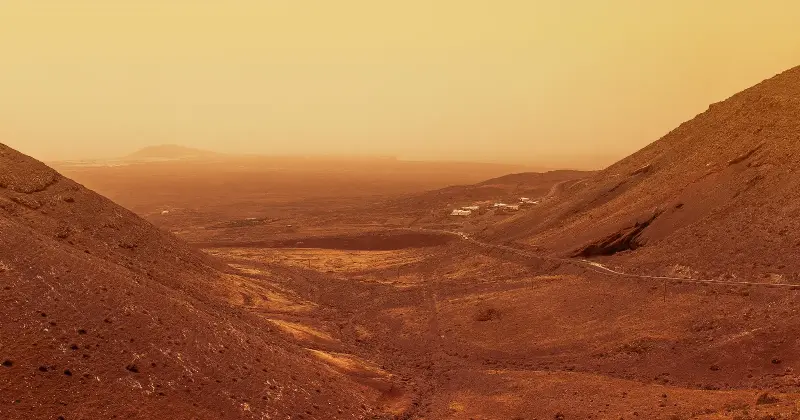
Mars produces dust storms unlike anything on Earth. The largest of them, called planet-encircling storms, can grow from a regional disturbance to a veil of dust over the entire planet in a matter of weeks. In 2018, one of these storms turned day into a dim, reddish dark over NASA’s Opportunity rover, cut off the sunlight the solar-powered machine ran on, and ended a mission that had already lasted more than fourteen years.
Opportunity was built for ninety days. It lasted nearly fifteen years. The storm is what finally stopped it, though, as is often the way with these things, exactly how it delivered the final blow is not entirely certain.
How the storm grew
The first warning did not come from the rover. On 30 May 2018, NASA’s Mars Reconnaissance Orbiter spotted a regional dust storm and alerted the team running Opportunity on the ground. Within days the storm had ballooned. It soon covered an area larger than North America, and then larger still, until it wrapped the whole planet. At its height, almost the entire surface was hidden, with only the summit caldera of Olympus Mons, the tallest volcano in the solar system, standing above the dust.
These storms grow through a feedback loop. Airborne dust absorbs sunlight and warms the surrounding air. The warm air rises, pulling in wind, and the wind lifts more dust, which warms more air. A storm that starts in one region can feed on itself until it spans the globe.
What is not well understood is why some Martian years produce a planet-encircling storm and others do not. They arrive irregularly, every few Mars years, without a reliable schedule, which makes them hard to forecast far in advance.
Why it was fatal to a solar rover
Opportunity drew its power from solar panels, which on a clear Martian day generated enough electricity to drive, run instruments, and keep the rover warm. Dust takes that away in two ways: it blocks sunlight in the air, and it settles on the panels.
Engineers track how much sunlight the dust blocks using a figure called tau, a measure of atmospheric opacity. At Opportunity’s location on the rim of Endeavour Crater, tau normally sat around 0.5. During the storm it climbed to a recorded value of roughly 10.5 to 10.8, among the highest ever measured on Mars. The rover needed tau below about 2 to gather enough light to charge its batteries. It was getting a small fraction of that.
Science operations were suspended on 8 June. The last signal arrived on 10 June 2018, a partial image and a reading showing the batteries down to about 21 or 22 watt-hours, just enough to tell the team the rover was about to drop into a low-power state in which everything but its clock shut off. Then it went quiet.
What actually finished it
The storm cut the power.
What happened next, over the months that followed, is where the certainty runs out. NASA kept trying. Over that period the agency sent more than a thousand commands, hoping that once the skies cleared the panels would catch enough light to wake the rover, and that a windy season late in 2018 might even blow the dust off them. Nothing came back. On 13 February 2019, NASA declared the mission complete. The most likely explanations are that dust coated the panels too thickly, or that the long stretch of cold and darkness during hibernation left the batteries or electronics unable to recover. Which of these it was cannot be confirmed from a rover that never spoke again.
The wind is not the threat
A common picture needs correcting here. Mars storms are often imagined as violent gales that could knock a spacecraft over, an image helped along by films. The reality is close to the opposite. Mars’s atmosphere is about one per cent as dense as Earth’s. Even a fast Martian wind would push with only a small fraction of the force of a comparable wind on Earth.
The danger is not the push of the wind. It is the dust: what it does to sunlight, and what it does once it settles on a surface. For a solar-powered machine, that is the whole problem. The storm did not blow Opportunity over.
It starved it.
Solar power against nuclear
The contrast with Mars’s nuclear-powered rovers is the clearest lesson. While the 2018 storm was darkening the sky over Opportunity, NASA’s Curiosity rover was working through the same dust on the other side of the planet, slowed but not stopped. Curiosity does not rely on sunlight. It carries a small nuclear power source, a radioisotope generator, that produces electricity regardless of the weather.
The newer Perseverance rover is powered the same way, for the same reason. Solar power is lighter and cheaper, and it served Opportunity well for fourteen years, but it leaves a machine exposed to exactly the event that ended this one. The lander InSight, also solar-powered, met a slower version of the same fate, its panels gradually buried under accumulating dust until it fell silent in 2022.
What to watch
Opportunity was meant to last ninety days and drive perhaps a kilometre. It lasted more than fourteen years and drove about forty-five, a record for any vehicle on another world. The storm that ended it was not a freak. Planet-encircling storms are a normal, if irregular, feature of the Martian climate, and another one will come. The open question for anything that has to survive on the surface, robot or eventually human, is the same one Opportunity ran into: how to keep the power on when the planet puts out the sun.
The post Mars can produce dust storms so vast they swallow the planet. In 2018, one of them turned day into darkness for NASA’s solar-powered Opportunity rover, cutting off the sunlight that had sustained it through more than 14 years on Mars. appeared first on Space Daily.