



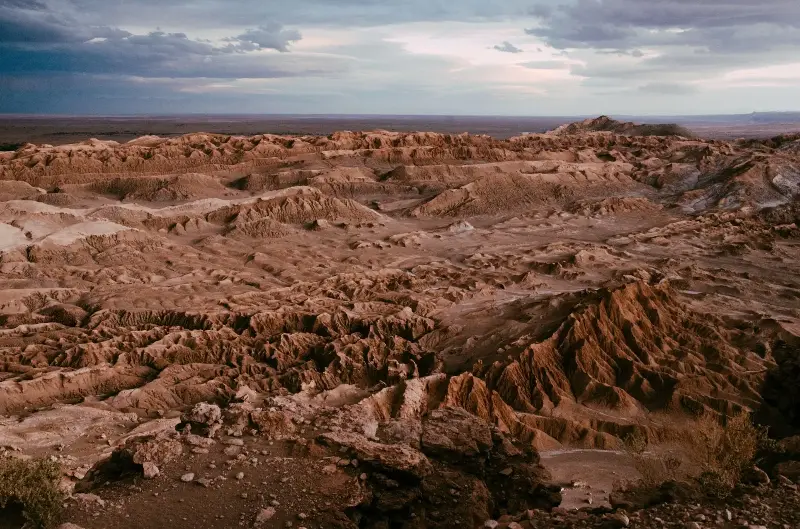
Stand on Mars and watch the Sun go down, and two things would look strange to an Earthling’s eye. The Sun itself would be noticeably smaller, about two-thirds the size it appears from home. And as it sank toward the horizon, it would glow blue, not red. Mars quietly reverses the colours we take for granted, and the reason lies in the dust hanging in its thin air.
A smaller Sun
The shrunken Sun is simple geometry. Mars orbits about 1.5 times farther from the Sun than Earth does, so the solar disc appears correspondingly smaller in its sky, roughly two-thirds the width we see. Because area falls off faster than width, that shrunken disc covers only about 40 per cent as much of the sky. The Sun is still easily the brightest thing up there, and still far too bright to look at, but it is visibly a smaller light than the one we know.
Earth’s colours, and why we have them
To see why Mars looks so different, it helps to remember why our own sky behaves as it does. On Earth, the blue daytime sky and the red sunset both come from air molecules scattering sunlight. Those molecules deflect short, blue wavelengths far more strongly than long, red ones, so the daytime sky glows blue. At sunset, when sunlight has to travel a long slanting path through the atmosphere, most of that blue is scattered away before it reaches your eye, leaving the reds and oranges behind. Blue day, red dusk.
Mars does it with dust
Mars breaks that pattern because its sky is coloured not by gas but by dust. The atmosphere is thin, with less than a hundredth of Earth’s surface pressure, but it is laden with fine, iron-rich dust held aloft almost constantly. It is this dust, rather than the sparse gas, that sets the colour of the Martian sky.
During the day, that dust scatters reddish light across the whole sky, giving Mars its familiar pinkish, butterscotch daytime hue. At sunset, the very same dust does something that looks, to us, upside down: it wraps the setting Sun in a cool blue glow. So both the daytime sky and the sunset are reversed compared with Earth.
Why dust turns the sunset blue
The key is the size of the dust grains. They are just the right size to treat blue light differently from red. When blue light strikes these particles, it tends to be scattered only through small angles, which keeps it travelling close to its original direction, straight toward you from the Sun. Red and yellow light, by contrast, get flung out across the wider sky.
The result is that near the Sun, where you are looking almost straight along the incoming beam, blue light is concentrated into a halo around the disc, while the rest of the sky stays yellow and orange. This is scattering by dust particles, a size-dependent process quite unlike the molecular scattering that colours Earth’s air, which is exactly why the outcome comes out inverted. It is not simply that Mars scatters short wavelengths the way Earth does; it is that the dust funnels the blue toward the Sun instead of spreading it across the sky.
We have actually seen it
None of this is a painting or a guess. Mars rovers have photographed it directly. In 2005, the rover Spirit captured the Sun sinking below the rim of its crater, and in 2015 the Curiosity rover recorded a sequence of images that were assembled into a short video of a Martian sunset, its first captured in colour. The pictures show just what the physics predicts: a rusty landscape all day, ending in a blue-tinged twilight gathered around the Sun.
Scientists study these sunset colours for more than their beauty. The precise shade and spread of the glow carry information about how much dust is in the air and how large the grains are, which feeds into understanding the Martian atmosphere and its weather.
What to take from it
The lasting point is that the colour of a sky is not a fixed feature of the universe. It is a property of whatever the light passes through on its way to your eye. Swap Earth’s clear gas for Mars’s fine dust, and the whole palette flips: a blue daytime sky becomes a dusty pink one, and a red sunset becomes a blue one.
It is also a glimpse of what a person would genuinely experience standing on Mars. Not the ruddy, dramatic sunsets of Earth, but a smaller Sun setting into a tan sky, ringed at the last by a strange, quiet blue. Same star, same physics of scattering light, an utterly different evening.
The post In the Martian sky, the sun appears roughly two-thirds the size it looks from Earth, and at sunset it glows blue rather than red — the same dust particles that make daytime skies pink on Mars scatter shorter wavelengths at dusk in exactly the opposite pattern to our atmosphere appeared first on Space Daily.